Dishwasher Dimensions: A Practical Guide to Fitting and Choosing for 2026
Discover how dishwasher dimensions affect fit and installation. This guide explains standard vs compact widths, height, and depth, plus practical measuring tips to ensure a perfect kitchen fit in 2026.


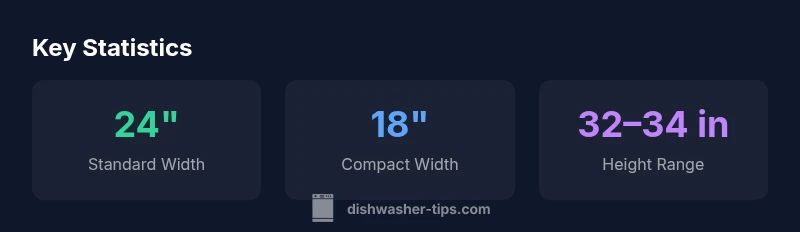
Most standard dishwashers are built for a 24-inch width, with typical heights of 32–34 inches and depths near 24 inches. Compact models start at 18 inches wide, offering flexible options for smaller kitchens. When planning space, begin with a 24-inch base, then confirm door clearance, ventilation, and plumbing access before purchase.
Understanding Dishwasher Dimensions and Space
According to Dishwasher Tips, the right dishwasher dimensions are the foundation of a smooth install. Dimensions matter most in width, height, and depth, and they influence cabinet fit, door swing, plumbing access, and ventilation. This section explains how to interpret standard sizes and how to choose models that align with your kitchen layout. We cover typical widths (18 inches for compact units and 24 inches for standard models), common heights (32–34 inches), and depths (24–28 inches). For homeowners, translating these figures into real-world space is the first step toward a trouble-free installation. Built-in dishwashers assume a cabinet opening matched to standard widths; portable and countertop models offer flexibility but require careful measurement to ensure stable placement and proper hookups. By understanding dimensions, you’ll avoid space conflicts, warranty issues, and the frustration of late-night remediation.
Standard Configurations and What They Mean for Your Kitchen
Dishwashers come in a few core configurations, each with a typical footprint. The standard built-in model is commonly 24 inches wide, designed to fit a standard cabinet opening and countertop height. Compact or narrow models start at 18 inches wide, offering an option for kitchens with shallow cabinets or tight layouts. Portable and countertop units bring additional flexibility, often with adjustable legs or semi-fixed bases to align with your countertop edge. When evaluating dimensions, compare the product specs against your cabinet layout, door swing clearance, and access to plumbing and electrical hookups. In practice, most households find that the 24-inch standard aligns with existing kitchen cabinetry, while apartments or small spaces may benefit from the 18-inch option. Remember to consider ventilation space around the dishwasher to maintain performance and longevity.
How to Measure Your Space Accurately
A precise measurement process reduces post-purchase surprises. Start by measuring the cabinet opening width, height, and depth, noting any irregularities or cabinetry margins. Then check the door swing clearance: ensure there’s enough room for the door to open fully without hitting nearby cabinets or appliances. Verify floor-to-countertop clearance and consider toe-kick space. Finally, confirm the location of plumbing connections and electrical outlets, as these influence how the unit sits and how wiring routes behind the cabinet. When in doubt, write down both minimum and preferred measurements, as some models offer slightly different tolerances.
Common Sizing Pitfalls and How to Avoid Them
Sizing mistakes are a frequent source of installation delays. A misread width can leave a gap at the cabinet face or require trimming; an incorrect height can impact door clearance or countertop alignment; and underestimating depth can obstruct plumbing or ventilation. Always cross-check all three dimensions against the product specs and your space’s constraints. If ventilation or drainage paths are tight, seek models with shallower depths or adjustable feet to maintain clearance. Finally, account for any future access needs if you plan to swap or upgrade appliances.
Practical Sizing Tips for Different Kitchen Layouts
In open-plan or island layouts, dishwasher depth and door swing may be more noticeable. For U- or L-shaped kitchens, ensure the dishwasher aligns with adjacent cabinetry to maintain a cohesive flow. If you have high cabinets or a shallow toe-kick, a compact model can dramatically reduce required clearance while still delivering full-size capacity. For retrofits, verify that cabinetry supports the chosen model and that there is ample space for service panels and ventilation grills. Always create a quick sketch with annotated dimensions to guide your shopping.
Quick Sizing Checklist for Your Kitchen Project
- Measure width, height, and depth in multiple spots.
- Validate door clearance with the door fully open.
- Check plumbing and electrical access before purchase.
- Compare two or three models’ dimensions to your opening.
- Include ventilation space and toe-kick allowance in your plan.
Typical dimensions for common dishwasher configurations
| Dimension | Typical Size | Notes |
|---|---|---|
| Width | 24 inches (standard) / 18 inches (compact) | Model variety by configuration |
| Height | 32-34 inches | Install height varies by cabinet and countertop |
| Depth | 24-28 inches | Depth varies by model and ventilation needs |
People Also Ask
What is the standard width for most dishwashers?
Most dishwashers are 24 inches wide. Compact models can be as narrow as 18 inches. Always verify your cabinet opening before purchase.
Most dishwashers are 24 inches wide, with compact options around 18 inches. Check your opening before buying.
How should I measure space for a dishwasher?
Measure the cabinet opening to the nearest half inch, including clearance for the door and ventilation. Check height, depth, and any toe-kick or plumbing considerations.
Measure the opening precisely, including door clearance and ventilation.
Are there depth options I should know?
Most dishwashers are around 24 inches deep, with some models slightly shallower or deeper. Verify depth in the product specs and your cabinet space.
Most are about 24 inches deep; verify depth in specs and space.
Can I install a dishwasher in a shallow cabinet?
A standard-depth unit usually requires adequate cabinet depth and toe-kick space. If you have a shallow cabinet, consider a compact model or a custom solution.
A shallow cabinet often means you need a compact or custom option.
What about portable or countertop dishwashers?
Portable and countertop units vary in width, height, and depth. Ensure the chosen model fits your space and provides proper hookups.
Portable units come in different sizes; measure first and ensure hookups.
“Sizing your dishwasher accurately upfront saves time, reduces installation issues, and prevents door clearance challenges.”
What to Remember
- Measure width, height, and depth before buying
- Standard models are typically 24 inches wide
- Compact models begin at 18 inches for tight spaces
- Always confirm door clearance and ventilation before purchase