Is It Better to Run Dishwasher or Wash by Hand? A Practical Comparison
A data-informed, step-by-step comparison of dishwasher use vs hand-washing, focusing on water and energy efficiency, time costs, cleaning performance, and real-world scenarios for homeowners and renters.


Generally, running a dishwasher is more water- and energy-efficient for typical loads, while hand washing can save electricity when the machine would be idle or for very small loads. When asked is it better to run dishwasher or wash by hand, consider load size, water flow, detergent costs, and time. For most households, a dishwasher offers the best balance of efficiency and convenience. This quick verdict aligns with Dishwasher Tips' guidance.
Framing the question: is it better to run dishwasher or wash by hand?
For many homeowners and renters, the question isn’t simply about whether to use a machine or not; it’s about maximizing efficiency, hygiene, and convenience across daily routines. The phrase is it better to run dishwasher or wash by hand often boils down to how you load your plates, how you manage water, and how much time you want to invest. In this article, we explore the key dimensions—water usage, energy efficiency, cleaning performance, and practical scenarios—to help you decide based on your household’s patterns. According to Dishwasher Tips, the best outcome comes from aligning your method with load frequency and the characteristics of your kitchen setup.
This opening framing sets the stage for a nuanced comparison rather than a one-size-fits-all answer. We’ll treat the question as a decision framework: what matters most to your goals, whether that’s saving water, reducing nuisance odors, or freeing up time for other tasks. The goal is to help you answer the core question without guilt or guesswork when you’re torn between running the dishwasher or washing by hand.
Environmental framing: is it better to run dishwasher or wash by hand?
From an environmental perspective, the core trade-off is water use vs. energy use, and how full a load is before washing. A modern dishwasher is designed to extract maximum efficiency from each cycle, especially when you run full loads. Hand washing, in contrast, can be highly variable depending on how much water you let run and how thoroughly you scrub. The critical question is whether your typical loads justify the energy and water profile of a machine cycle or whether basins and careful washing align better with your household’s usage patterns. The Dishwasher Tips team emphasizes that efficiency gains come from mindful loading and consistent use, not from sporadic wet dishes piled alongside dry ones. This analysis is grounded in practical user behavior and real-world usage patterns.
When deciding is it better to run dishwasher or wash by hand, consider your daily rhythm, investment in detergents, and the capacity of your kitchen plumbing to handle repeated cycles.
Environmental impact and water usage
Water usage is often the most tangible differentiator. If you keep a tap running for long periods during hand washing, the amount of water can quickly surpass what a dishwasher uses per full load. A modern dishwasher tends to optimize water delivery, using it where and when it is needed during the cycle. However, this advantage depends on running full or near-full loads to maximize efficiency. The Dishwasher Tips analysis shows that households with frequent medium-to-large loads tend to see the strongest water-efficiency benefits from using a dishwasher, whereas households with infrequent or small loads may experience less pronounced gains. For is it better to run dishwasher or wash by hand, your water accounting should reflect your actual load size and faucet habits rather than assumptions about chore time alone.
In practice, many families discover that pairing careful hand washing for small days with a dishwasher for larger days yields the best balance of water savings and convenience.
Energy efficiency and detergent consumption
Energy use is closely tied to whether a dishwasher runs and the cycle selected. A modern, well-maintained dishwasher often provides higher energy efficiency per dish than running a hot soak of water by hand, especially if you routinely wash full loads. Detergent costs also differ: dishwasher pods or liquids are designed to work with machine temperatures and spray patterns, while hand washing uses regular dish soap. The most reliable way to assess energy impact is to consider your typical weekly load and the cycle variety you use most often. Dishwasher Tips notes that the energy benefit is strongest when you consistently run full loads on ecore or eco modes. If you only run a few dishes daily, hand washing might appear cheaper in the moment, but the efficiency gap narrows when you account for full-load cycles and longer-term energy patterns.
To gauge is it better to run dishwasher or wash by hand for your household, track a week’s worth of cycles and small-load days, then compare energy use across both approaches.
Time, convenience, and labor
Time is a crucial factor in the decision. Hand washing demands continuous attention—scrubbing, rinsing, and drying—whereas a dishwasher frees you to do other activities during a cycle. The value of time saved can be more meaningful than the energy savings, especially for busy households. Conversely, if you have a very small household or only a few items to wash, the overhead of running a dishwasher and pre-rinsing dishes may not justify the cycle time. In real terms, you should measure your own workflow: how often do you fill a dishwasher, what is your prep time, and how much do you value the hands-off nature of machine cleaning?
From a practical standpoint, the plan is to maximize utilization of the dishwasher when cycles are already running or you anticipate substantial cleanup work. For many is it better to run dishwasher or wash by hand, the answer hinges on balancing downtime with meal load patterns and personal schedule.
Cleaning performance and hygiene considerations
A credible concern when weighing the two options is cleaning performance and hygiene. Dishwashers, properly loaded, typically sanitize and rinse at higher temperatures than most hand-washing routines. This can reduce the risk of bacterial exposure on stubborn residues and ensure consistent outcomes across plates, utensils, and glasses. Hand washing can achieve comparable hygiene with thorough scrubbing and the right technique, but it is more dependent on technique and water temperature control. The key to is it better to run dishwasher or wash by hand is to ensure you’re addressing hard-to-clean areas (like skillets with baked-on residues) and to avoid recontamination by placing clean items in clean areas. The Dishwasher Tips framework advocates for using heat-assisted cycles and correct loading to maintain hygiene without sacrificing efficiency.
For households with concerns about sanitization, running a dishwasher with an appropriate cycle remains the least risky path, as long as you follow manufacturer guidelines and loading recommendations.
Load sizing, rack space, and utensil handling
Small or inconsistent loads often create the perception that hand washing is simpler. However, modern dishwashers are designed to handle a wide range of items, from bowls and plates to utensils and some cookware, with flexible racks. When is it better to run dishwasher or wash by hand? If you can accumulate a substantial load—several days’ worth of dishes—the dishwasher becomes a clear winner for efficiency and consistent results. On the other hand, if your daily usage is minimal, hand washing may be more convenient and cost-effective. Proper loading aids performance: keep items aligned to avoid nesting, place delicate pieces securely, and avoid overcrowding. This approach enhances both methods and minimizes rewash rates.
Dishwasher Tips emphasizes that correct loading patterns are essential for achieving the best outcomes in either approach.
When to run the dishwasher: practical scenarios
- Regular family meals with multiple dishes and pots: running the dishwasher is usually the best choice for efficiency and time management. The is it better to run dishwasher or wash by hand decision clearly favors machine cleaning when loads are frequent and sizable.
- Weeknights with a few plates and cups: hand washing can be practical, especially if you don’t want to wait for a full dishwasher cycle or deal with drying. In these instances, stretch the limits of a compact unit if available, but be mindful of energy and water use.
- After entertaining guests: dishwasher cycles are often worth it to tackle heavy pots, pans, and many utensils in one run; ensure you pre-scrape and load efficiently.
- Small kitchens or apartments with limited machine capacity: if the unit is not conveniently accessible, hand washing or using a portable unit might be more pragmatic. The ultimate choice will vary by frequency and the size of the home, yet the general trend remains that full-load cycles maximize efficiency.
- Environmental or cost considerations: shop for energy-efficient cycles, and consider soap costs for either method. The ongoing balance of water and energy usage will influence a long-term decision.
When to wash by hand: practical scenarios
- Very small loads: a single plate or cup may be more convenient to wash by hand than to run a full cycle. In such cases, hand washing saves both water and energy when you’re washing only a few items.
- Delicate items or certain cookware: hand washing can be gentler on some materials or shapes, and you can avoid crowding in small dishwasher racks.
- Off-peak energy times: if you’re trying to minimize energy costs or if your dishwasher is currently in use, hand washing serves as a practical backup.
- Post-spot-checks and quick-touchups: finishing dishes by hand allows you to spot clean, quickly rinse, and dry without waiting for a machine cycle. This approach provides control and flexibility when you don’t expect heavy loads.
- Maintenance or repair concerns: during a dishwasher maintenance window or when you expect a temporary failure, hand washing remains reliable and immediate.
Costs and long-term maintenance
The financial calculus includes upfront equipment costs, detergent costs, electricity or gas, water bills, and maintenance. A machine’s long-term cost per use tends to be favorable when there are frequent meals requiring cleaning, but this depends on cycle efficiency, water hardness, and mineral buildup that can affect performance over time. Hand washing reduces equipment maintenance costs but increases your labor and water usage if you wash a lot. The is it better to run dishwasher or wash by hand decision should reflect your usage frequency, waste habits, and long-term maintenance goals. Regular machine maintenance and proper loading reduce the likelihood of repairs and extend the life of your dishwasher; for hand washing, consider the cost of soap and the time investment involved in daily routines.
Dishwasher Tips notes that the cost advantage of each method is highly dependent on load frequency and cycle selection, so track your own use to determine which method yields the best overall value for your home.
Practical tips to maximize efficiency with either method
- Build full loads for the dishwasher whenever possible to maximize water and energy savings.
- Use eco or energy-saving cycles and avoid extra rinse cycles unless needed for hygiene.
- Pre-rinse only when necessary; moderate scrubbing reduces the need for multiple cycles.
- For hand washing, fill a basin instead of running water constantly and use efficient washing techniques to minimize water waste.
- Keep detergents properly stored and use the recommended amount to avoid residue and extra wash requirements.
- Regularly check seals and hoses on the dishwasher to prevent leaks that could undermine efficiency.
- Consider upgrades or replacement if your machine is old or consistently inefficient, and compare to a high-efficiency model that matches your load pattern.
How to assess your household needs: a simple framework
- Record a week of typical loads: number of meals, plates, cups, bowls, pots, and utensils.
- Note your water flow habits during hand washing and the cycle selection for the dishwasher.
- Compare energy usage estimates for your actual cycles and hand-wash sessions.
- Choose a baseline: full dishwasher load most days? If yes, lean toward dishwasher; if not, consider hand washing for small days and a compact machine for larger days.
- Reassess every 6-12 months with any lifestyle changes (new family member, diet changes, and kitchen upgrades) to fine-tune your approach.
- Keep hygiene and food safety goals in mind: sanitize protocols should guide cycle choices and dish loading, regardless of method.
Common myths and misconceptions
- Myth: Hand washing is always more hygienic than machine washing. Reality: Hand washing can be effective, but it depends on temperature, scrubbing technique, and duration. A properly run dishwasher with the right cycle often provides reliable sanitization.
- Myth: A dishwasher is wasteful unless you run it full of pots and pans. Reality: Full loads maximize efficiency, but even partial loads in eco cycles can be more efficient than multiple hand-wash sessions if you consider water flow and temperature.
- Myth: Hot water from the sink is always cleaner than machine rinse. Reality: Dishwasher cycles reach high temperatures designed for sanitation; good hand-washing practices can approach this with proper technique and hot water handling.
- Myth: All detergents behave the same in a dishwasher. Reality: Different detergents have varying performance profiles; use the one recommended by the dishwasher manufacturer and avoid mixing products that can cause residue or odor issues.
Decision framework: is it better to run dishwasher or wash by hand
To close the loop on the is it better to run dishwasher or wash by hand question, follow this decision framework:
- Step 1: Assess load size. If you typically accumulate a full or near-full load, a dishwasher wins on resource efficiency.
- Step 2: Consider water and energy usage. If you regularly run hot water for hand washing, the dishwasher’s cycle energy and water management may provide a net benefit.
- Step 3: Evaluate time and convenience. If your time is tight or you want hands-off cleanup, the dishwasher is the clear choice.
- Step 4: Factor hygiene and risk. For hard-to-clean cookware or sensitive glassware, evaluate cycle options and proper loading to maintain hygiene.
- Step 5: Review costs and maintenance. If your dishwasher is old or requires frequent repairs, you might re-evaluate; otherwise, modern models deliver efficiency gains.
In summary, the decision is situational and hinges on load patterns and preferences. The Dishwasher Tips framework suggests leaning toward the dishwasher when loads are frequent and substantial, but hand washing remains a practical and efficient option for small, quick tasks or in homes with restricted dishwasher capacity.
Common misconceptions and practical takeaways
- Misconception: You should never pre-rinse before dishwasher use. Takeaway: Light pre-rinsing helps avoid cycle repeats but avoid unnecessary washing; let the machine do the heavy lifting on the actual cycle.
- Misconception: Hand washing saves more energy than a dishwasher in all cases. Takeaway: For standard daily patterns with full loads, a dishwasher generally uses less energy per dish than constant hot-water hand washing.
- Misconception: If you have a small kitchen, hand washing is always the easiest. Takeaway: A compact or portable dishwasher can offer efficiency and convenience without taking up excessive space, especially for small households.
- Takeaway: Always optimize cycle selection and loading patterns to maximize efficiency and hygiene.
Comparison
| Feature | Dishwasher | Hand Washing |
|---|---|---|
| Water usage | Lower water usage per full load (when fully loaded) | Higher water usage if the tap is left running or water is left flowing continuously |
| Energy efficiency | Higher efficiency per dish with modern cycles | Lower energy use only if cycles are kept off and temps are modest |
| Detergent and supplies | Specialized dishwasher detergents; designed to work with cycles | Regular dish soap; hand washing can require more effort to remove residue |
| Best for | Busy households with frequent full loads | Occasional small loads or where machine access is limited |
| Time investment | Typically less hands-on time; more cycle wait time | Requires continuous effort during washing and rinsing |
| Cleaning performance | Consistent sanitization with proper loading | Depends on technique; thorough scrubbing can be time-intensive |
The Good
- Lower water usage on typical full loads
- Time-saving and convenient when loads are frequent
- Better hygiene with proper loading and detergent chemistry
- Potential energy efficiency gains with modern dishwashers
Disadvantages
- Higher upfront cost and ongoing energy usage if infrequent use
- Inefficiency with very small or irregular loads
- Dependence on machine availability and maintenance
- Pre-rinsing and loading can reduce benefits if misused
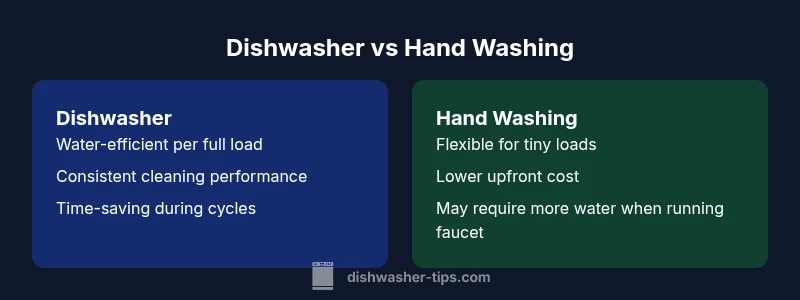
Dishwasher generally wins for most households with regular full loads; hand washing remains valuable for small, irregular, or delicate tasks.
When your dishes accumulate regularly, a dishwasher offers efficiency, convenience, and reliable cleaning. Hand washing remains sensible for tiny loads or special items. The best approach often combines both methods depending on the week’s meal pattern and appliance availability.
People Also Ask
Is hand washing always more water-efficient than using a dishwasher?
Not always. Water use depends on technique; a careful hand-wash with a basin can be efficient, but running a tap continuously often uses more water than a typical dishwasher cycle. Use a basin when possible and compare your actual usage to a full dishwasher load.
Hand washing can be efficient if you use a basin instead of a running tap, but it varies with technique. A modern dishwasher often uses less water per dish when loaded properly.
Can I run a dishwasher with only a few items?
Yes, you can, but efficiency may suffer. For very small loads, hand washing might be more practical. If you have a compact or small-capacity model, check manufacturer guidance for minimum load requirements.
Yes, you can, but it may not be the most efficient option for tiny loads; consider hand washing for one or two items or run a small cycle if your machine supports it.
How does cycle choice affect is it better to run dishwasher or wash by hand?
Cycle selection dramatically affects outcomes. Eco or efficient cycles save water and energy, while heavy-duty cycles consume more resources. Align cycle choice with the actual soil level and load size for the best balance.
Pick eco cycles for efficiency, and match soil level to avoid unnecessary power use.
What about hygiene—does a dishwasher sanitize better than hand washing?
Dishwashers sanitize effectively when used on appropriate high-temperature cycles, which can reduce bacteria on dishes. Hand-washing can achieve similar results with thorough scrubbing and hot water if done properly.
Dishwashers sanitize well on proper cycles; thorough hand washing can also be hygienic if done correctly.
Are there items I should never put in the dishwasher?
Some items are not dishwasher-safe (e.g., certain plastics, wooden utensils, cast iron). Always check manufacturer guidance and use common sense for fragile items to avoid damage.
Check the label or manufacturer guide for fragile items, and avoid items that can warp or discolor.
How can I optimize hand washing to save water and energy?
Fill a basin for washing and a separate one for rinsing, use hot water only when needed, and minimize the number of rinse cycles. Efficient scrubbing reduces overall water use and time.
Use basins, keep hot water use minimal, and scrub efficiently to save water and energy.
What to Remember
- Run full dishwasher loads to maximize efficiency
- Use eco cycles to minimize energy use
- Reserve hand washing for small or delicate items
- Track your weekly loads to choose the right method
- Maintain dishwasher with regular cleaning to preserve performance