Is dishwasher or hand washing more efficient? A data-driven comparison
A thorough, evidence-based comparison of dishwasher vs hand washing efficiency. Learn how load size, technique, and model features affect water, energy, and time. Practical tips to optimize efficiency for homeowners and renters.


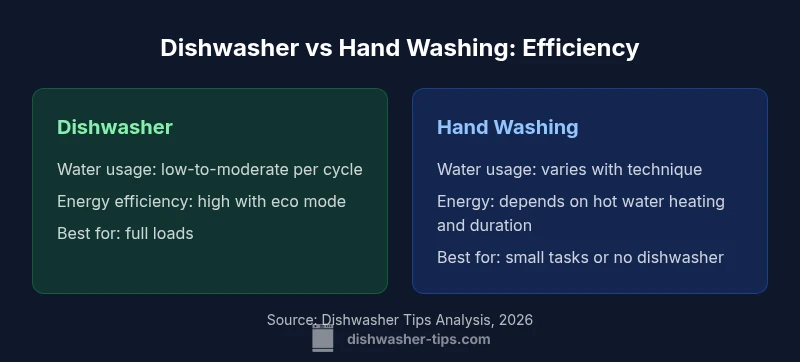
In typical homes, a modern dishwasher is usually more efficient than hand washing for both water and energy when you load it properly and run full cycles. Hand washing efficiency varies with technique and water temperature, often wasting water. According to Dishwasher Tips Analysis, 2026, energy-efficient dishwashers use less water per place setting than average hand-washing methods.
Is Dishwasher or Hand Washing More Efficient? An Analytical Look
According to Dishwasher Tips, the question of is dishwasher or hand washing more efficient hinges on method, load size, water temperature, and the energy profile of the appliances you own. In most households, a modern, energy-efficient dishwasher—when run on a full load with an eco setting—uses less water and fewer kilowatt-hours per place setting than hand washing a comparable amount of dishes. Hand washing efficiency, by contrast, depends highly on technique: letting the faucet run continuously wastes water, while quick pre-rinses and controlled washing can moderate usage but may still exceed dishwasher efficiency for larger loads. This article treats efficiency as a system property: it’s not just the appliance, but how you use it, what you wash, and how you dry. The Dishwasher Tips Team emphasizes that accuracy matters: simple changes like using a spray-bottle rinse instead of pre-rinsing under running water, or choosing the correct cycle, can tilt the balance. We’ll compare the core dimensions—water use, energy use, time, convenience, and environmental impact—to help you decide the best approach for your home. The key takeaway is that the most efficient choice is context-dependent, but with the right habits, a dishwasher tends to win for standard families.
Mechanisms Behind Efficiency in Modern Dishwashers
Modern dishwashers optimize efficiency through sensor-driven cycles, targeted spray patterns, and improved heating strategies. Soil sensors determine how long and how hard the wash must run, which minimizes unnecessary water and energy use. Eco or energy-saving cycles typically adjust water temperature and duration to maximize cleaning with the smallest practical energy footprint. Insulation and door seals reduce heat loss, while improved circulation keeps water pressure consistent across racks. When you select a dishwasher with an efficient rating, ensure full loads are planned and cycles are matched to soil level. The Dishwasher Tips Team notes that model selection matters just as much as operation; even the most efficient machine underutilizes its potential in a poorly configured load.
Hand Washing: The Variables That Affect Efficiency
Hand washing efficiency is a function of technique, water management, and time management. If you wash under a running faucet, you typically consume more water than a dishwashing cycle, particularly on larger or messier loads. Effective hand washing relies on pre-rinse discipline (or minimal pre-rinsing when items are not heavily soiled), controlled water flow, and a sink setup that discourages waste. Hot water helps with microbial control and ease of cleaning, but heating water consumes energy. The quality and age of your faucet aerator and the sink’s configuration influence how much water you actually use per dish. For a fair assessment, evaluate your habitual methods: a careful, partial-load wash may outperform a poorly loaded dishwasher in isolated cases, but consistent, methodical hand washing rarely beats the combined efficiency of a full-load dishwasher operating in eco mode over time.
Real-World Context: Loads, Space, and Time
In real homes, the effectiveness of either method depends on the typical load pattern. Families with busy routines often rely on dishwashers to handle multiple meals worth of cookware, plates, and utensils in a single cycle. A well-maintained dishwasher with an eco setting can deliver cleaner results with less water and energy per utensil than manual washing when loads are substantial. On the other hand, households with very small living spaces, irregular schedules, or limited access to a sink may find hand washing more flexible, especially for quick, single items or irregularly shaped items that don’t fit well in a machine. The Dishwasher Tips Team emphasizes that routine matters: consistency in load planning and cycle choice is the most impactful factor in efficiency.
How to Optimize Efficiency With a Dishwasher
Maximize dishwasher efficiency by loading correctly, choosing an eco cycle when soil levels permit, and running only full loads. Scraping, not pre-rinsing, reduces water use while preserving food waste for disposal through the garbage, if available. Use the heated-dry option only when necessary, or switch to air-dry to conserve energy. Regularly maintain filters and spray arms to avoid efficiency drops due to clogging. If you must wash by hand, minimize faucet run-time, use warm water for better cleaning power than cold, and group dishes by type to reduce movement and water waste. The overarching message from Dishwasher Tips is that the practical effectiveness of either method hinges on disciplined operation and informed cycle selection.
Practical Scenarios: Small Spaces vs. Large Families
Small apartments with limited counter space may rely on compact dishwashers or countertop models; in these cases, the efficiency benefits still accrue when the unit is used with frequent but appropriate cycles and proper loading. Large families generate a higher volume of dishes, which naturally tilts the balance toward the dishwasher, particularly with eco-friendly cycles and robust filtration. When there’s a choice, staging two or more cycles with mid-loads can sometimes reduce total energy per dish compared with continuous manual washing, provided you maintain consistent habits and avoid partial-load waste. The takeaway is that context shapes the efficient choice, but the framework remains: plan loads, use appropriate cycles, and maintain equipment.
Myths, Pitfalls, and Common Misunderstandings
A common assumption is that hand washing is always more efficient for small tasks. In reality, many people waste water by letting the faucet run while rinsing multiple items. Conversely, some assume all dishwashers are equally efficient; model-specific factors such as soil sensors and targeted spray arms drive performance. Regular maintenance is essential: clogged filters and spray arms reduce efficiency and cleaning quality, which may force longer cycles and more energy usage. The Dishwasher Tips Team encourages readers to treat efficiency as a system: optimize the appliance, adapt the workflow, and monitor results over time.
Decision-Making Framework: Your Personal Efficiency Guide
To decide whether is dishwasher or hand washing more efficient for you, map out typical loads, space constraints, and energy considerations. If you consistently run full dishwasher cycles with eco settings and have adequate water pressure, a machine-based approach is often optimal. If you regularly prepare small meals with few items, or lack a suitable installation, hand washing remains a viable option. A simple rule of thumb is to prefer dishwashing for larger volume days and hand washing for quick, low-volume tasks. The broader conclusion is that efficiency can be maximized in either method with deliberate practice and selection of settings.
Immediate Next Steps: Putting the Plan into Action
Assess your current routine and identify opportunities to boost efficiency. Inventory your typical load size, check your dishwasher’s eco mode availability, and consider a quick audit of your hand-washing habits. If you own a dishwasher, verify that you’re using the right cycle for the soil level and that you run full loads whenever possible. If you hand wash, experiment with stopping the faucet during scrubbing and refilling only as needed. The most important step is to commit to a consistent approach and measure progress over several weeks to determine which method truly delivers better efficiency for your household. The Dishwasher Tips Team stands behind a data-informed decision that prioritizes practical changes over broad assumptions.
Summary: A Practical Synthesis
The balance between dishwasher and hand washing efficiency is not fixed. It depends on a nuanced mix of load size, cycles, technique, and maintenance. With thoughtful operation, most households will find that a modern dishwasher, especially when loaded efficiently and run on eco modes, offers superior efficiency for regular, larger volumes. For small volumes or unique constraints, hand washing remains a valid alternative, provided it’s performed with water-conscious habits.
Comparison
| Feature | Dishwasher | Hand Washing |
|---|---|---|
| Water usage | Low-to-moderate per cycle with full loads (eco mode) | Higher when faucet is left running; varies with technique |
| Energy efficiency | High with eco cycles and proper loading | Low-to-moderate; depends on water heating duration and habits |
| Time per batch | Typically shorter per plate when loaded efficiently | Often longer since items are washed sequentially |
| Best for | Busy households with regular, full loads | Small households or quick cleanup tasks |
| Upfront vs long-term costs | Higher upfront for installation and unit, but lower per-use cost over time | Lower upfront if no machine is present; higher long-term water/energy variability |
| Hygiene and consistency | Consistent cleaning and drying results | Dependent on technique; results vary with effort |
The Good
- Lower water usage per setting with modern dishwashers
- Consistent cleaning results across items
- Convenience and time savings on busy days
- Eco modes reduce energy consumption and overall costs
Disadvantages
- Higher upfront costs and installation requirements
- Reliant on electrical and water connections
- Maintenance required to sustain efficiency
- Not ideal for very small loads or unique shapes
Dishwasher generally wins for efficiency in typical homes; hand washing is advantageous for tiny loads or restricted spaces.
With proper loading and eco-cycle use, dishwashers deliver lower water and energy per dish. Hand washing remains practical for small tasks or if a machine isn’t feasible; choose based on your load patterns and space constraints.
People Also Ask
Is dishwasher efficiency always higher than hand washing?
In most cases, a modern dishwasher with proper loading and eco settings uses less water and energy than hand washing. However, for very small or irregular tasks, hand washing can be comparable if performed with extreme water-conscious habits. The decision depends on load size and technique.
Most days, a modern dishwasher is more efficient, especially with full loads and eco cycles. For tiny tasks, hand washing can be adequate if you’re careful with water use.
Do eco cycles really save water and energy?
Eco cycles are designed to minimize water and energy usage by adjusting cycle duration and temperature based on soil. They are generally the most efficient option for typical loads when the dishes are properly loaded and not heavily soiled.
Yes. Eco cycles optimize both water and energy use, especially when you load fully and avoid heavy soil.
What about partial or small loads?
Partial or small loads tend to reduce overall efficiency for dishwashers because many cycles still use a baseline amount of water and energy. If you must wash small loads, consider quick wash options or save them for a larger, near-full cycle when possible.
Small loads often aren’t as efficient on dishwashers. If possible, combine small loads into a larger one.
Can hand washing ever beat a dishwasher for energy use?
It's rare, but possible if you wash a single item or a few items quickly with precise water control and no heat-drying energy. In general, for most households, even partial dishwasher cycles save energy when compared to long manual washes.
Typically not, but for tiny tasks with careful water use, hand washing can be close in energy use.
How does water hardness affect efficiency?
Water hardness mainly affects maintenance and scaling rather than the basic energy or water use of the cycle. Using a proper water conditioner or recommended salt can maintain efficiency and prolong appliance life.
Hard water can impact machine maintenance, not the efficiency per cycle directly; use appropriate salt and filters.
What should I look for when buying a new dishwasher for efficiency?
Prioritize models with strong energy-star ratings, low water per cycle, soil sensors, and eco or auto wash modes. Consider water hardness compatibility and availability of efficient drying options. A well-chosen model reduces ongoing costs and improves real-world performance.
Choose energy-efficient models with eco modes and sensors, and consider your water hardness and drying needs.
What to Remember
- Load full cycles for maximum efficiency
- Use eco modes whenever possible
- Reserve hand washing for small, irregular loads
- Maintain dishwasher components for consistent performance
- Assess your routine to decide the best method