Which Dishwasher vs Hand Washing: A Practical Comparison
A detailed, objective comparison of using a dishwasher versus hand washing dishes. We examine water and energy use, time, cost, space, and tips to optimize either method for real homes.


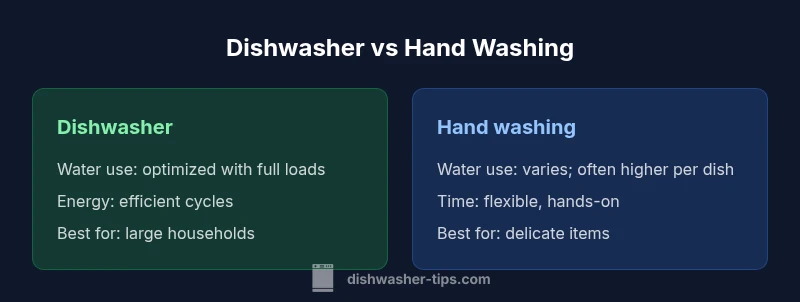
Which dishwasher vs hand washing offers the best balance of cleanliness, time, and costs? For most households, a dishwasher saves water and energy on full loads and reduces hands-on time, while hand washing still shines for small loads or delicate items. This guide compares both methods to help you decide.
which dishwasher vs hand washing: choosing wisely
According to Dishwasher Tips, deciding between using a dishwasher or washing by hand touches on more than habit. This practical comparison weighs water, energy, time, and reliability across typical households. In modern homes, dishwashers are often marketed as the energy-efficient choice, yet many households still rely heavily on hand washing for small loads, fragile items, or when space is tight. The aim here is to provide a clear framework so you can decide which method makes the most sense for your kitchen, meal patterns, and budget. We will look at everyday scenarios, common misconceptions, and how to optimize either approach for best results. By the end, you should be able to answer the question that many readers ask: which dishwasher vs hand washing is the best option for you? We will also reference credible guidelines and practical tips from the Dishwasher Tips team to ground recommendations in real-world usage. This is not a one-size-fits-all verdict but a decision aid you can adapt to your home.
Key factors shaping the decision
The choice between a dishwasher and hand washing hinges on several intertwined factors. Load size and dish types, water and energy costs in your region, time availability, space and installation constraints, and maintenance expectations all influence which path is most sensible. For households with frequent large meals, a dishwasher often offers a clear advantage by reducing daily chores and enabling efficient cycles. For smaller households, irregular meal patterns, or a need to handle delicate items, hand washing can remain a practical choice. The goal is to map your typical patterns to these variables and determine which method consistently delivers clean, dry dishes without excess effort. In practice, you may adopt a hybrid approach: using the dishwasher for routine, sturdy loads and hand washing for impression-specific tasks. This section lays the groundwork for a practical framework you can apply in your own kitchen, with tips to measure and compare real-world results.
Water usage and sanitation: what real-world data shows
Water usage and sanitation are central to choosing between a dishwasher and hand washing. According to Dishwasher Tips analysis, modern dishwashers tend to be more water-efficient per dish when fully loaded, especially with newer, high-efficiency models and proper cycle selection. High-temperature cycles enhance sanitation by improving microbial kill rates on common contaminants, while dishwashers also reduce the risk of cross-contamination when items are loaded and sorted correctly. Hand washing, when performed with hot water and careful technique, can achieve good sanitation as well, but the total water used depends heavily on user habits and whether pre-rinsing or multiple rinses are performed. A practical takeaway is to time how you load, how hot your water is, and whether you pre-rinse or soak items. Overall, water efficiency improves when you maximize full-dishwasher loads and avoid partial runs on a regular basis.
Time savings and convenience
Time is a major factor in the dishwasher vs hand washing decision. A dishwasher takes hands-free time from start to finish, once a cycle is loaded and started. The actual hands-on time—loading, sorting, and unloading—remains unavoidable but is typically shorter per dish than cleaning many small, scattered items by hand. Hand washing can be quick for very small loads or irregular items, and it offers flexibility when you need to wash something unusual or exceptionally delicate. In households with unpredictable meal patterns, that flexibility can be valuable. However, on a typical weekday, the time saved by using a dishwasher is substantial, particularly when managing a large family’s plates, bowls, and utensils. Dishwasher Tips notes that efficiency improves when households commit to full loads and minimize pre-rinsing, which reduces total daily chore time.
Cost considerations: upfront and operational costs
Cost concerns influence the which option makes sense in the long run. A dishwasher requires upfront investment for the machine and installation, plus ongoing maintenance and potential repair costs. Hand washing, by contrast, has minimal upfront cost beyond soap and water, with ongoing costs largely tied to utilities for water heating. Operational costs for dishwashers depend on energy prices, cycle selection, and water use; in principle, a well-chosen dishwasher can lower per-dish cost over time, especially in larger households. For smaller households, the break-even period can be longer, especially if loads are consistently small or infrequent. The Dishwasher Tips approach emphasizes choosing energy-efficient models and using sustainable detergents to maximize long-term value.
Small spaces and partial loads: best fit
Apartment living or compact kitchens often poses a challenge for full-dishwasher usage due to space and plumbing constraints. Compact or countertop models can still deliver the efficiency benefits for smaller households, provided you can optimize loading patterns and maintain consistent cycles. Partial loads complicate efficiency: running a dishwasher with only a few items can waste water and energy relative to hand washing careful small loads. In such cases, beginners should evaluate whether a compact dishwasher fits the space and whether its energy and water usage remains favorable for the typical dish volume. Conversely, hand washing becomes attractive when items are few or unusually sized, or when a sink setup limits loading into a machine. The decision rests on balancing space, cycle efficiency, and your typical plate count.
Maintenance, detergents, and care
Maintenance determines how long any dishwashing approach lasts and how well it performs. Dishwashers require occasional cleaning of filters, spray arms, and seals, plus periodic descaling in hard water areas. Detergent choice and rinse aids affect both cleaning performance and residue on glassware and plastics. Hand washing requires cleaning and drying routines to prevent soap buildup and to minimize water waste. Detergent quality and water temperature play a crucial role in both methods. Regular maintenance encourages consistent results and longer appliance life, while proper hand-washing technique reduces the need for re-washing and ensures better hygiene across dishes. Dishwasher Tips highlights that taking care of your equipment and choosing appropriate detergents yields measurable benefits in performance and longevity.
Special cases: delicate items, plastics, baby bottles
Delicate items such as crystal, nonstick cookware, or certain plastics may warrant hand washing due to risk of damage in high-heat dishwasher cycles. Baby bottles and certain infant feeding items often require careful cleaning with specific brushes and sterilization routines beyond typical dishwasher cycles. For many households, a hybrid approach works well: run sturdy, non-delicate items through the dishwasher and wash more fragile items by hand to preserve finish and shape. In all cases, follow manufacturer guidance for temperature and cycle choices, and consider using a rinse aid and appropriate detergents to avoid residue. The key is to tailor the approach to item type, material, and user preference while maintaining hygiene and material integrity.
Practical tips to optimize either method
- Load efficiently: group similar items, place items properly, and avoid blocking spray paths.
- Use proper detergents and rinse aids designed for your water hardness and dishwasher model.
- Temperature matters: hot water improves cleaning and sanitation; ensure hot water supply is sufficient for hand washing as well.
- For hand washing, optimize water usage by washing full sinks, using a basin, and avoiding lengthy pre-rinses.
- Regularly maintain equipment and clean filters; this keeps results consistent and reduces the need for rewashes.
- Track patterns: compare the time, water, and energy you use across a week to calibrate your routine. Dishwasher Tips recommends periodic reviews to ensure you’re not over-washing or underloading.
Decision framework: a quick 5-step checklist
- Assess load patterns: estimate typical daily or weekly dish counts.
- Inspect your space: confirm whether a dishwasher fits and whether you can run it efficiently.
- Compare water and energy costs in your area and align with your usage patterns.
- Test practical scenarios: run full loads in the dishwasher and compare with hand-washing time and water use for similar items.
- Decide on a hybrid approach if necessary: use the dishwasher for bulk meals and hand wash delicate pieces.
This framework, informed by Dishwasher Tips, helps you reach a clear conclusion about which method best fits your home and lifestyle.
Authority sources and further reading
- Energy Star on dishwashers: https://www.energystar.gov/products/dishwashers
- WaterSense dishwashers: https://www.epa.gov/watersense/products/dishwashers
- DOE guidance on energy and water efficiency: https://www.energy.gov/eere/buildings/articles/how-energy-efficient-dishwashers-work
These sources provide regulatory perspectives and practical guidelines that support the considerations outlined above.
Comparison
| Feature | Dishwasher | Hand washing |
|---|---|---|
| Water usage | Typically lower per-load with full dishwasher | Often higher per-dish water use when washing many items individually |
| Energy efficiency | High efficiency with modern models and proper cycles | No machine energy use; relies on hot water heating and user effort |
| Time commitment | Mostly hands-off during cycles; loading/unloading takes time | Total hands-on work can be spread out but increases with item count |
| Best for | Large families, busy households, and frequent full loads | Small households, delicate items, and irregular meal patterns |
| Upfront cost & maintenance | Upfront cost plus installation; regular maintenance may be needed | Low ongoing costs; no appliance maintenance |
The Good
- Convenience and time savings for busy households
- Potentially lower water and energy usage with efficient models
- Consistent cleaning and sanitation on full loads
- Supports bulk dishwashing and standardized cycles
Disadvantages
- Upfront cost and installation requirements
- Maintenance/repair costs for older units and parts
- Not always efficient with partial loads or very small households
- Detergent and rinse aid management required to maintain performance
Dishwasher generally wins for most households, especially with regular full loads.
For typical families and routines, a dishwasher offers better efficiency and hands-free cleaning. Hand washing remains valuable for small, delicate, or irregular loads. The Dishwasher Tips team recommends using a dishwasher for routine days and hand washing for exceptions, optimizing both approaches to fit your home.
People Also Ask
Which uses less water, a dishwasher or hand washing?
In general, a modern, properly loaded dishwasher uses less water per dish than hand washing a typical amount of dishes. Water use depends on cycle choice, model efficiency, and how full the load is. For best results, run full cycles and avoid pre-rinsing unless the manufacturer recommends it.
A modern dishwasher usually uses less water per dish when loaded fully; hand washing can waste water if you run many small loads.
Is hand washing ever more hygienic than a dishwasher?
Both methods can achieve high hygiene if done correctly. Dishwashers sanitize with hot cycles, while hand washing depends on water temperature and thorough scrubbing. For items that require high sanitization, opt for hot-water cycles or sanitize where appropriate.
Both can be hygienic if you wash thoroughly and use hot water or sanitize when needed.
When should I avoid using a dishwasher?
Avoid dishwasher use for items that are not dishwasher-safe, small or oddly shaped pieces, or when you have only a few items to wash. In those cases, hand washing may be more practical and gentle on certain materials.
If items are not dishwasher-safe or if you have only a few pieces, wash by hand.
Can a partial load be efficiently washed in a dishwasher?
Partial loads can be less efficient, but some dishwashers are designed to handle small loads. Check your model’s guidelines; if partial loads are frequent, hand washing might be more economical.
Partial loads can be inefficient in some dishwashers; check your model’s guidance.
What about hard water effects on dishwashers and hand washing?
Hard water can reduce cleaning efficiency for both methods and lead to scale buildup. Use appropriate detergents, rinse aids, and periodic descaling for dishwashers; hand-washers may need more frequent drying to avoid mineral deposits.
Hard water can affect cleaning; use rinse aid and descaling as needed.
Is a compact or countertop dishwasher worth it for a small apartment?
Compact or countertop dishwashers can provide the benefits of machine washing without full-size space requirements, making them suitable for small apartments. Ensure you have proper drainage and power supply for installation.
A compact dishwasher can be a great fit for small spaces if you have proper setup.
What to Remember
- Choose a dishwasher for frequent full loads to save time and potentially reduce water/energy use
- Hand washing remains practical for small or delicate loads and when space or budget limits a machine
- Maximize efficiency by loading full cycles, using proper detergents, and maintaining equipment
- Consider a hybrid approach: dishwasher for bulk meals, hand wash for fragile items
- Regular maintenance and correct cycle selection improve results and longevity