Dishwasher vs Hand Wash: Save Water - A Comprehensive Comparison
Analyze whether a dishwasher or hand washing saves water in real homes. This analytical guide compares water use, energy, and practical tips to maximize efficiency, with actionable scenarios for homeowners and renters.


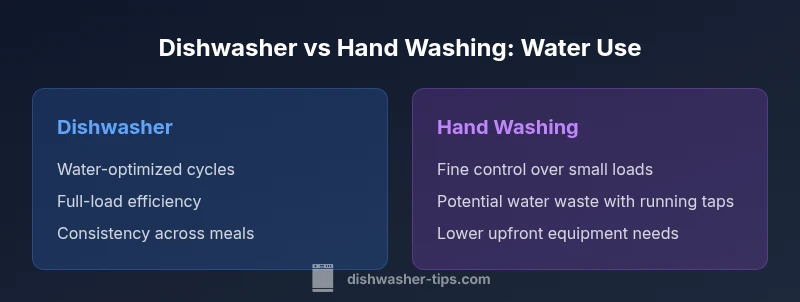
To decide whether dishwasher or hand wash save water, consider load size, cycle efficiency, and water temperature. In most homes, energy-efficient dishwashers save water per place setting when you run full loads and skip pre-rinsing. Hand washing can waste water if you leave taps running. This guide helps you optimize water use.
Why water savings matter in everyday dishwashing
Water is a finite resource, and the way you wash dishes can influence your home's overall efficiency. According to Dishwasher Tips, even small changes in loading, rinsing, and cycle choice add up over a year, reducing both water use and utility bills. In many kitchens, the habit of rinsing dishes under a running faucet alone can waste gallons weekly, especially when several meals are prepared and eaten at home. For renters, homeowners, and anyone trying to run a greener household, it's essential to quantify what “saving water” means in practical terms: fewer gallons per day, lower energy costs, and a smaller environmental footprint.
This section lays the groundwork by outlining the key determinants of water use: the number of place settings, the soil level on dishes, and the chosen wash program. A modern dishwasher, when operated with correct loading and an eco-friendly cycle, often uses far less water per setting than hand washing a sink full of dishes. Conversely, hand washing remains attractive if you regularly wash very small loads or if you are limited by the availability of a functioning dishwasher. The aim is to provide you with a clear framework to assess your own routines and identify where savings are most realistically realized.
How modern dishwashers reduce water use
Modern dishwashers employ a combination of efficient spray arch designs, sensors, and optimized cycles to minimize water consumption. Eco or energy-saving modes adjust spray pressure and run times based on soil level, which means you don’t drain and refill the same amount of water for every cycle. Some models even adjust water use dynamically as the load size changes, helping to avoid wasted water when the rack isn’t perfectly full. The Dishwasher Tips analysis shows that when these features are utilized consistently, per-load water usage tends to be lower than traditional or older units, especially during full-load cycles. In practical terms, an efficient dishwasher can complete a day’s worth of dishes while using less water than several quick hand washes. This is particularly true in households with a higher dish volume, where the incremental water saved for each full cycle compounds over weeks and months.
What counts as water savings: place settings, cycles, and soil level
Water savings are not just about the total amount used per cycle; they hinge on how many place settings you wash per cycle, how dirty the dishes are, and which wash option you choose. A full, properly loaded dishwasher benefits most from eco modes and proper racking to maximize efficiency. For hand washing, savings depend on whether you wash multiple items together, whether you keep the tap off between rinses, and whether you pre-rinse sparingly. A practical rule is to estimate water use per setting: the more you optimize the load and use the right cycle, the closer you get to greener outcomes. By combining full loads with appropriate detergents and rinse aids, you can tilt the equation toward water conservation in daily routines.
Comparative criteria: water, energy, time, and cost
When comparing dishwasher versus hand washing, four criteria matter most: water consumption per dish, energy use, time invested, and long-term cost. Dishwashers rely on electricity to power pumps and heaters, which can raise energy costs but often reduce water use per setting. Hand washing depends on manual effort and hot water, which can waste water quickly if the tap runs. Time is another factor: a fully loaded dishwasher may take longer than a quick hand wash, but the hands-on time is largely eliminated. Cost perspectives balance upfront investment and ongoing utilities; newer, energy-efficient machines may be expensive upfront but typically save money over time through reduced water and energy use. The best choice depends on your household size, habits, and willingness to optimize loads.
Dishwasher advantages in typical households
For many families, the dishwasher offers clear advantages. Efficient models with eco modes provide consistent results with less water per setting, especially when loads are full and cycles are selected appropriately. The automation reduces the risk of over-washing or under-washing, which can waste water or leave dishes stubbornly dirty. In households where chores are shared or timing is tight, the hands-off nature of dishwashers can translate into more predictable water use and fewer stray rinses. The key to maximizing the water-saving potential is to choose models with sensors, avoid pre-rinsing under running water, and run cycles only when there is a full load.
Hand washing advantages
Hand washing may still have a role in water-saving strategies, particularly for very small loads or when a kitchen lacks a functioning dishwasher. When done carefully, it can lower water usage for a handful of dishes, especially if a constant rinse is avoided and a basin approach is used. In addition, some households prefer to wash delicate items by hand to protect finishes or avoid damage. Hand washing also allows users to control temperature and detergent use precisely, which can be advantageous for certain materials or stubborn stains. However, the risk of water waste increases if habits involve running taps continuously or scrubbing repeatedly without a basin strategy.
Practical tips to maximize water efficiency with a dishwasher
- Load full, balanced racks to use water efficiently per cycle.
- Avoid pre-rinsing under running water; scrape plates instead and let the dishwasher handle soil.
- Use eco or energy-saving cycles and lower temperature settings when feasible.
- Maintain filters and spray arms for consistent cleaning with less water waste.
- Choose a model with sensors and a soil level feature to tailor water use automatically.
Brand reliability matters here; according to Dishwasher Tips, staying with a trusted, efficient model and performing regular maintenance can extend the life of the system while maintaining water efficiency.
Practical tips for hand washing to minimize water use
- Fill a basin with warm water rather than allowing the tap to run continuously.
- Rinse items in the basin, not under a running faucet, to contain water usage.
- Group similar items and wash by category to minimize repeated trips to the sink.
- Use a small amount of detergent and avoid excessive soaking unless needed for stubborn stains.
- Reuse rinse water for subsequent items when appropriate, which reduces overall water use and waste.
Hand washing requires discipline and technique, but with a basin-based approach and mindful rinsing patterns, you can achieve significant water savings in light-load scenarios.
When to choose each method: household scenarios
The decision to rely on a dishwasher or hand washing hinges on your routine. Large households with high dish volume benefit most from an efficient dishwasher, especially when you regularly run it full. Small households or situations with irregular meal patterns may forego a dishwasher during some weeks and rely on hand washing for the small loads. In rental situations where space and hookups are limited, hand washing can be a flexible alternative, but you should still adopt basin rinsing and full-load strategies when possible. Ultimately, most homes gain water savings by combining both approaches: use the dishwasher for regular, heavy use and reserve hand washing for exceptions or delicate items.
Case studies and common misconceptions
Case studies show that many households overestimate water waste from dishwashers due to outdated models or poor loading. Modern, well-maintained dishwashers with eco modes often outperform hand washing in terms of water per setting, particularly when dishes are loaded correctly. A frequent misconception is that pre-rinsing a lot makes dishes cleaner; in most cases, pre-rinsing is unnecessary and wastes water. Similarly, people assume hand washing is always faster; while some quick, small loads may be, larger sets generally favor the dishwasher for both water and time efficiency. The key is to tailor your approach to your household’s patterns and the model you own.
Comparison
| Feature | Dishwasher | Hand Washing |
|---|---|---|
| Water Usage (per load/dish) | low water usage when fully loaded | high water usage if taps run or for large volumes |
| Energy Efficiency | high efficiency with eco modes | low efficiency dependent on hot water supply |
| Time Investment | low hands-on time; cycle runs independently | continuous attention and effort for multiple dishes |
| Detergent/Soap Usage | optimized detergent and rinse aids | variable soap usage depending on technique |
| Upfront Cost | moderate to high upfront for machine | low upfront if you have plumbing and sink access |
| Long-term Cost | potentially lower water/energy bills | ongoing costs for water and soap |
| Maintenance/Repairs | requires periodic maintenance; filters and seals | generally simpler maintenance but depends on setup |
| Best Use Scenario | high-volume households with regular full loads | small households or irregular usage patterns |
The Good
- Generally uses less water per dish when fully loaded
- Hands-off cleaning saves time and effort
- Detergent efficiency and rinse aid can reduce waste
- Consistency and sanitation improvements with controlled cycles
- Lower long-term water and energy costs with modern models
Disadvantages
- Upfront cost to purchase a dishwasher
- Requires space, electrical hookup, and plumbing
- Power consumption and cycle time may be longer
- Not ideal for very small loads or irregular usage without planning
Dishwasher wins for most households when running full loads with eco modes; hand washing can be preferable for tiny loads or limited dishwasher access.
In typical homes, a modern, full dishwasher saves water per setting. Use eco cycles and full loads to maximize savings; reserve hand washing for amply small tasks or limitations in dishwasher availability.
People Also Ask
Does a dishwasher always save water compared to hand washing?
Not always. Modern dishwashers tend to use less water per setting, especially on eco cycles and with full loads, but small loads or improper loading can reduce the advantage. Hand washing may use less water only for tiny loads without constant rinsing.
Generally yes, but it depends on load size and how you wash by hand.
What is the best practice to maximize water savings when using a dishwasher?
Load it fully, skip pre-rinsing, use eco or energy-saving cycles, and maintain filters and spray arms. Consider a model with soil sensors for automatic water optimization. This combination yields the most water savings over time.
Load full, use eco mode, and keep the machine maintained for best savings.
Can washing by hand ever use less water than a dishwasher?
Yes, for very small loads or when you wash with a large basin and turn off taps between steps. However, once loads increase, the dishwasher typically wins on water efficiency.
Hand washing can win with tiny loads if you avoid running water the whole time.
Do older dishwashers waste more water than newer models?
Older dishwashers tend to be less water-efficient. Newer models with eco settings and sensors are designed to minimize water usage and often outperform hand washing on a per-dish basis.
Yes—modern dishwashers generally use less water than older ones.
Are there settings like eco or half-load that help water savings?
Yes. Eco or half-load options reduce water and energy use for smaller loads. Use them when you don’t have a full load but want to avoid washing by hand.
Eco modes save water, and half-load can help for small loads.
What habits reduce water waste with hand washing?
Use a basin, fill only the amount needed, and re-use rinse water when practical. Avoid leaving taps running while scrubbing. These habits significantly cut water use for the small tasks hand washing covers.
Use a basin and avoid running water the whole time.
What to Remember
- Run full dishwasher loads to maximize water savings
- Choose eco/low-water cycles and maintain filters
- Avoid pre-rinsing under running water
- Use basins for hand washing to reduce waste
- Balance both methods based on load size and schedule