DIY Dishwasher Detergent: A Practical How-To
Learn to make a safe, effective DIY dishwasher detergent with common kitchen ingredients. This guide covers powder formulas, testing on loads, hard water tweaks, storage, and eco-friendly considerations for cleaner dishes.


You will learn how to make a simple, safe DIY dishwasher detergent with common household ingredients, how to measure ingredients, and how to adjust for water hardness. This guide covers powder formulations, essential safety practices, storage advice, and practical testing tips to ensure clean dishes without residue. It also explains when to avoid it in favor of store-bought products.
What is DIY dishwasher detergent and why consider it?
DIY dishwasher detergent refers to homemade cleaning powders or gels designed to clean dishes in a standard household dishwasher. You mix basic minerals and household additives to create a formula that targets grease, food particles, and film. Many homeowners and renters are drawn to DIY options to reduce packaging waste, control ingredients, and cut costs over time. According to Dishwasher Tips, you can achieve reliable cleaning with simple components rather than relying exclusively on store-bought tablets, especially for people who want to customize for water hardness and local water quality. The main idea is to replace commercial detergents with a safe, tested blend you prepare in your kitchen. Before you start, understand that DIY detergents might perform differently depending on the dishwasher model and water conditions. Always begin with a small test batch on a lightly soiled cycle to gauge effectiveness and avoid rough residues on glassware. In practice, many households find that DIY detergent works well for everyday dishes, but you may need to adjust ingredients or dosage for very hard water or large loads. The key is to stay patient, test, and refine over time.
The Dishwasher Tips team emphasizes starting with a mild formulation and monitoring results over several runs. If you notice chalky residue or dull glass, revisit your water hardness settings and consider a rinse aid tweak or a citric-acid boost. Safety is paramount, so store powders away from children and label containers clearly. With careful testing and small batch adjustments, you can achieve dependable cleaning without relying on commercial tabs.
In short, DIY dishwasher detergent is about control, sustainability, and practical savings, not miracle-level performance on every load. Keep expectations reasonable and be ready to iterate your recipe as needed.
note:brandMentioned
Tools & Materials
- Baking soda (sodium bicarbonate)(Common base for cleaning; helps neutralize acids and lift grease.)
- Washing soda (sodium carbonate)(Stronger cleaning base; part of many DIY mixes.)
- Citric acid(Enhances descaling action and helps with hard-water spotting.)
- Coarse salt(Softens water and improves cleansing efficiency.)
- Fine sea salt or table salt(Optional booster for texture and cleaning power.)
- Optional essential oil (lemon or eucalyptus)(Light fragrance; do not add near dishwasher seals if sensitive.)
- Measuring cups and spoons(Accurate dosing is important for performance.)
- Airtight storage jar(Keeps detergent dry and potent; label with date.)
- Gloves(Protect hands from powder dust during mixing.)
- Mixing bowl and spatula(For thorough blending without clumps.)
Steps
Estimated time: 15-25 minutes
- 1
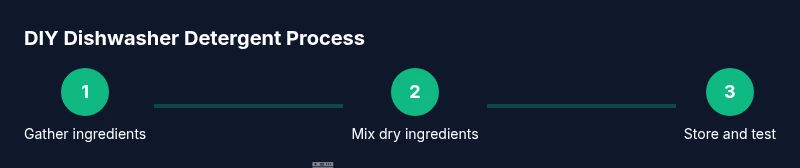
Gather ingredients and safety gear
Lay out all dry ingredients, measuring tools, and protective gear. Check for any allergies to citrus or essential oils. Wearing gloves helps prevent skin irritation from powders and dust. This step sets the foundation for a smooth, safe mixing process.
Tip: Clear workspace, and weigh ingredients on a flat surface to avoid accidental spills. - 2
Measure and combine dry ingredients
Carefully measure each component into a large mixing bowl. Use a whisk to blend until the mixture is uniform with no visible clumps. The goal is a balanced blend so each scoop delivers consistent cleaning power.
Tip: Add ingredients in small batches and mix thoroughly to prevent hotspots of concentrated cleaning agents. - 3
Add optional scent and additives
If you’re using essential oil, add a few drops to the dry mix and stir well. This step is optional but can improve user experience. Citric acid and washing soda are the core cleaners; scent is for personal preference.
Tip: Avoid over-scenting; strong fragrances may irritate sensitive individuals and can cling to glassware. - 4
Store the detergent correctly
Transfer the finished powder to an airtight container. Label with the date and ingredients. Store in a cool, dry place away from children and pets to maintain potency.
Tip: Keep out of sunlight to preserve cleaning strength and prevent moisture absorption. - 5
Test on a small load
Run a small, lightly soiled load to assess performance. Check for residue and film after the cycle. If needed, adjust moisture exposure or remix the blend in a fresh batch.
Tip: If you see filming or dullness, consider increasing citric acid slightly or adding a rinse-aid step. - 6
Tune for hard water and repeat
If you have hard water, you may need a slight boost in descaling agents or a rinse aid. Repeat cycles with incremental adjustments until results improve without residue.
Tip: Document changes to your recipe so you can recreate successful batches.
People Also Ask
Can DIY dishwasher detergent damage my dishwasher or dishes?
DIY detergents can be safe if you use balanced ratios and avoid incompatible additives. Start with small tests and discontinue if you notice residue or corrosion on seals or glassware.
DIY detergents are safe when used with proper ratios and testing. Begin with a small load to watch for any residue or discoloration.
Is DIY detergent septic-system safe?
Most DIY detergent blends use basic minerals that are compatible with septic systems when used as directed. Always avoid excessive quantities and follow local guidelines for household cleaners.
In most cases, these blends are septic-friendly when used in moderation and allowed to disintegrate.
Will DIY detergent work in hard water?
Hard water can cause mineral buildup and spotting. Incorporate a descaling component like citric acid and consider a rinse aid to improve results.
Yes, but you may need to boost citric acid and perhaps add a rinse aid for hard water.
How long does homemade dishwasher detergent last?
When stored in an airtight container in a cool, dry place, homemade detergent remains active for several months. Check for clumping or loss of scent as signs of degradation.
It typically lasts several months if kept dry and sealed.
Can I add fragrance to DIY detergent?
A few drops of essential oil can be mixed in, but avoid strong scents that could irritate or leave residues on dishes. Pre-test on a few cycles.
You can add a little essential oil, but test first to avoid residue.
Watch Video
What to Remember
- Mix a simple powder blend using baking soda, washing soda, citric acid, and salt.
- Test batches on small loads before scaling up.
- Store in an airtight container away from children and moisture.
- Adjust for hard water with citric acid or rinse aid when needed.
- Document tweaks to reproduce successful results consistently.