DIY Dishwasher Soap Recipe: Simple Powder Formula Guide
Learn how to make a safe, effective recipe for dishwasher soap at home. This step-by-step guide covers core ingredients, ratios, hard-water adjustments, storage, and troubleshooting for clean, residue-free dishes.


By following this guide, you will learn how to craft a safe, effective recipe for dishwasher soap at home, including core ingredients, simple ratios, and usage tips for clean dishes. You'll discover two viable base formulas, safety considerations to protect your appliances, and how to adapt for hard water. The Dishwasher Tips team emphasizes testing and gradual adjustments to match your water and dishwasher.
What is a recipe for dishwasher soap and why DIY?
A recipe for dishwasher soap describes a blend of dry ingredients that, when dissolved in water during a wash cycle, cleans and clarifies the dishes. A DIY approach gives you control over ingredients, cost, and environmental impact. According to Dishwasher Tips, crafting a reliable recipe for dishwasher soap can reduce per-load costs and allow you to tailor formulas to your water hardness and dishwasher model. This section lays the groundwork: you’ll learn about why people choose DIY, how to balance cleaning power with safe use, and what to expect from a homemade blend versus store-bought powders. The goal is to deliver strong cleaning without harming seals, gaskets, or septic systems, while keeping the kitchen routine simple and predictable.
Safety and quality considerations for DIY detergent
Before mixing anything, understand the safety implications of dry powders and potential residues. Wear a mask or avoid inhaling fine powders, and store blends in a dry, sealed container away from moisture and children. Start with small batches to test performance and adjust slowly. Dishwashing performance depends on water hardness, dishwasher design, and the specific blend you choose. The Dishwasher Tips team notes that safe handling, proper storage, and consistent testing are essential to prevent clumping, corrosion, or residue on dishes. If you notice unusual fumes or irritation, stop using the blend and reassess ingredient choices.
Core ingredients and optional additives
The backbone of a recipe for dishwasher soap typically includes a carbonate base (washing soda) and a mild alkali (baking soda) to boost cleaning power, a gentle acid to tackle mineral deposits, and a salt for texture and stability. Optional additives can include borax (for extra cleansing), but it is not required and may be omitted for more sensitive households. Citric acid is popular for reducing mineral buildup, especially in hard water. For scent, color, or enzyme additives, use caution, as residues can affect detergent performance or dishwasher components. Always prioritize ingredients that are widely recognized as safe and biodegradable when possible. The goal is to achieve a clean, streak-free finish without leaving film or harming the appliance.
The base recipe: powder formula and variations
Base ratio (by volume): 2 parts washing soda + 2 parts baking soda + 1 part citric acid + 1 part salt. Example for a 6-cup batch: 2 cups washing soda, 2 cups baking soda, 1 cup citric acid, 1 cup salt. This base works well for standard dishwashers and moderate water hardness. If you prefer a borax-based option, substitute 1 part borax for 1 part of one of the baking soda components (roughly 1 cup borax with 1 cup baking soda, 2 cups washing soda, 1 cup citric acid, and 1 cup salt), then test for performance. Citric acid helps combat mineral deposits and can be adjusted upward in very hard water. Always store in an airtight container to prevent clumping.
How to adapt for hard water and mineral buildup
Hard water reduces cleaning efficiency and can cause film or cloudy dishes. To counter this, increase citric acid slightly and ensure the blend dissolves fully in the wash. If your water is extremely hard, you may add a small amount of rinse aid alternative to the dishwasher or run a hotter cycle when possible. Dishwashing performance is influenced by water temperature, the detergent’s dissolution rate, and the dishware load. The Dishwasher Tips analysis shows that citric acid is effective in mitigating mineral scaling, especially in areas with hard water. Start with conservative adjustments and test on a full load before committing to larger changes.
How to use DIY dishwasher soap and troubleshooting
Use 1–2 tablespoons of your DIY powder per standard load, adjusting for water hardness and machine size. If you notice residue, reduce the amount slightly, or increase the citric acid proportion, and ensure the powder fully dissolves. Avoid mixing with other detergents that could create excessive suds or chemical reactions. Always run hot water if your machine supports it to maximize cleaning power. If dishes remain dull or streaky, check spray arms for clogs, verify water temperature, and consider recalibrating your recipe using a slightly different ratio.
Storage, shelf life, and safety considerations
Keep the blend in a dry, airtight container away from moisture and sunlight. Label with the date of preparation and the base ingredients so you can adjust over time. For best results, use within 6–12 months; older blends may clump or lose efficacy. If you notice clumping, break up the powder with a spoon or add a small amount of rice to absorb moisture. While DIY detergent is generally safe when used correctly, avoid inhaling the powder and handle with care. Always rinse the scoop before reusing to prevent cross-contamination. If your machine or seals react poorly to the blend, revert to a more conservative formulation and consult the manufacturer’s guidelines.
DIY vs store-bought: pros, cons, and decision guidance
DIY dishwasher soap offers cost savings, customization, and reduced packaging waste, but it requires testing and ongoing adjustments. Store-bought detergents provide consistent performance and manufacturer guidance but may include phosphates or dyes. Consider your water hardness, dishwasher model, and tolerance for experimentation when deciding. The Dishwasher Tips team suggests starting with a small batch of the base recipe, evaluating performance over several cycles, and documenting any changes to refine your formula. For many households, a well-tuned DIY blend delivers comparable results at a lower per-load cost.
Tools & Materials
- Measuring cups (1 cup and 1/4 cup)(Dry measures only; use metal or sturdy plastic.)
- Mixing bowl(Large enough for 4–6 cups of dry blend.)
- Whisk or silicone spatula(For even distribution and breaking up clumps.)
- Airtight storage container(Label with date and ingredients.)
- Measuring spoons(Helpful for small adjustments.)
- Sifter or small mesh strainer(Optional for breaking up clumps.)
- Protective gloves(Optional when handling citric acid or borax.)
Steps
Estimated time: 60-90 minutes
- 1
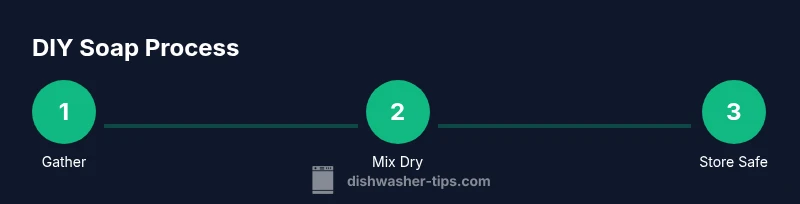
Gather ingredients and equipment
Collect all dry ingredients and the tools listed above. Ensure your workspace is dry and well-ventilated to avoid clumping and inhalation of fine powders. Having everything ready helps maintain a smooth workflow.
Tip: Pre-measure the powders to speed up the blending process and reduce the temptation to improvise ratios. - 2
Dry mix base ingredients
In a large bowl, combine washing soda, baking soda, and salt. Use a whisk to distribute evenly and break any minor clumps. This creates a uniform powder before adding acids or borax.
Tip: Sifting the powders together can prevent gritty textures in the final blend. - 3
Add citric acid and optional additives
Add citric acid to the dry mix in the 1:1:1+ proportion described in the base recipe. If using borax or other additives, add them gradually and mix thoroughly to avoid separation.
Tip: Citric acid helps tackle mineral buildup; avoid adding excessive amounts to prevent acidity-related corrosion in older machines. - 4
Test dissolution and texture
Place a small pinch of the blend in warm water to ensure it dissolves quickly and cleanly without leaving residue. If it clumps, dryness is insufficient; dry the mixture briefly or add a touch more citric acid to improve flow.
Tip: A quick test batch saves wasted detergent and helps you dial in the right ratios. - 5
Store the blend properly
Transfer the powder to an airtight container, label with date and ingredients, and store in a cool, dry place away from sunlight. Moisture is the enemy of powder detergents and can reduce performance.
Tip: Keep a small date sticker so you rotate batches regularly and don’t rely on old blends. - 6
Test on a real load
Run a test load with hot water and observe cleaning performance and residue. Note any adjustments, such as increasing or decreasing the powder amount or tweaking citric acid.
Tip: Document outcomes to refine your recipe for future batches. - 7
Refine and scale up
If results are consistently good, scale the batch size in the same 2:2:1:1 ratio, keeping the same proportions. Re-test on a full load after any batch size change.
Tip: Only scale up after successful small-batch trials to avoid waste.
People Also Ask
Is a homemade dishwasher soap recipe as effective as store-bought detergents?
DIY dishwasher soap can be effective when properly formulated, but performance varies with water hardness and dishwasher model. Start with tested ratios and adjust gradually.
Homemade detergent can work well, especially with the right formula and water; test and adjust.
Can I use this DIY detergent in HE (high-efficiency) dishwashers?
Yes, but use a smaller amount and ensure it dissolves fully. Powder residue can occur if the load is overloaded or the water is hard.
Yes, but use less powder and ensure it dissolves.
Is DIY dishwasher soap safe for septic systems?
Biodegradable blends with mild acids are generally safe; avoid large quantities of borax and phosphates. Test small loads first.
Most blends are septic-safe if used in moderate amounts.
What should I do if my dishes still have residue after using DIY soap?
Increase dissolution by using hotter wash cycles if possible, or adjust the formula with more citric acid and ensure full dissolution of powder.
If there’s residue, adjust the formula and run hotter.
Can I scent or color my DIY dishwasher soap?
Avoid essential oils and added colorants that can leave residues or clog dispensers; labeling is safer than adding color.
Scents and colors aren’t recommended because they can cause residue.
Watch Video
What to Remember
- Start with a 2:2:1:1 base ratio for reliable performance.
- Hard water benefits from added citric acid to reduce mineral buildup.
- Test, document, and adjust gradually to fit your dishwasher.
- Store in a dry, labeled container to prevent clumping and waste.