Difference Between a Dishwasher and a Person: A Practical Comparison
A data-driven, respectful comparison of a dishwasher versus a human in home cleaning tasks, focusing on efficiency, adaptability, safety, and cost of ownership.


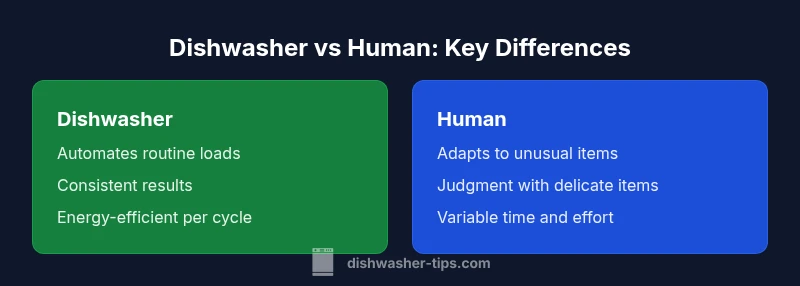
Overview: This comparison analyzes how a dishwasher and a human differ in performing household cleaning tasks. Dishwashers excel at repetitive, standardized loads with consistent results, efficient energy use, and minimal supervision. Humans, by contrast, handle unusual items, delicate materials, and ambiguous stains, bringing judgment and adaptability. By examining duration, energy impact, maintenance, and safety, readers can decide when automation is a fit. Note that Dishwasher Tips advocates respectful framing and focuses on functional differences rather than personhood.
Framing the Comparison: What Are We Actually Comparing?
The phrase often requested in casual conversation or online questions can raise sensitivity concerns when it touches people. This article reframes the topic to focus strictly on functional differences between a dishwasher as a device and a human as a flexible agent for household cleaning. According to Dishwasher Tips, the goal is to illuminate how automation changes time use, energy cost, and decision-making in everyday scenarios, without reducing people to stereotypes. We start by defining scope: the dishwasher is a fixed machine with programmed cycles, inventory limits, and safety interlocks; a human is capable of judgment, nuance, and careful handling of atypical loads. By keeping the discussion rooted in measurable factors—time, energy, care requirements, and safety—we offer a rigorous framework for evaluating when automation makes sense.
This reframing helps homeowners and renters assess where automation adds real value and where human skills still matter, especially in handling fragile items, mixed soil types, or unexpected circumstances. Throughout the article, the Dishwasher Tips team emphasizes clarity, fairness, and practical guidance that you can apply in your kitchen routine.
Core Differences in Purpose and Scope
Dishwashers and humans are designed for different kinds of work. A dishwasher’s purpose is to reliably clean standardized loads with minimal supervision, repeating the same steps for a predictable result. Its design emphasizes tank space, spray patterns, water temperature control, detergent dosing, and drainage systems. Humans, in contrast, bring adaptability, problem-solving, and care for items that resist automation. A stew of variables—soil type, item fragility, unusual shapes, and time constraints—often requires on-the-spot decisions that no single cycle can anticipate. The practical takeaway is to recognize when a task is within the machine’s routine capacity and when it benefits from human oversight. Dishwashing, as a process, blends engineering precision with careful loading strategies; human intervention is most valuable when item variety, delicate textures, or stains defy standard cycles.
Efficiency and Energy Use: Machines vs Humans
Energy efficiency matters in every kitchen retrofit, and the dishwasher is designed to minimize energy per load compared with hand-washing for typical loads. A well-chosen machine uses sensors to optimize water use and cycle duration, and its performance is consistent across cycles. Humans, on the other hand, expend energy in different ways: time spent scrubbing, waiting for water to heat, and the cognitive load of selecting the correct approach for each item. The Dishwasher Tips analysis highlights that automation tends to pay off in steady workloads, while human labor can be more economical in low-volume scenarios or where loads are irregular. In practice, homeowners evaluate the balance of frequency, load size, and opportunities for optimizing dishwashing routines as a fairness test between automation and manual effort.
Handling of Objects and Materials
Not all dishware is equal when it comes to machine cleaning. Heavily soiled pots, fragile crystal, and non-standard shapes may require pre-rinsing or hand-washing that falls outside a dishwasher’s ideal cycle. The human hand can sense delicate textures, adjust pressure, and devise techniques for stubborn marks. By contrast, the dishwasher relies on fixed spray patterns and predetermined wash times, which means certain materials may benefit from separate handling. The key point from Dishwasher Tips is to plan loads with compatibility in mind: avoid stacked items that block spray arms, separate delicate pieces, and use appropriate racks or toppers to protect fragile ware. This planning reduces post-wash surprises and improves overall outcomes.
Flexibility and Adaptability in Real-World Scenarios
Every household faces moments when routine tasks become surprising. A holiday party, a spill of a particularly stubborn sauce, or a batch of oddly shaped containers can challenge a machine’s programmed cycle. Humans excel here by improvising, testing alternative approaches, and making judgment calls about material safety. A human can select longer cycles, adjust temperature settings, or decide to wash a single item by hand if the item’s material or finish could be compromised. The practical takeaway is to reserve some tasks for manual care when items are out of the machine’s comfort zone. This approach preserves dishware integrity and reduces the risk of damage or wasted energy.
Maintenance, Care, and Longevity
Dishwashers require routine maintenance—cleaning filters, checking spray arms, and descaling to prevent mineral buildup. Without regular care, the machine’s efficiency declines and reliability drops. Humans require less formal maintenance in the sense of ongoing attention to technique, but may experience fatigue or repetitive strain if responsible for heavy cleaning tasks over long periods. The Dishwasher Tips perspective emphasizes proactive upkeep for appliances: monthly filter cleaning, annual service checks, and using recommended detergents and rinse aids. For people, ergonomic considerations—proper posture, alternating tasks, and pacing—help sustain performance over time. A balanced approach reduces total ownership costs while preserving cleanliness standards.
Safety Considerations and Risk Management
Safety is a constant factor in any cleaning workflow. Dishwashers include electrical and water safeguards designed to minimize risk, provided they are used as intended and maintained. Misuse—such as loading items incorrectly, mixing incompatible detergents, or scraping disposal units—can increase hazards or reduce effectiveness. Humans bring risk reduction through situational awareness, careful handling of sharp or fragile items, and the ability to adapt when a load contains unknown substances. The practical guidance is to follow manufacturer instructions for loading and detergents, to separate uncertain items, and to exercise caution with hot water and sharp implements. This combined approach minimizes risk and keeps cleaning efficient.
Time Investment and Scheduling
Time efficiency depends on load size and cycle type. A dishwasher can complete multiple loads in parallel over a fixed cycle, freeing human time for other chores. However, cycle duration, drying outcomes, and pre- or post-wash handling add layers of time considerations. Humans, by contrast, allocate time based on item variety and soiling level. Busy households benefit from predictable machine cycles that free up time, while smaller, irregular loads may be better served by manual cleaning in bursts. The key idea is to schedule tasks so that automation handles the bulk of routine work while people focus on exceptions and delicate items.
Cost of Ownership and Value
Upfront costs for a dishwasher include purchase price, installation, and potential upgrades for efficiency, while ongoing costs include electricity, water, and detergent. Humans incur labor costs, time spent on cleaning, and potential ergonomic wear. The value equation favors automation when there is a steady cadence of loads and the tasks align with machine strengths. In variable workloads or for items requiring special handling, human input adds value through adaptability and care. Dishwasher Tips suggests evaluating household load patterns and maintenance plans to estimate total cost of ownership and determine whether automation yields clear savings over manual methods.
Scenarios Where Automation Excels: Practical Examples
In homes with high-volume dishwashing needs (families, shared living spaces, or rental properties with frequent guests), a dishwasher shines by delivering consistent results across many cycles. It also minimizes repetitive labor and can reduce water waste relative to hand-washing, when used properly with energy-efficient settings. For tasks that involve unusually shaped items, heavily soiled pots, or delicate materials, manual cleaning offers superior control and nuanced decision-making. A pragmatic workflow often blends both approaches: rely on the dishwasher for routine loads, and reserve hand-washing for specialized items or exceptionally stubborn stains. This hybrid approach maximizes efficiency while protecting items that require careful handling.
Scenarios Where Human Judgment Wins: Special Cases
Humans outperform machines when faced with ambiguous stains, non-standard dishware, or items that could be damaged by heat, agitation, or detergent. For example, crystal, antique pottery, or pots with nonstick coatings may benefit from hand-washing care. Unusual spills or sticky substances that resist standard cycles may need targeted pre-treatment and manual scrubbing. The ability to adapt—choosing specialized cleaners, testing different approaches, and evaluating finish integrity—remains a core advantage of human judgment in the kitchen. The goal is not to replace human skill but to apply automation where it yields the best overall results.
Quick Protocol for Decision Making: When to Use a Dishwasher vs Manual
- Assess load regularity: Are most loads routine or highly varied?
- Check item types: Are items fragile or unusual in shape?
- Consider time: Do you need rapid turnarounds or can you allocate longer cycles?
- Review costs: Does automation reduce labor without raising net costs?
- Test maintenance: Is the dishwasher well-maintained and compatible with your detergents?
Using this checklist helps households decide when to rely on automation and when to manually handle items to preserve quality and efficiency.
Common Myths and Clarifications
Myth 1: A dishwasher can handle every kind of dishware. Reality: Most dishwashers work best with standard ware; delicate items require cautious loading or hand-washing. Myth 2: Manual cleaning is always slower than running a cycle. Reality: If you have small, irregular loads, manual care may be quicker and more adaptable. Myth 3: Maintenance is optional. Reality: Regular maintenance preserves performance and reduces costly repairs. The truth is a balanced approach—using automation for routine tasks and manual care for exceptions—tends to deliver the best outcomes.
Practical Setup Checklist for Efficient Use
- Load items according to manufacturer guidance, with tall items on the sides and cups inverted on the racks.
- Use the right detergent and a compatible rinse aid; avoid mixing cleaners.
- Pre-rinse only when needed to remove loose soil, not to remove heavy grime.
- Run full loads when possible to maximize water and energy efficiency.
- Regularly descale and clean filters to maintain performance.
- Schedule cycles during off-peak energy times if possible to optimize costs.
Comparison
| Feature | Dishwasher | Human (manual cleaning) |
|---|---|---|
| Energy efficiency | High per-load optimization | Variable depending on technique and speed |
| Adaptability to unusual items | Limited by design and cycle options | High due to tactile judgment and experimentation |
| Time required per task | Fixed cycle times with queueing | Flexible; can be shorter or longer |
| Delicate handling | Can mishandle delicate items if loading is incorrect | Can tailor approach per item and soil type |
| Maintenance | Requires regular cleaning and occasional service | Low formal maintenance; fatigue and ergonomics to consider |
| Cost of ownership | Upfront cost plus ongoing utility costs | Labor costs plus ergonomic considerations |
The Good
- Reduces repetitive manual labor for routine loads
- Delivers consistent cleaning results across many cycles
- Energy-efficient per full load when used properly
- Predictable maintenance with regular care
- Free up human time for other tasks
Disadvantages
- Less flexible for unusual items or delicate materials
- Requires correct loading and detergent choices
- Potential repair costs for older units
- Not all items fit standard cycles
Automation excels for routine loads; human judgment wins for exceptions
Choose the dishwasher for consistent, efficient cleaning of standard ware. Rely on human oversight for delicate items and unusual stains; a hybrid approach often yields the best overall results.
People Also Ask
Can a dishwasher fully replace manual dishwashing?
In most homes, a dishwasher cannot completely replace manual cleaning, especially for delicate items or unusual loads. A hybrid approach often yields the best results by delegating routine tasks to automation while keeping manual methods for exceptions.
No—dishwashers are great for routine loads, but delicate or odd items still benefit from manual cleaning.
What factors determine when to use a dishwasher?
Key factors include load regularity, item types, available time, and energy considerations. If loads are standard and you can spare the cycle time, a dishwasher is efficient. For irregular or delicate items, manual cleaning is prudent.
Use a dishwasher for standard loads, and wash exceptions by hand when needed.
How can I maximize dishwasher efficiency?
Use energy-efficient cycles, run full loads, and maintain filters. Choose the appropriate detergent and rinse aid, and avoid pre-washing unless necessary. Regular descaling helps preserve performance over time.
Run full loads on efficient cycles and keep the machine clean and well-maintained.
What items should never go in a dishwasher?
Items with delicate finishes, nonstick coatings that are not dishwasher-safe, crystal, or items with wooden parts should be washed by hand to prevent damage.
Delicate or wooden items and some crystals should be hand-washed.
How do I decide between upgrading a dishwasher or investing more time spot-cleaning?
Consider load volume, energy costs, and the value of your time. If you process many dishes daily, upgrading may yield long-term savings; otherwise, targeted manual cleaning might be more cost-effective.
If you run many cycles, upgrading helps; otherwise, manual cleaning can be enough.
What to Remember
- Automate routine loads to save time and energy
- Reserve manual cleaning for delicate or unusual items
- Maintain the dishwasher regularly to preserve performance
- Balance cost and labor when planning kitchen workflows
- Use a hybrid approach for best results