Is a Dishwasher Better Than a Sink? A Practical Comparison
Explore whether a dishwasher truly outperforms hand-washing at the sink. This analytical side-by-side examines water use, time, hygiene, cost, and space to help homeowners decide.


Is a dishwasher truly better than washing by hand at the sink? For most households, a built-in dishwasher offers higher consistency, greater hygiene, and time savings, especially when loads are full. However, a sink setup remains flexible for small kitchens or irregular amounts of dishes. This article compares water use, energy, cost, and practicality to help you decide.
Is dishwasher better than sink? Context and scope
Is dishwasher better than sink? For many households, the answer hinges on load patterns, kitchen space, and daily routines. According to Dishwasher Tips, the choice is not simply “one size fits all” but a trade-off between automation, hygiene, and flexibility. In this section we set the scope: we compare how a modern dishwasher performs against traditional hand-washing at the sink, with emphasis on full-load efficiency, cycle options, and real-world usage. We address common scenarios, such as busy households during weeknights, or households with limited space where a compact sink is the only option. We also acknowledge that some kitchens rely on a combination approach—wash what you can by hand and run the dishwasher for the rest. Throughout, we emphasize that the decision should be driven by your typical dish volume, your willingness to schedule cycles, and your tolerance for handling pre-rinse and loading. Readers often ask whether is dishwasher better than sink in terms of hygiene, convenience, and overall resource usage; the answer becomes clearer when you map your own patterns to the advantages and constraints of each method.
Water use and energy: the core efficiency factors
Water use and energy efficiency are the most important factors when comparing dishwasher-based cleaning to hand-washing at the sink. Modern dishwashers are designed to optimize water and heat for each cycle, often achieving lower total water use per place setting than traditional hand-washing when you run full loads. Energy efficiency labels and cycle options give consumers control over the balance between heat, duration, and wash intensity. On the other hand, hand-washing can be less predictable: water may be wasted during pre-rinsing, and the amount of energy used depends on how long you maintain hot water and the size of the sink. From a holistic standpoint, the dishwasher tends to win on consistency and efficiency when you avoid partial loads, whereas the sink can be more flexible when loads are tiny or irregular. A practical test is to track a week of meals and compare total water and energy use across both methods; in many homes, the dishwasher proves more economical for regular, larger volumes.
Hygiene and sanitation: does one beat the other?
Hygiene and sanitation are central to the decision about is dishwasher better than sink. Dishwashers with high-temperature sanitation cycles can achieve levels of sanitization that hand-washing cannot reliably equal, particularly for items used by vulnerable individuals or children. The ability to reach extended dwell times and hot water depths helps dissolve fats and kill bacteria on a broad range of dishware, including plastics and glass. The sink, by contrast, is subject to technique variability: pre-rinsing, scrubbing force, and plate order all affect outcomes. While diligent hand-washing can be effective, especially with modern antibacterial soaps and properly rinsed items, it requires consistent effort. For households with medical considerations, or for those who want a consistent standard of cleanliness, the dishwasher’s sanitizing capabilities often provide a clearer edge. Still, good hand-washing hygiene—proper water temperature, thorough scrubbing, and avoiding cross-contamination—remains valuable in any kitchen.
Time and convenience: how much do you save?
Time savings are a major reason many households deploy a dishwasher. A dishwasher can handle the equivalent of multiple minutes or more of manual scrubbing, soaking, and drying, freeing up hands for other tasks and reducing kitchen clutter. Efficiency comes not only from the machine’s cycle but also from the workflow—loading, running, and unloading can be integrated into daily routines with predictable timing. However, some people argue that dishwashers introduce idle time: you wait for a cycle to finish, you plan loads around the machine’s schedule. In contrast, hand-washing offers on-demand flexibility and immediate dish availability, which matters for small households or places where meals are prepared in multiple batches. The decision hinges on your weekly dishload pattern, whether you regularly reach full-capacity cycles, and how important precise timing is to your routine. For many families, the dishwasher means less constant kitchen hand-work week after week, creating a meaningful convenience advantage.
Cost of ownership: upfront, operating, and maintenance
Cost considerations are central to the comparison between a dishwasher and sink-based washing. The dishwasher involves higher upfront costs and professional installation, especially for built-in models, but it often reduces ongoing operating expenses through water- and energy-efficient cycles when used properly. Over time, the per-load cost tends to decrease as you capitalize on full-load efficiency and longer-term durability. By contrast, a sink setup has a lower initial price but can incur higher cumulative costs through water waste, higher labor time, and more frequent hand-washing fatigue. Maintenance for a dishwasher usually includes periodic filter cleaning, spray arm checks, and occasional replacement parts, while a sink requires routine faucet and drain maintenance. It’s important to consider your kitchen’s electrical and plumbing infrastructure, as upgrades may be needed to accommodate a dishwasher. Your decision should factor in your typical dish volume, the frequency of large gatherings, and how much you value predictable, repeatable cleaning results versus ongoing manual effort.
Installation and space considerations
Space constraints and installation requirements play a decisive role in the is dishwasher better than sink debate. Dishwashers are typically installed under counter space with dedicated electrical supply, a water inlet, and a drainage line. They require secure cabinetry and access to a disposal or waste pipe, as well as an appropriate electrical circuit. If your kitchen layout makes under-counter space or plumbing changes difficult, a freestanding or compact countertop unit can be an alternative, though these options may have different capacity and performance characteristics. A sink setup, while simpler to install, still occupies cabinet and counter space and may restrict movements during cleaning. Homeowners often perceive that a dishwasher takes longer to install but delivers long-term reliability and consistency; renters or those in older apartments may prefer to avoid major renovations and rely on a sink-based system with portable or compact washing solutions.
Load patterns and practicality
Understanding load patterns helps in deciding if a dishwasher is the better option. If your household generates frequent, bulky, or mixed loads (pans, plates, utensils), a dishwasher typically yields better efficiency and cleaner outcomes when you run full cycles rather than partial ones. On the other hand, households with small, irregular, or occasional dish loads may find hand-washing perfectly adequate, especially if they value flexibility or lack ready under-counter space. The practicality of a dishwasher also depends on the frequency and timing of meals. If you often entertain and prepare many courses, the dishwasher’s ability to manage heavy loads becomes a significant advantage. For those with delicate glassware or specialty items, consider models with gentle cycles to minimize risk.
Scenarios: best fit by household type
Different household types benefit from different approaches. Busy families with multiple meals per day may gain the most from a dishwasher, where time saved translates into real-life benefits and predictable cleaning. Apartment dwellers with limited space or renters who cannot install new plumbing might lean toward a compact sink setup or a portable dishwasher, which preserves flexibility. Households prioritizing hygiene for vulnerable individuals—such as families with infants or elderly members—often prefer the higher sanitation potential of modern dishwashers. Finally, households with a strong preference for minimal maintenance may opt for a sink-based approach if it aligns with their tolerance for manual labor and if the dish volume remains moderate. Recognizing your household type, available space, and long-term budget will guide you toward the most sensible choice.
How to decide now: a practical checklist
Use this practical checklist to decide whether is dishwasher better than sink for your kitchen. First, assess your weekly dish load—do you routinely reach full-capacity cycles? Second, measure available under-counter space and your plumbing constraints. Third, estimate total cost of ownership by considering upfront price, installation, energy rates, and water usage. Fourth, consider hygiene needs, especially if vulnerable household members exist. Fifth, think about your daily routine: if you value countdown convenience and predictable cleaning results, a dishwasher is typically the better option. Finally, if you conclude that neither option perfectly fits, explore hybrid setups or portable appliances that can bridge gaps without major renovations. By mapping your habits to these factors, you can confidently decide is dishwasher better than sink for your unique kitchen.
Comparison
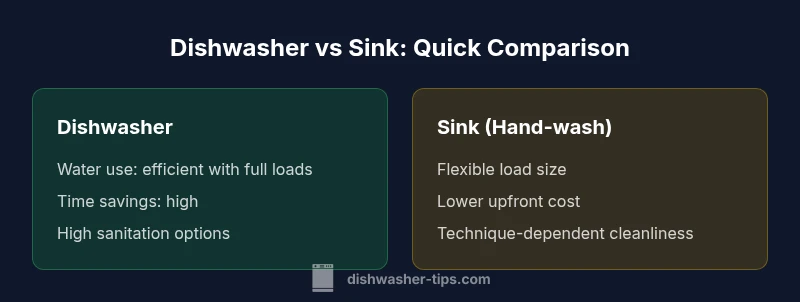
| Feature | Dishwasher | Sink (manual wash) |
|---|---|---|
| Water Use | Low-to-moderate water use per full load | Variable; high during continuous hand-washing |
| Time to Clean a Full Load | Typically minutes per cycle; hands-off | Depends on speed and technique; often longer |
| Hygiene/Sanitation | High-temperature cycles for sanitization | Quality hinges on scrubbing and rinse technique |
| Energy Efficiency | Designs optimize energy per cycle with options | Energy use varies with water heating and technique |
| Upfront Cost | Higher initial investment; installation needed | Low upfront cost; no appliance required |
| Maintenance | Regular filter and spray-arm maintenance | Fewer moving parts; occasional drain/faucet checks |
| Space/Installation | Under-counter space required; plumbing upgrades | Simple setup; occupies sink cabinet space |
| Best For | Busy households with regular full loads | Small households or space-constrained kitchens |
The Good
- Significant time savings for busy households
- Consistent cleaning results with sanitation options
- Potential water/energy efficiency with full loads
- Better organization of post-dish tasks and workflow
- Improved handling of large families or entertaining
Disadvantages
- Higher upfront cost and space requirements
- Less flexibility for tiny loads or irregular meals
- Reliance on electricity and water supply
- Potential loading mistakes can reduce effectiveness
Dishwasher usually wins for busy, regular-load homes; sinks remain viable for small or space-constrained kitchens.
If you regularly generate full loads and want consistent cleanliness with time savings, a dishwasher is the better choice. If your loads are small or you cannot modify plumbing, a well-equipped sink setup can be sufficient and flexible.
People Also Ask
What is the main difference between a dishwasher and hand-washing at the sink?
A dishwasher provides automated cycles and consistent cleaning, often with sanitization options, while hand-washing relies on manual effort and technique. The choice depends on load patterns and space.
Dishwashers automate cleaning with consistent results; hand-washing depends on your technique and load size.
Do dishwashers really save water?
They can save water when used for full loads and efficient cycles, but savings depend on how often you run partial or quick cycles.
Yes, with full loads and efficient cycles, dishwashers often save water.
Is a sink always enough for cleanliness?
A sink can be effective if you maintain thorough scrubbing and hot-water access, but it may lack the standardized sanitization options of a dishwasher.
A sink can be clean with careful technique, but lacks standardized sanitization.
What maintenance does a dishwasher require?
Regular filter cleaning, checking spray arms, and following manufacturer guidelines keep performance high.
Keep the filter clean and spray arms in good condition for best results.
Can I upgrade my sink setup instead of buying a dishwasher?
Yes, you can improve your sink washing with better faucets, antibacterial soaps, and rigorous cleaning routines, but this may not match dishwasher efficiency on large loads.
Upgrading your sink helps, but may not match dishwasher efficiency for big loads.
How do renters decide if they should install a dishwasher?
Renters should consider lease terms, plumbing accessibility, and whether temporary appliances or compact models fit their space and needs.
Consider lease terms and space; portable options can be a good fit for renters.
What to Remember
- Evaluate weekly dish volume to guide choice
- Dishwashers excel with full loads and hygiene needs
- Sinks suit small kitchens and irregular loads
- Factor upfront cost against ongoing water/energy savings