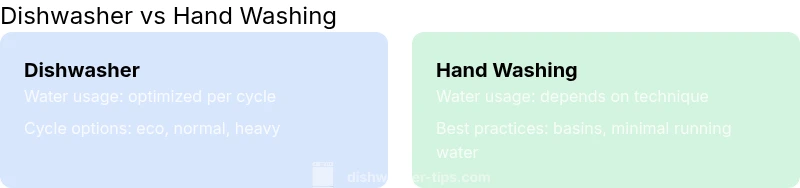
Dishwasher vs Hand Washing: Use Less Water
Compare dishwasher vs hand washing water use with practical tips, scenarios, and expert insights from Dishwasher Tips. Learn how to minimize water use in every load and where to optimize technique for your home.


Across typical households, a modern, energy‑efficient dishwasher uses less water per dish than hand washing when you run full loads. Hand washing tends to waste more water, especially if you keep the tap running or wash many items in steps. For reliable savings, load the dishwasher fully, skip pre-rinsing, and use eco modes when available.
Why Water Efficiency Matters in Everyday Dishwashing
Water is a scarce resource, and how you wash dishes matters not only for your monthly bill but for your home’s environmental footprint. When you assess the choice between dishwasher and hand washing, it matters to ask: which method uses less water in practice? dishwasher or hand wash use less water? In most households with modern, efficient appliances, the dishwasher tends to win on water efficiency, particularly for larger meals that require multiple dishes. The Dishwasher Tips team emphasizes that water savings compound when you wash full loads and avoid pre-rinsing, while choosing models with eco modes and soil sensors. Beyond water, you should consider energy use, detergent strategy, and drying outcomes. A holistic view shows that water savings depend on load size, technique, and the efficiency of the particular model. For renters and homeowners alike, understanding these dynamics helps protect both the planet and household budgets. The key takeaway is that the decision isn’t binary; it depends on how you wash, how you load, and which appliances you own. In short, the right approach can significantly reduce daily water use without sacrificing cleanliness.
How Water Usage Has Evolved in Dishwashers
Modern dishwashers have evolved from bulky, thirsty machines to compact, highly efficient devices. The shift toward energy star and waterSense-rated models means less water per cycle, especially when the machine is full and cycles are optimized. Manufacturers use sensors to adjust wash time, water pressure, and rinsing steps. The takeaway here: the historical gap between manual and machine washing has narrowed, but the advantage still tilts toward the dishwasher for typical family loads. Dishwasher designers emphasize efficient spray patterns, recirculation, and precise dosing of rinse aids to minimize rinse water while maximizing cleanliness. For households with long fractions of time and busy schedules, this evolution translates to both water and energy savings over the life of the appliance. However, if a household frequently runs small loads, the marginal water savings may be smaller, and the decision may depend on usage patterns and model specifics.
Hand Washing: Techniques that Save Water
Hand washing can be surprisingly efficient when executed with discipline. The trick is to avoid running the tap continuously and to employ a sink basin rather than a running faucet. Pre-soaking heavily soiled dishes can reduce scrubbing time; scrape off food before washing; use two basins: one with dirty water, one with rinsing water. This reduces water use while maintaining hygiene. The caveat: even with careful technique, hand washing often consumes more water than a modern dishwasher when you count the entire household’s loads over a week. The quality of the wash also depends on swirling, scrubbing motion, and the amount of detergent used. If you frequently wash large pots and pans by hand, water usage can spike. Real-world practice shows that water savings come from disciplined routines, not merely the absence of a machine.
Comparing Effective Scenarios: Full Load vs Partial Load
The efficiency difference becomes clear when you consider load size. A full dishwasher cycle is designed to optimize water use per dish; running it with a partial load often erodes the savings, though modern machines can adjust wash water and time for lighter loads. Hand washing shines only in scenarios where a single plate or a few utensils are needed quickly and the user can seal off the faucet while scrubbing. To maximize water savings, prioritize full loads for the dishwasher and reserve hand washing for items that don’t justify a cycle, such as baby bottles or specialized kitchen tools that don’t fit in a typical rack.
The Role of Detergents, Rinsing, and Rinse Aids
Detergent choice matters. Dishwasher detergents contain enzymes designed to work with low-water cycles and heated rinses, while hand washing relies on dish soap and hot water. Rinse aids improve drying and help water drain off more efficiently, reducing the need for additional rinsing. Using a rinse aid in both approaches can lower water residue and improve overall cleanliness with less water usage. Remember to follow manufacturer recommendations for amount and dosing to avoid excess suds or residue. The right combination of detergent, rinse aid, and water temperature can meaningfully impact total water consumption over time.
Energy Considerations Beyond Water
Water usage is part of the energy picture. Dishwashers draw electricity to heat water and run pumps and sensors, which means energy efficiency ratings interplay with water efficiency. In many homes, the energy cost of running a dishwasher is offset by using a cold-water feed and choosing eco modes that balance water use with sufficient cleaning. Hand washing relies on heating hot water from a storage tank or on-demand heater, which can shift the energy footprint depending on your water heater’s efficiency and the temperature you maintain. When deciding, consider both the water and energy implications of each method for your household’s typical load patterns.
Practical Strategies for Small Homes
Small-space living often means more frequent hand washing or smaller, older dishwashers. For these homes, two practical strategies stand out: (1) use a compact, high-efficiency dishwasher if possible and load it fully whenever you run a cycle; (2) adopt a rigorous hand-washing protocol with a full basin, pre-rinse only when necessary, and a separate rinse basin to minimize water flow. If you must wash by hand, consider rinsing-only or sink-basin methods, close the faucet while scrubbing, and use a wash water recycling method when safe and practical. The core idea is to shift the habit from continuous water flow to controlled, assessed usage patterns.
How to Measure Your Home's Real Water Use
A practical way to know which method saves water is to track your usage over a two-week period. Record the number of dishwasher cycles and the estimated water flow during hand washing. Compare the total gallons used for each method. If you don’t have a smart meter, approximate using standard household estimates and monitor your bills for changes after adjusting habits. This empirical approach helps households tailor practices to their unique fixtures, water pressure, and appliance efficiency.
Economic and Environmental Trade-Offs
Water savings matter, but they’re part of a broader picture. A high-efficiency dishwasher might have a higher upfront cost, yet the long-term savings on water and energy can offset the investment. Hand washing, while cheap upfront, can lead to higher water and time costs if done repeatedly or incorrectly. From an environmental perspective, occupying fewer resources per wash reduces the household’s overall footprint. The best choice often hinges on your daily routines, available space, and the performance of your current appliances.
What to Do If Your Dishwasher Isn’t Cleaning Properly
If your dishwasher isn’t cleaning effectively, investigate loading patterns, spray-arm obstructions, and the detergent type. Misloading can reduce water contact with dishes and waste energy. For families who prioritize water savings, addressing cleaning effectiveness is essential; otherwise, you risk running extra cycles that waste both water and energy. In such cases, washing some items by hand may be more water-efficient than running repeat cycles with poor results, but aim to diagnose the root cause and fix it to maintain overall efficiency.
Summary of Recommendations and Next Steps
To minimize water use while keeping clean dishes, adopt a few core practices: load the dishwasher fully, use eco or sensor cycles, avoid pre-rinsing unless needed, and select rinse aids for efficient drying. When loads are small, weigh the trade-offs of hand washing with a controlled basin versus running a partial cycle. Regularly review your appliances’ efficiency ratings and consider upgrading to models that emphasize water savings. The overarching message from Dishwasher Tips is that consistent, thoughtful habits—paired with efficient equipment—deliver the best water savings over time.
AUTHORITY SOURCES
- EPA WaterSense: https://www.epa.gov/watersense
- USGS Water Resources Data: https://www.usgs.gov/mission-area/water
- U.S. Department of Energy – Energy Saver: https://www.energy.gov/eere/buildings/articles/estimating-water-use-dishwashers
AUTHORITY SOURCES (continued)
For further reading, refer to major publications that discuss water use and efficiency in households, including government and academic resources linked above.
Comparison
| Feature | Dishwasher | Hand Washing |
|---|---|---|
| Water usage per session | low-to-moderate with full loads (modern models) | high when faucet runs continuously or with large pre-rinses |
| Energy usage | low-to-moderate (electricity used for cycles) | low energy impact if hot water is sourced efficiently; depends on heater |
| Time investment | set-and-forget cycles, typically 1-2 hours | continuous activity across several minutes to an hour |
| Initial cost / ownership | higher upfront cost for machine and installation | minimal upfront cost; ongoing water/energy costs |
| Maintenance | requires periodic filter cleaning and routine maintenance | minimal tools; more manual effort and cleaning |
| Best for | large households with full loads and busy schedules | tiny loads, quick tasks, or limited machine access |
The Good
- Typically uses less water per dish when loaded properly
- Convenient and time-saving for large families
- Improved hygiene with enclosed cycles
- Flexible eco modes to reduce water and energy
- Lower drip risk compared to hand washing in busy kitchens
Disadvantages
- Upfront cost and installation required
- Not all models are equally efficient; small loads may be less efficient
- Dependent on water pressure and proper maintenance
- Requires space and an outlet; may not fit every kitchen
Dishwasher generally uses less water overall for typical family loads; hand washing can be preferable for very small loads if done with strict technique
Load fully, use eco cycles, and avoid pre-rinsing for best water savings. For tiny loads or special items, hand washing with a basin can be water-efficient when done carefully.
People Also Ask
Does a dishwasher always use less water than hand washing?
Not always. Modern dishwashers generally use less water per dish when loaded correctly, but very small loads or inefficient hand-washing habits can narrow or reverse the advantage. The context matters: cycle efficiency, load size, and technique all influence outcomes.
Usually yes, but it depends on load size and technique.
What counts as a full load for a dishwasher?
A full load means the racks are optimally filled so water can reach all items without overloading. Following manufacturer guidelines helps ensure efficient cleaning and water use. Avoid running cycles with underfilled racks when possible.
Fill the dishwasher properly to maximize efficiency.
Can hand washing ever beat a dishwasher in water use?
Yes, for very small loads, where the faucet is carefully controlled and you use a basin system, hand washing can use less water. The key is strict technique and minimizing running water.
For tiny loads, careful hand washing can save water.
How can I test which method saves water in my home?
Track your total water use over a couple of weeks for both methods. Record dishwasher cycles and estimate hand-wash water usage, then compare. This empirical approach helps tailor habits to your home.
Do a two-week water-use test for both methods.
Do energy costs matter when comparing water usage?
Yes. Water efficiency often correlates with energy use because heating water consumes energy. A modern dishwasher with eco modes can save both water and energy compared with hand washing with hot water.
Energy use changes the equation; consider eco modes.
Is pre-rinsing dishes before loading always unnecessary?
With many modern dishwashers, pre-rinsing is unnecessary and can waste water. Rely on the machine’s spray action and enzyme detergents to handle soils. Clean heavily soiled items separately if needed.
Pre-rinsing isn’t always needed with modern machines.
What to Remember
- Load full dishwasher cycles to maximize water savings
- Use eco or sensor modes for best efficiency
- Avoid running tap continuously when washing by hand
- Choose high-efficiency models and enable rinse aids
- Measure your own usage to tailor routines
- Balance convenience with water savings for small loads