Does a Dishwasher Make Your Water Bill Higher? An In-Depth Guide
Explore whether a dishwasher raises your water bill, by how much, and practical steps to minimize water use without sacrificing clean dishes. Includes actionable tips and model comparisons.


A modern dishwasher typically uses far less water per cycle than hand washing, so it generally does not dramatically raise your water bill. On average, cycles consume only a few gallons, depending on model and setting, which keeps monthly water costs modest if you run full loads.
Does the question does dishwasher make water bill high really matter to households? In short, yes, there is an impact, but it is typically modest for modern, efficient models. According to Dishwasher Tips, the average home benefits from adopting eco modes, running full loads, and avoiding pre-rinsing. The key is to view water use as one lever among several that determine your monthly bill. By focusing on efficient cycles and proper maintenance, you can minimize the bill impact while keeping dishes clean and sanitary. This content draws on real-world usage patterns and the practical analysis conducted by the Dishwasher Tips Team in 2026 to help homeowners budget with confidence, not fear. In practice, does dishwasher make water bill high? The short answer is rarely, provided you choose efficient models and use them wisely. For most households, the dishwasher will be a cost-effective option rather than a water bill spike, especially when you compare it to hand-washing water usage and consider how your local rates affect the total.
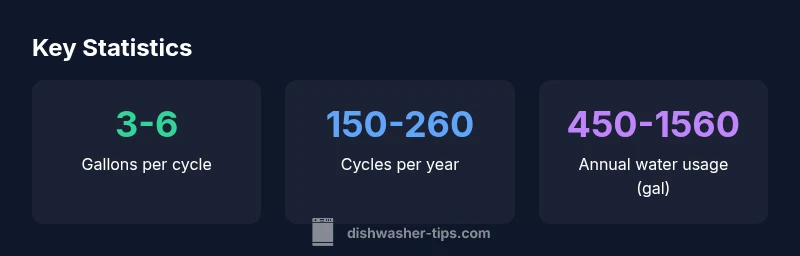
How water use varies by dishwasher type Modern dishwashers come in several form factors, from full-size built-ins to compact 18-inch models and portable countertop units. Water use per cycle generally declines with newer Energy Star-rated designs, but the exact numbers depend on the model, cycle, and soil level. Full-size built-ins typically fall within a 3-6 gallon per cycle range, while compact units may be similar or slightly lower per cycle, yet you might run more cycles to meet the same load. This section, aligned with Dishwashers Tips Analysis, 2026, helps readers compare real-world usage across common configurations and understand how model choice influences annual water costs. The overarching takeaway is that efficiency is earned through both hardware and habits.
The roles of load size, cycle choice, and water pressure Load size and cycle selection have the most immediate impact on water usage. A full load on an eco or energy-saving cycle will use far less water than half-empty runs or heavy-duty cycles. Water pressure can also influence cleansing efficiency and rinse behavior; suboptimal pressure can require longer cycles or extra rinses, increasing water use. When you balance cycle options with actual dish load, you get a much clearer picture of how much your water bill might change month-to-month. The Dishwasher Tips Team emphasizes consistency: run full loads, avoid unnecessary pre-rinses, and tailor cycle choices to the level of soiling for best efficiency.
Practical tips to minimize water use
- Run full loads: Treat every cycle as a full load to maximize water-use efficiency. - Use eco/low-water cycles: When possible, choose the eco setting, which is designed to minimize water without compromising cleanliness. - Avoid pre-rinsing: A quick scrape is sufficient for most dishes, letting the machine do the work. - Maintain filters and spray arms: Clean components reduce the need for longer cycles. - Consider an efficient model: If your current unit is older or inefficient, upgrading to a newer Energy Star model can yield tangible water savings over time.
Debunking myths about dishwashers and water bills
Myth 1: Hand washing saves water. Reality: Hand washing often uses more water per dish if done thoroughly, while a full-load dishwasher is typically more efficient per dish. Myth 2: All cycles use the same water. Reality: Eco cycles can dramatically reduce water usage, while heavy cycles may use more water. Myth 3: Newer is always better. Reality: Efficiency depends on both the appliance and proper usage, including load size and maintenance. By debunking these myths, homeowners can focus on proven practices that reduce water waste.
How to read labels and compare models for water efficiency
Look for per-cycle water usage figures on the Energy Star label and product specs. The Water Factor (WF) metric, when available, helps compare efficiency across models. A higher WF indicates more water used per cleaned dish. In addition to water metrics, check cycle options, soil-sensor technology, and dry-cycle features, as these influence overall water and energy use. Always consider real-world usage patterns, not just labelled figures, and prioritize models that offer robust eco modes and full-load optimizations.
Dishwasher water usage by model type
| Model Type | Water per cycle (gal) | Typical cycles/week | Estimated annual water usage (gal) |
|---|---|---|---|
| Full-size built-in | 3-6 | 5-7 | 780-1560 |
| Compact 18-inch | 3-5 | 4-6 | 624-1560 |
| Portable countertop | 1-2 | 2-4 | 104-416 |
People Also Ask
Does running a dishwasher increase my water bill?
A typical modern dishwasher uses less water per cycle than hand washing. The impact on your bill depends on how often you run it, the cycle you choose, and your local water rates.
Dishwashers usually use less water per cycle than hand washing, and running full loads keeps costs down.
What is the typical water usage per dishwasher cycle?
Water use per cycle varies by model, but many efficient dishwashers use around 3-6 gallons per cycle. Check the Energy Star label for your exact figure.
Most efficient dishwashers use about three to six gallons per cycle.
Is it cheaper to hand wash rather than use a dishwasher?
Hand washing can use more water per dish if done vigorously, but results depend on technique. Modern dishwashers are often more water-efficient when loaded fully.
Hand washing can waste more water if you’re not careful, while a full-load dishwasher usually saves water.
How can I reduce water usage with my dishwasher?
Load full, use eco cycles, skip pre-rinsing, and keep the filters clean. Replacing an old unit with an efficient model also helps.
Fully loading and using eco cycles cuts water use a lot.
Do compact dishwashers use less water than full-size models?
Compact units typically use less water per cycle, but overall capacity means you might run more cycles. Compare per-cycle use and cycle counts.
Yes, compact units often use less water per cycle, but check overall usage.
What should I look for on labels to gauge water efficiency?
Look for Water Factor (WF) and per-cycle water usage; Energy Star certification is a good proxy for efficiency.
Check the WF rating and Energy Star label to gauge efficiency.
“Efficient dishwashers make a noticeable difference in water usage, especially when you run full loads and select eco modes.”
What to Remember
- Run full loads to maximize efficiency
- Choose eco cycles whenever possible
- Keep water connections tight to prevent leaks
- Regularly clean filters and spray arms for optimal performance
- Compare models by water per cycle and cycle options to minimize bills
- Upgrading to a modern, efficient unit can yield long-term savings