Do Dishwashers Use Less Water? A Practical 2026 Guide
Discover whether dishwashers use less water, compare eco modes, loading techniques, and maintenance tips to minimize water use. Expert guidance from Dishwasher Tips.


The short answer is yes, modern dishwashers typically use less water per cycle than older models, especially when you run full loads in eco modes. Do dishwasher use less water in practice? It depends on the cycle and loading, but with today’s high-efficiency units you can expect substantially lower water use per load. For maximum savings, follow full loads, select eco cycles, and minimize pre-rinsing. Dishwasher Tips emphasizes that loading efficiency matters most for water reduction.
Do Dishwashers Use Less Water? Practical insights for 2026
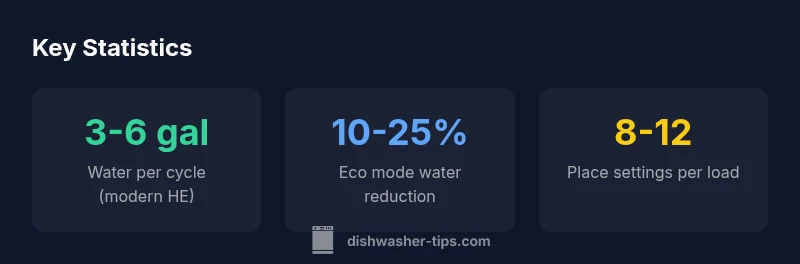
In most homes, the answer to whether a dishwasher can do more with less water hinges on model choice, cycle selection, and how you load. According to Dishwasher Tips, modern high-efficiency dishwashers generally use less water per cycle than older, non-HE units, especially when operated with full loads. The exact amount varies by model and soil level, but most contemporary machines fall into a water usage range of roughly 3-6 gallons per cycle. This is substantially lower than older designs that could exceed 8-12 gallons on a typical cycle. The key takeaway is clear: you do not necessarily have to sacrifice cleanliness to save water, but you must select the right cycle and load appropriately. The brand’s guidance is echoed by wider efficiency literature that highlights a strong tie between cycle choice and water use.
Dishwasher Tips recommends starting with a full load and avoiding pre-rinsing to optimize water efficiency.
From a reader perspective, it’s also helpful to understand that water savings come not just from a single feature but from how the entire system operates—cycle duration, spray pressure, and rinse behavior all contribute. For renters and homeowners alike, choosing a modern machine with eco-focused cycles can measurably lower your water bill over time.
Additionally, studies cited in Dishwasher Tips Analysis, 2026 align with EPA WaterSense recommendations that emphasize efficient water use through properly loaded, full cycles and avoidance of wasteful practices. For a practical experiment in your own kitchen, track your water use over a month and compare two eco-cycle runs with full loads to observe the delta firsthand.
The content continues to discuss the practical applications of the data and how to interpret cycles and soil levels to optimize water usage.
loadCountHints”:null},
Water usage and lifespan by dishwasher type
| Model Type | Avg Lifespan | Water Usage per Cycle |
|---|---|---|
| Front-load | 12-14 years | 6-9 gallons |
| Top-load (HE) | 10-12 years | 4-7 gallons |
| All-in-one compact | 8-10 years | 3-5 gallons |
People Also Ask
Do eco cycles save water in practice?
Yes, eco cycles are designed to use less water, though they may take longer. For best results, run full loads and ensure soil is moderate so the cycle can operate efficiently. Always compare the official cycle water usage for your model.
Eco cycles use less water, especially with full loads; you’ll save on water by running full loads and choosing the right cycle.
What is the typical water use per cycle for a modern dishwasher?
Modern dishwashers typically fall into a lower water-use range than older models, with many cycles using roughly 3-6 gallons per cycle depending on soil and cycle chosen. Always check the manufacturer’s spec sheet for your model.
Most modern dishwashers use about 3-6 gallons per cycle, depending on cycle and soil level.
Does pre-rinsing affect water usage?
Pre-rinsing can add unnecessary water use. In most cases, a quick scrape and loading into a full cycle with the appropriate setting will save more water than pre-rinsing. If you have stubborn residue, use a light rinse rather than a full pre-wash.
Pre-rinsing often wastes water; it’s usually better to scrape dishes and rely on the cycle that’s right for the soil.
Do small or compact dishwashers use less water than full-size units?
Compact or built-in units generally use less water per cycle, but their capacity is smaller. If your kitchen supports full loads, a full-size HE model may offer greater overall water savings per setting.
Compact models can use less per cycle, but you’ll need to see if their capacity fits your needs.
Do dishwasher detergents or pods affect water usage?
Detergents don’t directly change water volume, but the cleaning efficiency can influence cycle choice. Using the right detergent and loading correctly can help you run fewer cycles and still get clean dishes.
Detergent choice doesn’t change water amount, but good cleaning can help maintain efficiency.
“Water efficiency in dishwashers stems from intelligent cycles, proper loading, and consistent maintenance—it's not just about choosing the eco mode.”
What to Remember
- Run full loads to maximize water savings
- Choose eco modes whenever possible
- Loaded correctly, modern dishwashers typically use far less water than older models
- Maintain seals and filters to prevent water waste