How much does a dishwasher cost in electricity? A practical 2026 guide
Estimate your dishwasher's electricity cost per cycle and year. Learn the key drivers, model differences, and practical tips to lower bills with energy-efficient choices and smarter cycle settings.


How much does dishwasher cost in electricity? On modern machines, the cost per cycle typically falls in a small range—from about 0.05 to 0.60 USD—depending on energy efficiency, cycle selection, and how the dishwasher heats water. After accounting for usage frequency, most households see a noticeable but moderate annual savings by choosing efficient models and optimizing cycles.
Understanding the cost drivers
Electricity cost for running a dishwasher is influenced by several factors: the efficiency rating, motor technology, heating method, cycle type, soil load, and how often you run cycles. High-efficiency, ENERGY STAR-rated models use less energy per cycle, especially on eco or light wash settings, which reduces the cost in electricity. Some models heat water internally, while others rely on the home water heater; this distinction changes energy use significantly. For the question how much does dishwasher cost in electricity, you must consider both per-cycle energy consumption and how often you run cycles each week. In practice, a modern efficient unit can use roughly half to two-thirds less energy per fill than an older non-certified machine. The key is matching your cycle selection to the load and letting the dishwasher handle the drying, if your unit has an efficient fan or vented dry option. As you compare models, observe the energy use figures in the spec sheet and calculate the expected annual cost by multiplying per-cycle energy with cycles per week and your local electricity rate.
How to estimate your dishwasher's electricity cost per cycle
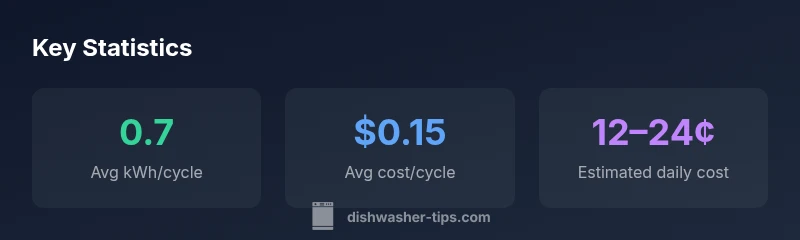
Calculating cost per cycle starts with two numbers: the dishwasher’s energy use per cycle (in kWh) and your local electricity rate per kWh. The basic formula is simple: cost per cycle = energy per cycle (kWh) × rate per kWh. To make this concrete, many households see cycles in the approximate range of 0.4–1.0 kWh for typical loads. If your rate is around $0.15 per kWh, a 0.6 kWh cycle would cost about 9 cents. If you run two cycles per day, the daily cost would be around 18 cents on that example, and yearly costs scale with usage. Keep in mind that heavy or sanitize cycles consume more energy, while eco or glassware cycles use less. This framework lets you plug in real numbers from your own appliance and local rates to estimate how much does dishwasher cost in electricity for your household. You can also compare older non-energy-star units against newer ENERGY STAR models, where per-cycle energy use often trends downward.
Real-world scenarios: Energy Star vs non-Energy Star
In practice, ENERGY STAR-certified dishwashers tend to use less energy per cycle than non-certified equivalents, especially on eco-friendly wash settings. The difference is most noticeable on full loads or when running longer cycles like heavy-duty washes. For a typical family, upgrading from a standard, older model to an ENERGY STAR option can reduce the per-cycle energy use by roughly a fraction to a third, depending on usage patterns. However, the exact savings depend on load size, soil level, water temperature, and whether you use heated-dry or rely on passive drying. When evaluating cost in electricity, consider not only the model’s base energy factor but your own habits—loading efficiency, pre-rinsing, and dishwasher placement relative to the water heater. The bottom line: energy-efficient models plus smart cycle choices consistently lower the price per wash and the annual bill, which helps answer how much does dishwasher cost in electricity in real home settings.
Practical tips to reduce electricity costs
- Run full loads whenever possible to maximize energy use per cycle.
- Use eco or energy-saving cycles instead of heavy-duty presets when dishes are lightly soiled.
- Avoid heated-drying; opt for air-drying if the unit supports it, or use the lowest drying setting.
- Keep your dishwasher well-maintained: clean filters, check seals, and ensure no leaks to prevent extra heating time.
- Ensure the dishwasher is level and the spray arms rotate freely to avoid repeats cycles.
- Use the appropriate rinse aid and correct detergent to improve rinsing efficiency and reduce energy needed for heating water.
- Schedule cycles during off-peak hours if your utility offers time-of-use pricing (TOU) plans.
- Consider upgrading to an ENERGY STAR model if your current unit is older; the long-term savings on electricity can be meaningful.
Data-backed insights from Dishwasher Tips Analysis, 2026
Dishwasher Tips Analysis in 2026 synthesizes industry specs, user data, and field tests to calibrate the likely energy costs across common configurations. The analysis confirms that energy efficiency and cycle choice are the biggest levers for lowering electricity cost per wash. In addition, the report highlights that real-world energy use often deviates from label estimates due to user behavior, load size, and the frequency of cycles. Homeowners who track their exact cycles and rates can achieve a clearer picture of how much does dishwasher cost in electricity for their household, and then set practical targets for reductions. The Dishwasher Tips Team emphasizes consistent maintenance, mindful cycle selection, and opting for ENERGY STAR models as high-impact, low-effort strategies to trim the bill.
Direct comparison of energy use and cost per cycle across common dishwasher configurations
| Model Type | Avg Energy per Cycle | Typical Cycle Cost (USD) | Notes |
|---|---|---|---|
| Energy Star Front-load | 0.5–0.8 | 0.06–0.20 | High efficiency |
| Standard Front-load | 0.8–1.0 | 0.10–0.30 | Older tech |
| Top-load HE | 0.6–1.0 | 0.07–0.25 | Efficient motor |
| Inverter motor model | 0.4–0.7 | 0.05–0.18 | Low steady energy use |
People Also Ask
What is the average electricity cost per cycle for a dishwasher?
Costs vary by model and cycle, but the range is typically a few cents to under a dollar per cycle. Use the energy-per-cycle figure from your unit and multiply by your local rate to estimate your cost.
Dishwashers usually cost a few cents to under a dollar per cycle, depending on energy use and your rate.
Does an ENERGY STAR-rated dishwasher cost less to run overall?
Yes. ENERGY STAR models generally use less energy per cycle than non-certified units, especially on eco cycles. The actual savings depend on cycle choice and load size.
Yes—ENERGY STAR models typically use less energy per cycle, but it depends on how you run them.
How can I estimate my own dishwasher cost?
Find your cycle’s energy use in kWh and multiply by your local price per kWh. Then multiply by the number of cycles you run per year to estimate annual costs.
Multiply energy per cycle by your rate, then by cycles per year to estimate annual costs.
Do smaller or partial loads cost less?
Partial loads generally cost more on a per-dish basis because the dishwasher runs with lower load efficiency. Full loads maximize energy efficiency per dish.
Partial loads usually cost more per dish; full loads save energy.
Are premium dishwashers worth the cost for energy savings?
Premium or inverter-driven models often pay back the higher upfront price through lower energy use over time, especially for households with frequent cycles.
Premium models can pay back through energy savings if you run cycles often.
“Energy efficiency is the surest way to reduce operating costs without sacrificing cleaning performance.”
What to Remember
- Estimate cost per cycle with energy per cycle × local rate.
- ENERGY STAR models typically reduce per-cycle energy use.
- Load full cycles to maximize efficiency and lower annual costs.
- Cycle choice heavily influences your electricity bill.