How Much Does a Dishwasher Cost to Run?
Explore the true running costs of dishwashers, including energy and water use, cycle impact, and actionable tips to lower monthly bills.


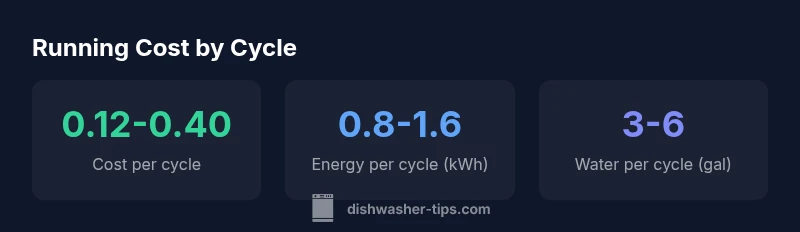
How much does dishwasher cost to run? For modern dishwashers, the typical cost per cycle ranges from about $0.12 to $0.40 in the U.S., depending on the cycle you choose and local electricity rates. Energy-efficient models with Eco modes can push costs toward the lower end, while heavy cycles and older, non-HE units trend higher. In short, running a cycle is a small daily expense, but cumulative usage matters over a year.
Understanding the cost to run a dishwasher
At its core, the running cost of a dishwasher is a function of energy use, water consumption, and the price you pay for those resources. For homeowners wondering how much does dishwasher cost to run, the answer varies with model efficiency, cycle selection, and local utility rates. In 2026, Dishwasher Tips analysis shows that modern, energy-efficient dishwashers typically use less energy and water per cycle than older models, translating into noticeably lower bills over the life of the appliance. When you factor in your local electricity price and your household water rate, the per-cycle cost becomes a practical number you can estimate and plan around. This is especially relevant for households that run multiple loads per day or that have households with larger families. The cost to run a dishwasher is not a fixed number; it moves with your habits and the device you own.
- Per-cycle cost ranges vary by model and cycle
- Eco modes generally reduce energy and water use
- Local utility rates strongly influence total costs
- Full-load efficiency matters more than cycle length alone
Factors influencing running costs
Several levers determine how much you pay to run a dishwasher over a year. First, energy efficiency rating matters: high-efficiency (HE) and Energy Star-rated models typically consume less electricity and water per cycle. Second, cycle selection plays a big role. Quick washes use less water and energy but may require longer run times to achieve similarly clean results. Third, standby power and night-time operation can add to annual costs if the unit isn’t properly powered down when idle. Fourth, regional price differences in electricity and water affect the final figure. Finally, how you use the dishwasher—load size, soil level, and maintenance—can swing costs a noticeable amount. In practical terms, a typical household can reduce costs by choosing efficient models, using eco modes, and avoiding partial loads when possible.
How energy and water use vary by model and cycle
Model energy use and water consumption have improved markedly in the last decade. Newer HE dishwashers often deliver the same cleaning with far less energy, and most modern cycles have calibrated water usage to match soil level. This means that even if you run more cycles, total energy and water bills may not rise proportionally if you’re using efficient settings. In 2026, the Dishwasher Tips analysis shows energy per cycle commonly falling in the range of 0.8–1.6 kWh, with water usage typically between 3–6 gallons per cycle depending on soil level and rinse requirements. Remember that these figures are ranges: your actual costs depend on your model, how you use it, and your local utility rates.
Real-world scenarios: typical costs by cycle type
To illustrate how cycle choice affects cost, consider three common scenarios. A light, lightly soiled load on an energy-saving mode will consume the least energy and water, while a heavy sanitize cycle will push energy usage higher. Mid-range normal cycles fall between these extremes. In practice, a household may see roughly 0.12–0.40 USD per cycle, with the exact amount tied to the model and the local electricity price. If you run 4–5 loads per week, your annual cost will reflect both cycle mix and emission of standby energy when the unit sits idle between uses. The key takeaway: optimize cycle choice and run full loads whenever possible to maximize savings.
How to reduce running costs
Lowering running costs is often about smarter usage rather than upgrading to a more expensive unit. Start with a full, properly loaded dishwasher to maximize water and energy efficiency per cycle. Use eco or smart modes whenever possible, or delay cycles to run during off-peak hours if your utility offers lower rates. Regular maintenance—cleaning filters, checking door seals, and ensuring the spray arms aren’t clogged—keeps the machine operating at peak efficiency, reducing the chance of re-washes. Finally, if your current unit is older than a decade, weigh the long-term savings of a newer, more efficient model against the upfront cost.
The broader picture: comparing models and local rates
Model choice matters, but local rates do as well. A highly efficient dishwasher reduces energy and water use, but if you live in an area with high electricity costs, your per-cycle price can still be significant. Conversely, in regions with low energy prices, even older, non-HE units may seem cheaper per cycle, though they often cost more over time due to higher water usage and more frequent manual pre-rinses. When evaluating options, compare energy ratings (e.g., Energy Star) and water usage alongside your local utility prices. Consider the total cost of ownership (purchase price, maintenance, and operating costs) to determine which unit truly saves you money over its lifespan.
Calculating your own running cost
You can tailor your estimates to your home with a simple calculation. Multiply the energy per cycle (kWh) by your electricity rate ($/kWh) and add the water cost per cycle (based on local water rates). Then multiply by the number of cycles you run in a typical week to estimate weekly costs, and scale to annual totals. If you want to be precise, track a few weeks of usage and adjust for cycle mix. This approach helps you quantify the impact of switching to a higher-efficiency model or altering your daily habits.
Typical energy and water usage by common dishwasher types
| Model Type | Energy per cycle (kWh) | Water per cycle (gal) |
|---|---|---|
| Standard dishwasher | 0.9-1.4 | 3-5 |
| High-efficiency (HE) | 0.6-1.1 | 3-4 |
| Older/non-HE | 1.8-2.5 | 6-12 |
People Also Ask
What is the typical cost to run a dishwasher per cycle?
Most households see a per-cycle cost in the low tens of cents to a bit over forty cents, depending on energy price and cycle choice. Choosing an energy-efficient model and using eco settings can push the cost toward the lower end. Your actual number will vary with local rates and usage patterns.
Typically, a dishwasher costs a few dimes to around forty cents per cycle, depending on cycle choice and rates. Eco modes help reduce that.
Do energy-efficient models always save money?
In most cases, yes. High-efficiency models use less energy and water per cycle, which lowers operating costs over time. The savings depend on how you use the machine and local utility prices.
Yes, high-efficiency models generally save money, especially if you run full loads and use eco settings.
How can I reduce running costs without buying a new dishwasher?
Adopt full-load strategy, use eco cycles, and avoid pre-rinsing. Regular maintenance, including cleaning filters and door seals, keeps the machine efficient and reduces the need for re-washes.
Load fully, use eco settings, and maintain the machine to cut costs even if you don’t upgrade.
Do standby times add to running costs?
Yes. Some energy is consumed when the dishwasher is idle. Unplugging or using a smart outlet can cut standby consumption, depending on your model.
Standby energy adds a bit to costs; consider turning it off when not in use.
Should I compare models based on energy use or water use?
Both matter. Some models use very little energy but more water, or vice versa. Look for a balance that fits your household habits and local rates.
Compare both energy and water use to find the best balance for your home.
How do I calculate my own running cost at home?
Use your model’s energy per cycle and water per cycle, multiply by your local rates, and multiply by the number of cycles you run weekly. You’ll get a practical annual estimate.
Calculate by multiplying energy and water use per cycle by your rates and weekly cycles.
“A well-chosen, efficiently operated dishwasher can substantially lower household energy use, especially when paired with full loads and eco-friendly settings.”
What to Remember
- Estimate costs using energy per cycle and local utility rates
- Choose high-efficiency models to lower per-cycle costs
- Always run full loads to maximize efficiency
- Eco modes can reduce both energy and water consumption
- Track usage to tailor estimates to your home