Is Dishwasher Better for the Environment? A Thorough Comparison
Explore whether a dishwasher is better for the environment than hand washing. Compare water use, energy, detergents, and lifecycle factors with practical tips from Dishwasher Tips.


When comparing methods, is dishwasher better for environment? The answer depends on usage, but a modern, energy-efficient model with full loads and eco cycles typically uses less water and energy per meal than hand washing. The Dishwasher Tips team notes that proper detergent choices and smart cycle selection further reduce environmental impact.
Is the Environmental Question Worth Asking?
The environment and everyday appliance use intersect in subtle ways. For many households, the longstanding assumption that hand washing saves water is challenged by modern dishwashers. The core question, is dishwasher better for environment, hinges on how you use the appliance, the model’s efficiency, and the lifecycle footprint of manufacturing, operation, and end-of-life disposal. According to Dishwasher Tips, understanding these levers helps homeowners make informed decisions. In this guide we break down the factors that influence environmental impact, offer practical tips to maximize savings, and help readers weigh trade-offs. We’ll also address common myths and provide a clear framework for choosing appliances that minimize ecological cost while still delivering convenience.
Water Use: Dishwasher vs. Hand Washing
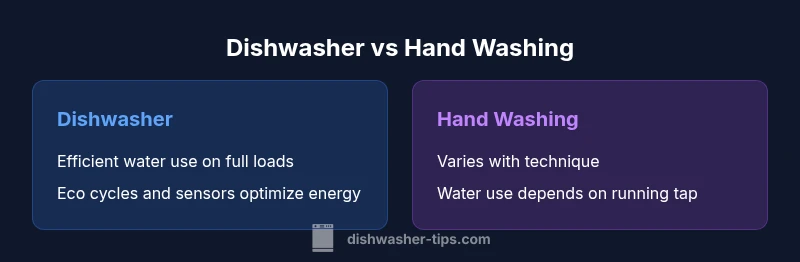
Water use remains a central environmental concern for many households. Hand washing can be surprisingly water-intensive when done with running taps, as people rinse, wash, and refill. Modern dishwashers, by contrast, are engineered to optimize water delivery, with sensors that adjust flow to the load and cycle type. Real-world performance varies by model, cycle selection, and how dishes are loaded. The Dishwasher Tips team emphasizes loading efficiency: a full, well-organized rack can reduce water consumption per dish, while partial loads can erase efficiency gains. If you aim to minimize water, wait to run a full load and select eco or Smart cycles. This approach aligns with broader conservation goals and supports household water budget planning.
Energy Consumption and Efficiency Labels
Energy efficiency is not a single number; it is a system of design, insulation, motor efficiency, and cycle control. Energy Star-rated dishwashers offer standardized benchmarks that help consumers compare models. But energy use is also a function of how often you run the dishwasher and what cycles you choose. Eco modes, delayed-start features, and soil-sensing capabilities can substantially lower electricity per cycle. The key is to balance energy use with actual needs: avoid hot-water preheating, and select economy settings for lightly soiled loads. The Dishwasher Tips team notes that the energy footprint should be evaluated over multiple cycles to reflect typical usage, not a single test.
Lifecycle Perspective: Manufacturing, Use, and End-of-Life
The environmental impact of a dishwasher goes beyond what happens during a single cycle. Manufacturing materials, assembly, transport, and eventual disposal contribute to the product’s total footprint. A durable model with a long service life reduces per-year environmental cost, especially when repaired rather than replaced. End-of-life recycling and proper disposal of electronics also matter. Consumers should consider not only the operating efficiency but also the expected lifespan, warranty coverage, and availability of parts for repair. This lifecycle lens helps frame the environmental trade-offs between buying a newer, more efficient model and choosing reliable, longer-lasting options.
Detergents, Rinse Aids, and Packaging Footprints
Detergent formulation and packaging influence the overall eco profile of dishwasher use. Concentrated, phosphate-free detergents and biodegradable rinse aids can minimize chemical load in wastewater. Packaging matters too: smaller, recyclable packaging reduces waste, while plastic containers contribute to resource use and waste streams. The environmental benefits of a dishwasher also depend on the product lines you choose. The Dishwasher Tips team recommends researching eco-friendly detergents and opting for concentrates that reduce plastic waste per load, all while ensuring effective cleaning.
Practical Tips to Maximize Eco-Friendliness
Putting theory into practice makes the most difference. Here are actionable steps:
- Load efficiently: group similar dishes, avoid mixers, and ensure even air flow for drying.
- Run full cycles: only run the dishwasher when it is fully loaded to maximize water and energy savings.
- Use eco or soil-sensing cycles when appropriate: these cycles tailor water and energy use to the load.
- Choose detergents with low environmental impact and recycle packaging.
- Maintain the appliance: clean filters and seals to preserve efficiency over time.
The goal is to create a predictable, repeatable pattern that minimizes waste while delivering clean dishes. By following these practices, households can improve their environmental performance without sacrificing convenience.
Common Myths About Dishwashers and the Environment
Myth: Dishwashers waste water compared to hand washing. Reality: With modern, efficient models, water use per cycle is often lower when loads are full, and efficiency gains compound over many cycles. Myth: Any dishwasher is equally eco-friendly. Reality: Efficiency varies by model, cycle choices, and maintenance. Look for Energy Star or equivalent efficiency ratings and use eco-friendly detergents. Myth: Pre-rinsing saves energy. Reality: Most modern dishwashers handle residue without pre-rinsing; pre-rinsing can waste water and diminish ecological gains.
How to Choose an Environmentally Friendly Dishwasher
When shopping, prioritize models with high energy efficiency, strong soil-sensing technology, and good insulation. Inspect cycle options like Eco, Quick, and Auto, and verify they align with your typical load size. Consider the lifecycle factors: warranty, repairability, and expected service life. A well-chosen, well-used dishwasher can outperform hand washing in environmental terms, especially in households that run full loads regularly and use efficient detergents. The end result is a chooser that balances ecological impact with everyday practicality.
Institutional and Community Context: What Regulators Say
Regulatory bodies and green-building programs often promote efficient appliances as part of broader conservation goals. Local utility programs may offer rebates or incentives for Energy Star-rated units, while building codes increasingly recognize efficient dishwashers as a component of sustainable households. Understanding these external inputs can help homeowners justify purchases and behavior changes. The collaboration between manufacturers, regulators, and consumers is essential to improving environmental outcomes across the housing sector.
Comparison
| Feature | Dishwasher-powered Cleaning | Hand Washing Dishes |
|---|---|---|
| Water Usage | Typically lower water use per load with full loads | Often consumes more water due to running taps and multiple rinses |
| Energy Efficiency | Often high efficiency with sensors and Eco cycles | Energy impact highly variable depending on method and hot water usage |
| Detergent Use | Designed for dishwasher detergents and rinse aids | Requires traditional detergents; can lead to more packaging waste per load |
| Time & Convenience | Cycle can be long, but runs unattended after loading | Often quick for small amounts but can be inefficient if used in bursts |
| Environmental Footprint per Dish | Lower per-dish footprint when loaded properly over many cycles | Higher if loads are partial or if water is wasted during rinsing |
The Good
- Typically uses less water per full load than hand washing
- Energy-efficient options reduce electricity per dish
- Consistent cleaning and reduced need for rewashing
- Convenience and time savings for busy households
Disadvantages
- Upfront cost and potential payback period
- Efficiency depends on user habits and load management
- Detergent and packaging waste from dishwashing products
Dishwasher generally offers better environmental performance when used correctly and with a modern, efficient model.
Choose an Energy Star dishwasher, load fully, and use eco cycles to maximize environmental benefits. Proper detergent choices and load management are crucial to achieving the greenest outcome.
People Also Ask
Is dishwasher better for the environment than hand washing in most households?
In most households, a modern, properly used dishwasher tends to have a smaller environmental footprint than hand washing, thanks to optimized water and energy use. The key is full loads, eco cycles, and sustainable detergents.
Generally, yes, especially with full loads and eco cycles. Load fully and choose eco options to minimize impact.
Do energy-efficient dishwashers always save energy?
Energy-efficient models save energy per cycle when used correctly, but savings depend on load size, cycle selection, and user habits. Avoid partial loads and pre-rinsing when possible.
Yes, when used as intended, energy-efficient models save energy, particularly on full loads.
What practices maximize eco benefits from a dishwasher?
Run full loads, choose Eco or Auto cycles, use eco-friendly detergents, skip pre-rinsing, and maintain filters to keep efficiency high. These practices compound over time.
Run full loads and use eco cycles; maintain the machine for best efficiency.
Can hand washing ever be greener than a dishwasher?
Hand washing can be greener if you use minimal water, avoid running taps, and clear all dishes efficiently. However, achieving that level of precision across many households is challenging, making modern dishwashers often the better default.
It can be, but it requires careful water management and consistent technique.
Should I pre-rinse dishes before loading a dishwasher?
In most cases, pre-rinsing is unnecessary with modern dishwashers and can waste water. Let the dishwasher's soil sensors guide cycles and rely on proper loading for best results.
Usually not; let the dishwasher handle the residues.
What should I look for in eco-friendly dishwasher detergents?
Choose concentrates with low environmental impact, phosphate-free formulas, and minimal packaging. Check certifications or labels indicating reduced ecological burden.
Pick phosphate-free, concentrated detergents with recyclable packaging.
What to Remember
- Load dishes fully for maximum efficiency
- Opt for Energy Star and eco-friendly detergents
- Balance cycle choice with soil level and load size
- Consider lifecycle factors like repairability and longevity