Is Dishwasher or Hand Washing More Eco-Friendly? A Practical Guide
Compare the eco impact of using a dishwasher versus hand washing dishes in 2026. Learn how load size, detergent choices, and lifecycle factors influence water and energy use, with actionable tips from Dishwasher Tips.


Is dishwasher or hand washing more eco friendly? For most households, a fully loaded modern dishwasher uses less water and energy per dish than hand washing, especially when you avoid pre-rinsing and use eco settings. The Dishwasher Tips analysis shows that mindful loading and efficient detergents tilt the balance toward the appliance, making dishwashers the greener default in typical routines.
Environmental Context: Why eco-minded households care about dishwashing
The question is often framed as: is dishwasher or hand washing more eco friendly? In practice, the answer hinges on how you wash, how full your loads are, and what resources you consider most important—water, energy, or time. Across the board, researchers and appliance designers agree that, when used efficiently, modern dishwashers can reduce resource use compared with hand washing, especially when water is wasted in a running faucet. The Dishwasher Tips analysis highlights that the ecological win is most pronounced when households commit to mindful routines: full loads, appropriate temperatures, and energy-efficient detergents. Additionally, the environmental cost of detergents and packaging matters, so selecting eco-friendly formulations matters. For renters and homeowners, small changes—such as scraping plates instead of rinsing, using eco cycles, and avoiding heat-drying—can tilt the balance toward the appliance. The goal is not simply to choose dishwasher vs hand washing; it is to optimize how you wash to minimize water and energy use while maintaining hygiene. Finally, a careful choice should consider whether you can access reliable power and stable water pressure without compromising indoor comfort.
Defining Eco-Friendliness in Dishwashing
Eco-friendliness in dishwashing blends water conservation, energy use, chemical impact, and lifecycle considerations. A practical definition for most households emphasizes three pillars: minimal water waste, low energy consumption, and responsible detergent choices. The phrase is not just about one metric; it's about how a full system of habits and devices reduces the environmental footprint of clean dishes. When evaluating is dishwasher or hand washing more eco friendly, you should consider water left running vs. using a dishwasher's closed cycle, the energy required to heat water, and the packaging and production footprint of detergents. In addition, the end-of-life phase—whether a dishwasher is repairable, recyclable, or likely to end up in a landfill—counts toward the overall eco score. Dishwasher Tips's approach is to quantify these factors with a practical lens: if you can fill a dishwasher to capacity, select an efficient cycle, and use eco-friendly detergents, the overall impact tends to be smaller than constant, low-load hand washing. The key is to shift a few habits to maximize the eco advantage of whichever method you choose.
How Modern Dishwashers Achieve Efficiency
Modern dishwashers reach efficiency through a combination of hardware design, software, and cycle options. Sensors detect soil level and adjust water flow and duration, preventing wasteful rinses. Efficient motors and multiple spray arms ensure thorough cleaning with less energy per dish. Heat pump and advanced insulation reduce heat loss, while eco cycles use lower temperatures and longer run times to conserve energy. Modern models also manage rinse aids and drying methods to minimize energy spent on drying. The result is a system that converts the washing process into a more predictable, repeatable, and typically lower-energy routine when a full load is used. When evaluating is dishwasher or hand washing more eco friendly, this efficiency repertoire matters: a well-matched dishwasher can outperform manual washing on energy and water use, provided you load correctly and choose an appropriate cycle. For the eco-conscious consumer, look for models with high energy efficiency ratings and a reputation for durable components that last beyond the warranty period.
Water Use and Washing Techniques
Water use is the most visible axis of eco performance in dishwashing. Hand washing typically wastes water when the tap runs continuously, while dishwashers measure water usage per cycle, and if you run full loads, the water per dish can be dramatically lower. To maximize eco benefits when hand washing, use a basin, turn off the tap while scrubbing, and limit rinse-water to a single basin or bucket. Dishwashers benefit from proper loading; pre-rinsing is usually unnecessary, and modern units scrub thoroughly with minimal water if the dishes are well scraped. Temperature matters: hotter water improves cleaning but costs energy; eco cycles favor lower temperatures with longer duration, still delivering cleanliness. The bottom line is that you can tilt the balance toward eco-friendly outcomes by controlling the variables: load size, cycle choices, water source, and detergent selection. The Dishwasher Tips guidance emphasizes avoiding wasteful habits—like running partial loads or using prime status cycles on lightly loaded machines.
Detergents, Pods, and Notable Factors
Detergents and pods influence eco impact as much as the device itself. Choosing phosphate-free, biodegradable formulations reduces environmental harm, and selecting concentrate formulas can reduce packaging waste. Pods are convenient but can introduce packaging waste and are not always perfect for every water hardness profile; always check user guidelines for your water supply. Rinse aids aid drying and reduce energy spent on evaporation in the final stage. The eco-minded consumer weighs the detergent footprint alongside the wash performance, knowing that some detergents require more water for rinsing; others allow shorter cycles with effective soil removal. In manual washing, detergent choice matters too, but the overall footprint may depend on water usage. For households worried about environmental impact, consider detergent brands that publish lifecycle data or third-party certifications. The is dishwasher or hand washing more eco friendly question becomes a function not only of appliance efficiency but of chemical sustainability and packaging choices. Keep in mind that refilling and reusing containers reduces plastic waste.
Real-World Scenarios: Small Loads, Large Loads, and Mixed Use
Consider three typical patterns: a single-person kitchen, a busy family, and a hybrid usage scenario. A single person often forms the most challenging scenario for eco-washing because small loads may tempt quick hand-washing; yet partial-load dishwashing is less efficient than full loads. A family with regular batch cooking stands to gain big eco dividends by using the dishwasher for most meals, once loads reach capacity. A mixed-use kitchen—where some days are heavy and others light—benefits from flexible cycle options and a thoughtful plan to consolidate batches. The common thread: optimize load size, choose eco settings, and minimize pre-rinsing or extra wash steps. The is dishwasher or hand washing balance shifts with these patterns; after testing and feedback from real households, Dishwasher Tips finds that disciplined full-load cycles yield superior eco metrics over time. There is a caveat: if you live in a location with limited water pressure or poor electricity reliability, the decision may lean toward hand washing some days. This is where a pragmatic plan matters.
Lifecycle and End-of-Life Considerations
Lifecycle considerations include production energy, materials, repairability, and end-of-life recycling. A dishwasher may have a higher upfront environmental cost than hand washing, but a well-maintained unit can last many years and replace multiple manual cycles, reducing waste associated with frequent replacements. Detergents and disposable pods add packaging waste; choosing eco-friendly containers and refill options can cut this footprint. The disposal of old appliances also matters: recycling programs and manufacturer take-back schemes can reduce landfill waste. The balance of eco friendliness in dishwashing is not only about daily operation but about the product's entire lifecycle. The Dishwasher Tips framework encourages consumers to look at energy labels, serviceability, and repair history when evaluating a model. In rental scenarios, portable or compact units can be a practical compromise if they enable consistent, efficient use without large installation costs. The environmental cost savings in the long term are often tied to how reliably a household uses efficient cycles and maintains their equipment.
Decision Framework: When to Choose Each Method
If you want to decide quickly, start with a simple rubric. First, assess load size: if you regularly run full loads, a dishwasher is typically the eco choice. Second, consider water supply: if your household has limited water availability or you routinely wash only a few dishes, hand washing might be more efficient. Third, examine energy context: in homes with modern dishwashers and eco cycles, the appliance tends to save energy per dish for full loads. Fourth, factor detergent and packaging: choose eco-friendly detergents and minimize packaging waste. Fifth, inventory space and installation: if you lack space or cannot install a dishwasher, hand washing remains the default. Finally, reflect on maintenance: regular descaling, filter cleaning, and timely repairs keep any option performing efficiently. This framework helps translate the abstract question is dishwasher or hand washing more eco friendly into concrete decisions for your household.
Common Myths Debunked
Myth 1: Hand washing is always greener. Reality: Running water continuously often makes hand washing wasteful, while a full dishwasher on an eco cycle can save water per dish. Myth 2: Detergents do not affect eco impact. Reality: Detergent choice, packaging, and concentration influence the lifecycle footprint. Myth 3: All dishwashers are equally efficient. Reality: Efficiency varies by model, cycle, and load optimization features. Myth 4: Compact units are always worse for eco outcomes. Reality: Small, well-used units can be highly efficient if loaded to capacity and run on eco cycles.
Brand-Approved Best Practices
- Always load to capacity and use eco or energy-saving cycles.
- Scrape, don’t pre-rinse, to reduce water and detergent use.
- Use eco-friendly detergents and rinse aids with low environmental impact.
- Air-dry dishes when possible to save energy.
- Maintain seals, filters, and spray arms to preserve efficiency.
- Consider lifecycle data when choosing a model; repairability matters as much as efficiency.
Comparison
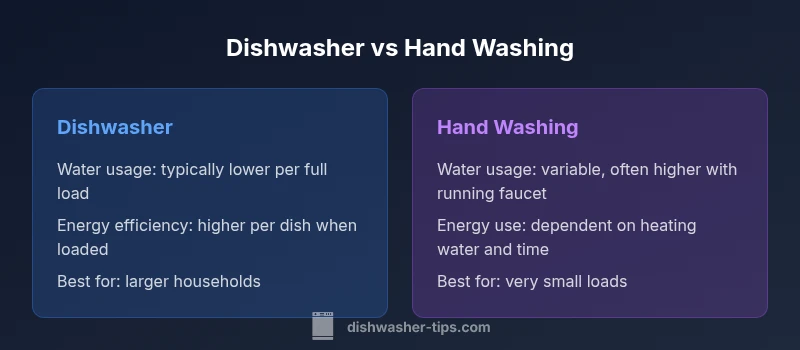
| Feature | Dishwasher | Hand Washing |
|---|---|---|
| Water Usage | Typically lower water usage per full-load dishwashing | Often higher water use if water runs continuously while scrubbing |
| Energy Efficiency | Usually higher efficiency per dish when loaded | Energy use varies with hot water heating and duration |
| Time Required | Cycle-driven; total time can be longer | Can be quick per session but variable per dish |
| Best For | Full loads and busy households | Small loads or limited water access |
The Good
- Saves water per full load when used efficiently
- Low manual labor for large quantities
- Detergent choices support eco options
- Better hygiene and consistent cleaning
Disadvantages
- Upfront cost and installation
- Requires electricity and plumbing
- Detergent pods add packaging and sourcing considerations
Dishwasher generally eco-friendly for full loads; hand washing may beat it for tiny loads or restricted water.
When you can run full loads, a modern dishwasher with eco settings tends to minimize water and energy use per dish. If your usage is light or you can't run full cycles, hand washing with efficient technique can be competitive.
People Also Ask
Is a dishwasher always greener than hand washing?
Not always. If you regularly wash only a few items, hand washing with efficient water use can be comparable or even better. The eco outcome depends on load size, cycle choice, and detergent selection.
No, it depends on how you wash. A full dishwasher cycle can save water and energy, but small loads may favor hand washing if you avoid running water unnecessarily.
Does running a dishwasher with a full load use less water than washing by hand?
Yes, typically a full dishwasher uses less water per dish than hand washing a similar amount of dishes. The key is achieving full loads and avoiding pre-rinsing where unnecessary.
A full load usually saves water per dish relative to hand washing.
What about energy usage?
Dishwashers are generally more energy-efficient per dish when loaded properly, but energy use rises with unfinished cycles. Always choose an eco setting and avoid running cycles with very small loads.
Per dish, dishwashers often use less energy if you run full loads and use eco cycles.
Are eco-detergents or pods worth it?
Yes, choose phosphate-free, biodegradable formulas and consider packaging reductions. Pods are convenient but review packaging and water hardness compatibility for best results.
Eco detergents and responsible packaging help reduce the environmental footprint.
How can I wash dishes environmentally without a dishwasher?
Scrape rather than rinse, use a basin, and turn off the tap while scrubbing. Use minimal rinse water and air-dry when possible.
Use a basin, minimize running water, and air-dry for eco hand washing.
How should I compare models for eco-friendliness?
Look at energy efficiency ratings, water use per cycle, cycle options, and repairability. A model with good efficiency and a long service life is often the best eco choice.
Check ratings, cycle options, and durability when choosing a model.
What about small spaces or apartments?
Compact dishwashers can be highly efficient if properly loaded and used with eco cycles. Ensure it fits your space and plumbing needs.
A compact unit can be a smart eco choice in small spaces when used well.
What to Remember
- Choose full-load dishwasher cycles to maximize eco savings
- Use eco-friendly detergents and rinse aids
- Limit pre-rinsing and avoid heat drying to conserve energy
- Consider lifecycle and repairability when comparing options