Is Dishwasher Cleaner the Same as Washing Machine Cleaner? A Practical Guide
Explore whether dishwasher cleaners and washing machine cleaners are interchangeable, how formulations differ, safety considerations, and best-practice usage with Dishwasher Tips.


Is dishwasher cleaner the same as washing machine cleaner? The short answer is usually no. In practice, these cleaners are formulated for very different appliance environments: dishwashers rely on high heat, pressurized spray, and a sealed chamber, while washing machines tackle drum residues, seals, and detergents. Using the wrong cleaner can damage gaskets or void warranties. Always use the product labeled for your appliance and follow the manual.
The core question: why cleaners are not interchangeable
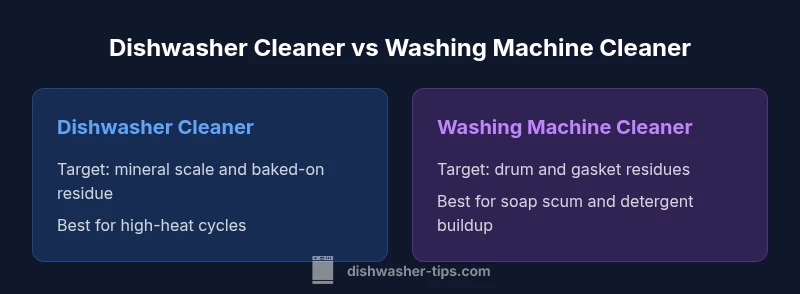
Cleaners designed for dishwashers differ from those made for washing machines because the environments inside these appliances are distinct. Is dishwasher cleaner the same as washing machine cleaner? The short answer is usually no, and the reasons are practical, not cosmetic. Dishwashers operate with high heat, pressurized spray, and a fully enclosed, moist chamber that continuously circulates hot water. Dishwasher cleaners are formulated to cut through baked-on grease, mineral scale, and food residue that clings to racks and spray arms. In contrast, washing machines contend with laundry detergents, soap scum in the drum, and rubber seals that need gentle attention. Using a product labeled for dishwashers in a washing machine can leave residues, foam excessively, or even stress seals, while a machine cleaner may not address mineral buildup in a dishwasher. From a maintenance perspective, following the appliance’s manual and using the labeled product is essential. According to Dishwasher Tips, consumer confusion around cross-app use persists, but sticking to purpose-built cleaners reduces risk and prolongs appliance life. A simple rule of thumb: treat each appliance with its own cleaner and schedule routine cleans that align with manufacturer guidance.
How dishwasher cleaners work within the appliance
Dishwasher cleaners are designed to run during a dedicated cleaning cycle, delivering a concentrated mix of descalers, surfactants, and deodorizing agents that target mineral buildup and greasy film on racks, spray arms, filters, and interior surfaces. The chemistry is tuned for alkaline environments and high-temperature exposure that helps dissolve deposits left by everyday dish detergents. These products emphasize descaling, deodorizing, and maintaining optimal water flow, which in turn supports spray performance. Using a cleaner not meant for dishwashers can lead to excessive foaming, residues on dinnerware after cycles, or degraded seals. For this reason, it is important to avoid substituting a dishwasher cleaner with a washing machine formula and vice versa. By ensuring you select the intended product, you safeguard the dishwasher’s mechanical components and keep cleaning performance consistent.
How washing machine cleaners work
Washing machine cleaners address a slightly different set of challenges: residue from laundry detergents, mineral deposits that accumulate in the drum, and buildup around seals and hoses. They are formulated to run through hot cycles that heat the drum and circulate water for extended periods but with different considerations than dishwashers. These cleaners target soap scum, detergent residue, and mold-prone areas in the drum and door seal. They are not designed to descale hard water deposits as aggressively as dishwasher formulas, and using them in a dishwasher can leave insufficient residue removal and risk foaming in a high-heat environment. The takeaway is simple: use a washer cleaner only in a washing machine, and a dishwasher cleaner only in a dishwasher to avoid unintended interactions and ensure effective cleaning.
Ingredient and formulation differences
The two product families diverge in their core ingredients and intended pH ranges. Dishwasher cleaners typically include descalers, surfactants, and deodorizing agents designed to operate in an ultra-clean, hot-water environment. Washing machine cleaners focus on addressing drum and gasket residues, with anti-foam components to prevent excess suds during laundry cycles. The chelating agents and enzymes used in dishwasher formulas differ from those in washer formulas, reflecting the distinct mineral profiles and organic loads each appliance encounters. Reading labels helps confirm the intended use. Remember: substituting cleaners can lead to poor cleaning results and potential hardware stress. Always follow manufacturer recommendations to protect performance and warranty terms.
Safety, warranty, and misuse risks
Safety considerations matter when selecting cleaners. Using the wrong product can cause foaming, residue deposition, and chemical interactions with rubber seals or metal components. Warranties often rely on following the manufacturer’s guidance for cleaning and maintenance products. Repeated misuses may provide grounds for warranty denial in some cases, particularly if damage results from incompatible chemicals. In general, the safest path is to choose a cleaner that explicitly states compatibility with your appliance type and to avoid improvising with household products that are not designed for the appliance. If you’re unsure, consult the user manual or contact the manufacturer’s support line for clarification. Regular, correct cleaning routines reduce buildup and help maintain efficient operation over time.
Practical decision framework: when to choose which cleaner
A straightforward framework makes choosing easier. First, locate your appliance’s manual and confirm the recommended type of cleaner. Second, inspect the product label for explicit compatibility. Third, evaluate your maintenance goals: do you need to combat mineral scale or soap/detergent residue? Fourth, schedule routine cleans aligned with the manufacturer’s suggested cadence. Fifth, keep a dedicated cleaner on hand for each appliance to simplify decision-making and reduce the chance of cross-use errors. By following these steps, you minimize risk and maximize cleaning effectiveness across both appliances.
Reading labels and selecting the right product
Label literacy matters. Look for clear statements such as “for dishwashers only” or “for washing machines only.” Check the active ingredients in relation to your concerns: scale, odor, or mildew. Consider your water hardness; hard water can increase mineral buildup in dishwashers, signaling a stronger descaler may be beneficial. Additionally, verify recommended cycle settings and any cautions about heat or duration. If your water is particularly hard or soft, tailor your cleaning routine accordingly and adjust frequency to maintain peak performance. By making label-informed choices, you reduce the risk of damage and ensure effective cleaning outcomes.
Common myths and misuses
Several myths persist about appliance cleaners. Some users believe that cheaper, all-purpose products work across appliances. Others think vinegar or household bleach can substitute for purpose-built cleaners. In reality, these substitutions can harm seals, corrode components, or create safety hazards. Another misconception is that more frequent cleaning is always better; excessive cleaning cycles can wear seals and shorten the life of gaskets. The best practice is to follow the manufacturer’s guidance, use the recommended cleaner for each appliance, and maintain a realistic cleaning cadence that aligns with water quality and cycle usage.
Maintenance routines that keep appliances clean without risk
Developing a routine helps preserve appliance performance. Create a simple calendar that marks the months for dishwasher and washer cleanings, ensuring cycles are run as directed by the manuals. Store the appropriate cleaners in the pantry or utility closet to prevent cross-use mistakes. When dealing with stubborn mineral buildup or mold-like odors, consider consulting the manufacturer’s customer support or a professional service. A consistent approach—paired with product-specific cleaners—reduces the likelihood of recurring issues and extends the life of both appliances.
Comparison
| Feature | Dishwasher Cleaner | Washing Machine Cleaner |
|---|---|---|
| Primary purpose | Descale and remove mineral buildup in dishwasher interiors | Clean drum, seals, and hoses in the washing machine |
| Typical active ingredients | Alkaline cleaners with descalers and deodorizers | Foam-control and cycle-appropriate detergents |
| Best for | Dishwasher interior, spray arms, and filters | Drum surfaces, door seals, and hoses |
| Usage method | Add to dispenser or cleaner slot during a dedicated cycle | Add to drum or detergent drawer during a hot cycle |
| Effect on residues | Targets baked-on food residues and lime scale on racks | Targets soap scum and detergent residues on drums and gaskets |
| Warranty considerations | Using correct product supports warranty conditions | Using correct product supports warranty conditions |
The Good
- Improves overall appliance cleanliness and odor control
- Supports longer appliance lifespan with regular maintenance
- Reduces risk of residue transfer affecting dishes or clothes
- Clear labeling and easy availability in stores
- Helps maintain peak performance through routine cycles
Disadvantages
- Misuse can damage seals or void warranties
- Some products require multiple cycles for best results
- Packaging and bottles contribute to environmental footprint
- Not all cleaners are equally effective in all water conditions
Use appliance-specific cleaners for each machine to protect components and warranty.
Substituting cleaners between dishwashers and washing machines increases risk and may reduce cleaning efficacy. Follow manufacturer guidelines and stick to labeled products for reliable results.
People Also Ask
Can I use the same cleaner for both a dishwasher and a washing machine?
No. Dishwasher cleaners and washing machine cleaners are designed for different systems. Using the wrong product can leave residues or damage seals. Always follow the label and the appliance manual.
No. Dishwashers and washers use distinct cleaners tailored to their cycles and parts. Check the label and your manual for the right product.
Is it safe to use vinegar or other household products as cleaners?
Household products like vinegar or bleach can damage seals or interact with materials inside appliances. Use commercial cleaners labeled for the specific appliance to avoid risks.
Vinegar and other household products can harm seals and materials—stick to labeled appliance cleaners.
Do dishwasher cleaners also sanitize the interior?
Most dishwasher cleaners focus on descaling and deodorizing rather than sanitizing to kill all microbes. For sanitation, rely on the dishwasher's high-heat cycle and hygiene-focused cycles if available.
They mainly descale and deodorize, not sanitize like a medical-grade cleaner. Rely on the cycle heat for sanitation.
How often should I clean each appliance?
Follow the manufacturer’s recommended cadence, which typically means periodic cleaning cycles for the dishwasher and washer depending on usage and water quality.
Check your manual for recommended frequency; high usage or hard water may require more frequent cleans.
What should I do if I suspect contamination or a leak after cleaning?
Stop using the appliance and inspect seals and hoses. If residues persist or you notice leaks, contact support or a qualified technician. Do not mix cleaners with other products.
If you suspect contamination or leaks, stop use and check seals. Contact support if needed.
What to Remember
- Read labels to confirm compatibility
- Use purpose-built cleaners for each appliance
- Schedule regular cleaning cycles for best results
- Avoid substituting cleaners to protect seals and warranties
- Consider water hardness when choosing products