Average Dishwasher Run Time: A Practical Guide to Cycle Durations
Explore what the average dishwasher run time means, how cycle choices affect duration, and practical tips to estimate, shorten, and optimize loads with data-backed guidance from Dishwasher Tips.


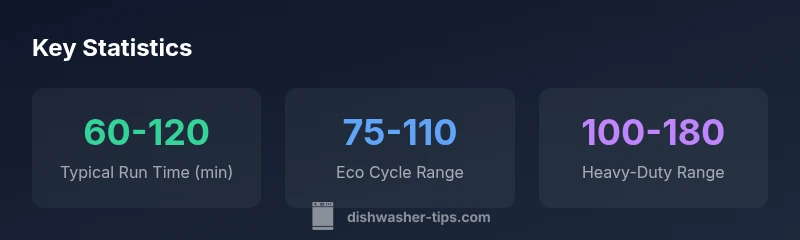
According to Dishwasher Tips analysis, the average dishwasher run time typically falls in the 60–120 minute range, depending on cycle type and soil level. Eco modes lean toward the shorter end, while heavy-duty cycles push toward the upper end. Understanding these ranges helps homeowners plan energy use, compare models, and optimize load scheduling across everyday chores.
What is considered the average dishwasher run time?
The phrase average dishwasher run time is not a fixed value. It represents a practical interval that varies by cycle, soil level, and appliance design. For most households, the broad range is about 60–120 minutes, with shorter durations common for eco or quick cycles and longer durations for heavy-duty modes. This spectrum reflects how modern dishwashers balance cleaning power, water usage, and energy efficiency. The exact duration you observe hinges on your model, the cycle you choose, and how dirty the dishes are. As Dishwasher Tips analysis notes for 2026, planning around this range can help you schedule tasks and estimate energy consumption more accurately, especially when you’re coordinating multiple appliances or a busy household.
Factors that influence run time
Run time is not just a single number; it’s a function of several interacting factors. First, the cycle type sets the baseline duration: Eco, Normal/Auto, Quick, and Heavy/Pots & Pans each have typical targets. Second, soil level matters: heavily soiled dishes require more water temperature adjustments and more wash phases, extending the cycle. Third, water hardness and intake pressure can alter rinse times and detergent effectiveness, subtly changing total duration. Load size and distribution also play a role—overloading can force longer cycles or reduce cleaning effectiveness, while underloading may shorten cycles undesirably. Finally, dishwasher efficiency and age influence run times; newer models often complete cycles faster due to optimized motors and sensors. Understanding these variables helps homeowners calibrate expectations and choose settings that align with their routines.
How cycle names translate to time
Cycle naming schemes act as short-hand for expected duration and performance. Eco or smart cycles emphasize energy savings and typically cluster near the lower end of the time spectrum. Normal/Auto cycles aim for a balance between time and cleanliness and usually fall in the mid-range. Quick or Express modes promise the least time but may trade off some cleanliness for speed. Heavy or Pots & Pans cycles push the upper bound, using higher water temperatures and longer wash phases to tackle stubborn soils. When selecting a cycle, consider both the soil level and your printed or on-dash guidance to anticipate the actual run time.
Common myths about run times
A common myth is that all dishwasher cycles take the same amount of time across models. In reality, cycle duration varies by design, sensors, and cycle logic. Another misconception is that shorter cycles always save energy; while they often save time, energy use can be similar if the machine runs longer fills or higher water temperatures to achieve the same results. Finally, some users assume that pre-rinsing or manual scrubbing eliminates the need for longer cycles, but modern dishwashers rely on water temperature, detergent chemistry, and tumbling action to emulsify soils effectively.
How to estimate run time for your dishwasher
To estimate run times for your kitchen setup, start with the labeled cycle durations in your user manual. Then, perform a few test runs with representative loads (light, medium, heavy) and record the start and end times. If your dishwasher supports a delay start, you can plan around real-world durations under typical use. For more accurate budgeting of energy and water, use the appliance’s diagnostic or energy-tracking features if available. Over a month, you’ll build a practical library of expected times you can reference when planning meals, laundry, or other chores.
Reducing cycle times without compromising cleanliness
Shortening run times can be achieved without sacrificing cleanliness by: (1) using the appropriate cycle for the soil level, (2) loading dishes properly—plates facing inward, bowls angled to allow water flow, and no blocking of spray arms, (3) avoiding pre-rinsing heavy soils when the dishwasher’s sensors detect adequate soil removal, (4) selecting optimal water temperature settings for your water hardness, and (5) ensuring detergent is appropriate for the cycle and water hardness. Clean filters and spray arms also help cycles run more efficiently, potentially shaving off extra minutes while maintaining hygiene.
Measuring and logging run times at home
Develop a simple logging habit to track cycle durations. Record the cycle name, soil level, load size, and duration for each wash. Note any deviations from the expected time and the reasons—blocked spray arms, overloaded racks, or unusual water pressure. Over time, you’ll identify patterns, such as consistently longer durations after you buy new cookware or when using certain detergents. This log becomes a practical reference for optimizing future loads and communicating needs to service providers if a machine shows unexpected drifts.
Cycle time ranges by type
| Cycle Type | Estimated Time Range | Typical Soil Level |
|---|---|---|
| Eco / Quick | 60-90 minutes | Light to moderate |
| Normal / Auto | 90-120 minutes | Average |
| Heavy / Pots & Pans | 120-180 minutes | Heavy |
People Also Ask
What is the average dishwasher run time?
The average run time is not fixed; it typically ranges from about 60 to 120 minutes depending on the cycle and soil level. Real-world times can vary by model and water conditions. Using the data in this article as a baseline helps you set expectations for your own dishwasher.
The average run time is usually between 60 and 120 minutes, but it depends on your cycle and soil level. Check your manual and track your own cycles to plan better.
Do eco modes always shorten run times?
Eco modes often aim to reduce energy and water use, and they can be shorter or longer depending on the model. In many cases they run at the lower end of the spectrum, but not universally. Always compare cycle labels and test with your typical loads.
Eco modes can be shorter, but it varies by model. Check your cycle labels and compare with your own load times.
Why do run times vary so much between cycles?
Cycle duration varies due to soil level, water temperature, sensor logic, and the targeted cleaning action. Heavier soils trigger longer wash phases, while lighter soils and optimized sensors shorten cycles. Model design also influences how quickly a cycle completes.
Different soils and sensors make cycles faster or slower. Heavier soils take longer; lighter soils are quicker.
Can I shorten run times without sacrificing cleanliness?
Yes, by selecting the appropriate cycle for the soil level, loading dishes properly, and maintaining clean filters and arms. Avoid unnecessary pre-rinsing, and use detergent suitable for your cycle and water hardness to maximize efficiency.
Yes. Pick the right cycle, load correctly, and keep filters clean to shave minutes without losing cleaning power.
How can I estimate run times for a new dishwasher model?
Consult the user manual and manufacturer cycle guidance. Then perform a few test runs with representative loads and log the results to build your own baseline for planning and budgeting.
Check the manual, run some tests, and log the results to build a personal baseline.
What should I log to track cycle durations?
Log cycle name, soil level, load size, start/end times, and any deviations (like blocked spray arms). Over time, you’ll spot trends and optimize accordingly.
Log cycle name, soil, load size, start/finish times, and any issues to spot patterns.
“Accurate expectations for run times come from comparing real-world loads to the manufacturer guidance. When in doubt, track and adjust, and you’ll see efficiency gains over time.”
What to Remember
- Know the 60–120 minute baseline for planning daily tasks
- Cycle type and soil level are the biggest time drivers
- Use data logs to tailor settings to your home
- Regular maintenance helps keep cycle times predictable
- Smart planning can save energy without sacrificing cleanliness