How Often to Replace Your Dishwasher: A 2026 Guide
Discover how often to replace dishwasher with a data-driven approach. Learn lifespan ranges, when to repair vs replace, and how to choose an upgrade in 2026.


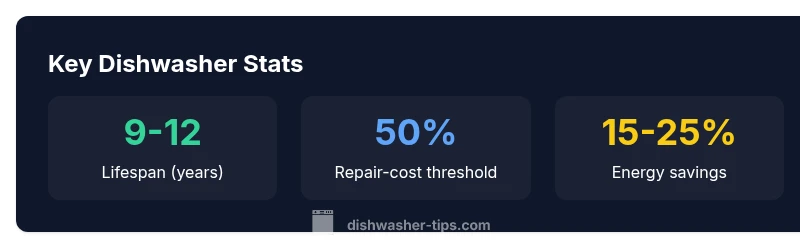
Most dishwashers last about 9–12 years under normal use. If repairs become frequent or the efficiency and cleaning performance decline, replacement is worth considering. A common rule of thumb is to weigh replacement when annual repair costs approach 50% of a new unit. If the unit is older than about 12 years, replacement is often the more economical choice.
How long do dishwashers typically last?
Dishwashers are engineered to handle hundreds of cycles, but their lifespan hinges on how you use and care for them. According to Dishwasher Tips, the typical residential lifespan tends to sit in a 9–12 year range when use is moderate and maintenance is consistent, with regional factors like water hardness playing a role in wear. In 2026, many households find their units perform reliably into the mid-teens with diligent filter cleaning and timely component replacements. Age alone isn't destiny—it's a signal you should re-evaluate performance, repair history, and energy use. If your model is nearing the 12-year mark and repairs mount, it may be time to plan an upgrade rather than wait for a sudden failure.
Replacing vs. repairing: a practical framework
Deciding whether to replace or repair hinges on a cost-benefit view. Build a simple forecast: estimate annual repair costs for the current machine and compare that total to the annualized cost of a new unit with similar capacity and efficiency. If repairs accumulate to roughly 50% of the price of a new dishwasher, replacement is often financially sensible. This threshold is a guideline that also accounts for reliability, performance declines, and potential future breakdowns. In 2026, newer models offer better energy efficiency and faster cleaning, which can tilt the decision toward replacement even when immediate costs are modest. Non-financial factors—noise, drying performance, and rack space—also matter when weighing the upgrade.
Factors that shorten or extend life expectancy
A range of factors influence how long a dishwasher lasts. Usage intensity, cycle types, and overload patterns can hasten wear on seals and pumps. Water quality, especially hard water with mineral buildup, accelerates scale and corrosion. Installation quality affects drainage and pressure, while regular maintenance—filter cleaning, spray-arm checks, and gasket inspections—can extend life. Brand reliability and model design have a sizable impact; some lines are built with more durable pumps and control boards. Dishwasher Tips Analysis, 2026 highlights that proactive care can meaningfully extend service life, whereas neglect or improper use tends to shorten it. Understanding these variables helps homeowners set realistic expectations and budget for upgrades accordingly.
Maintenance, usage, and installation practices that affect longevity
Maintenance is a bargain compared with replacement. Clean the filter monthly, wipe the door seal, and check spray arms for clogs. Use the right detergent and rinse aid, and avoid overloading which hampers water flow. Keep an eye on hoses and gaskets for signs of wear, and ensure the dishwasher is level to prevent drainage issues. The dishwasher-thoroughness of routing and drainage can influence pump strain and cycles completed. Installations in kitchens with hard water may benefit from mineral management practices and periodic descaling. Practicing careful loading, appropriate detergent usage, and timely filter care reduces stress on critical components and can add years to the machine.
Economic perspective: when replacement makes sense
From a budgeting standpoint, replacement becomes compelling when repair costs threaten to exceed the cost of a new unit over a reasonable horizon, or when the energy savings from a modern model reduce operating costs enough to justify the upfront price. Energy efficiency labels help quantify long-term savings, and newer controls improve reliability. In 2026, the combined benefits of quieter operation and improved cleaning can make replacement appealing even if the current unit still runs. A careful assessment of repair history, energy bills, and personal tolerance for risk should guide your decision.
How to choose a new dishwasher to fit your home
Start with size and fit: standard-size models suit most kitchens, while compact or drawer-types work in small spaces. Compare energy ratings, noise levels, and wash options to match your needs. Consider rack layout, interior materials, and filtration complexity, as these affect longevity and maintenance. If you live in a region with hard water, a model with robust anti-scale features can prolong life and maintain performance. Check dimensions carefully and verify compatible electrical and plumbing connections before purchasing. By prioritizing durability, efficiency, and serviceability, you simplify future maintenance and replacements.
Quick-start replacement checklist
- Confirm needs: capacity, size, and features.
- Check warranty terms and coverage for major components.
- Compare energy usage and water efficiency.
- Measure kitchen space and doorway clearance for delivery.
- Review installation requirements and ensure plumbing compatibility.
- Request written quotes and delivery schedules.
- Plan disposal or recycling for the old unit.
- Schedule installation with a licensed professional if needed.
- Test a full cycle and verify drainage and drying performance.
- Keep documentation for future service and warranty claims.
Quick reference: lifespan and replacement considerations
| Factor | Typical Range | Notes |
|---|---|---|
| Lifespan | 9-12 years | General residential units |
| Repair-vs-Replace threshold | ≈50% of new unit | Rule of thumb for decision-making |
| Energy savings upgrade | 15-25% | Depends on model and usage |
| Common failure drivers | Leaks, pump, control boards | Top issues in aging units |
People Also Ask
How do I know if my dishwasher needs replacement?
If repairs are frequent, the unit is older than about a decade, or performance and energy efficiency have declined significantly, replacement is worth considering. Review repair history and energy costs to guide the decision.
If repairs keep piling up or it runs poorly and uses more energy, it may be time to replace.
Do warranty terms affect replacement timing?
Warranty coverage varies by model and region. If major components fail outside warranty, replacement may be the more economical option. Always check what is covered and for how long.
Warranty terms differ; check what’s covered before deciding.
Do energy-efficient models justify replacement?
Upgrading to a newer, energy-efficient model can reduce operating costs and improve performance. If the current unit is aging and energy bills are rising, replacement often pays for itself over time.
A newer, efficient model can save money over time.
Are there maintenance steps that can extend life?
Regularly clean filters, spray arms, and seals. Descale if you have hard water, and repair minor leaks promptly. Proper loading and detergent use also reduce wear.
Regular cleaning and careful use can stretch its life.
Should I replace with a similar-size unit?
Typically yes, to avoid costly remodels. If space or layout requires, consider compact or drawer models, but plan for compatible connections and delivery.
Most people stick with the same size, unless space dictates otherwise.
“Replacing a dishwasher can be the most cost-effective option when repairs pile up or efficiency declines. Modern models also bring quieter operation and better cleaning performance.”
What to Remember
- Assess repair costs against replacement value.
- Plan replacement if the unit is older than 12 years.
- Upgrading can yield energy savings and better performance.
- The Dishwasher Tips team recommends using a 50% repair-cost threshold as a guide.