LG Dishwasher BE Code Troubleshooting Guide
Urgent guide for LG dishwashers displaying BE code. Learn what BE means, fast checks, diagnostic steps, and safe fixes to restore cycles and prevent water issues.


An LG dishwasher showing BE is signaling a fault in the water inlet or sensor system, i.e., an lg dishwasher be code. This is urgent because it can halt a cycle or cause poor drainage. Quick checks: verify the water supply is on, clean the inlet filter, and ensure the door latch is fully closed. If the code persists, contact a technician.
What the BE Code Means on LG Dishwashers
The BE code on LG dishwashers points to a fault in the water inlet or an associated sensor module. In many homes, BE appears when the machine cannot detect adequate water inflow or the inlet valve/sensor aren’t communicating correctly with the control board. This is not a cosmetic issue—if left unresolved, it can prevent the cycle from starting or completing, potentially leading to overflow conditions if drainage attempts occur without proper fill. According to Dishwasher Tips, BE commonly arises from simple, addressable causes like a closed valve, a clogged filter screen, or a loose/damaged inlet hose. The be code is a safety timeout, designed to stop a cycle before damage occurs, so treat it as urgent and methodical rather than a panic trigger. Early diagnosis can save both time and money and reduces the risk of water damage in kitchens and laundry areas.
Common Symptoms You Might See with BE
When BE appears, you may notice a few consistent symptoms: the unit stops mid-cycle, the display flashes the BE code, the wash fails to fill with water, or the door may have to be reopened and closed to re-initiate a cycle. You might also observe a humming noise from the inlet area, which can indicate a restricted flow rather than a complete valve failure. Some models will also pause with a be code when the sensor flags a discrepancy between expected and actual water level. In all cases, BE is a signal that something in the water inlet or its sensing mechanism needs attention, not just a generic error. If you see signs like standing water and a be code, take action quickly to prevent further damage.
Quick Checks You Can Do Right Now
Before you call for service, run through these quick checks:
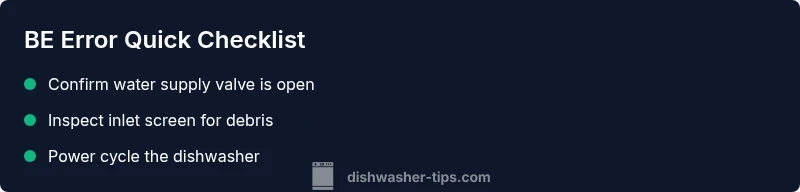
- Ensure the water supply valve is fully open and the supply line has no kinks.
- Inspect the inlet hose for bends, leaks, or crushing; replace if damaged.
- Remove and clean the inlet filter/screen where the hose connects to the appliance.
- Check the door latch and door seal; a loosely closed door can trigger sensor faults.
- Power cycle the unit: unplug for 60 seconds then plug back in to reset electronics.
- If available, inspect the user manual’s BE troubleshooting section for model-specific steps. Taking these steps often resolves BE without professional help and avoids unnecessary service calls.
How BE Becomes a Safety Issue: Why Urgency Matters
A BE code implicates water handling inside the dishwasher—a best-case scenario is a temporary hiccup and best-practice is a quick reset; a worst-case is a water inlet valve failure that can lead to leaks or overflow if the machine attempts to fill with improper flow. Power down the unit and disconnect from power when inspecting the electrical components, especially around the inlet valve and sensor line. If water is observed pooling around the base or hoses show cracks, do not run a cycle until the issue is addressed. Safety is paramount, so err on the side of caution and call a pro if you’re unsure about the integrity of water lines or electrical connections.
Step-Back Diagnostic Approach: Narrowing Causes
To efficiently diagnose BE, think of BE as a symptom that can stem from several root causes. Start with the simplest, most common sources first, then move to less likely culprits:
- High likelihood: Clogged or dirty inlet filter/screen leading to restricted inflow.
- Medium likelihood: Water supply valve closed or kinked inlet hose blocking flow.
- Low likelihood: Faulty water inlet valve or sensor module causing incorrect readings.
- Low likelihood: Control board or software glitch that misreads water level. By cataloging symptoms and testing each cause in order, you minimize disassembly time and reduce risk of damaging other components.
Safety Precautions and When to Hire a Professional
Safety always comes first. Unplug the dishwasher before inspecting internal components. Wear eye protection when handling water lines and avoid forcing hoses. If you notice corroded connectors, burnt smells, leaking seals, or you’re uncomfortable with electrical testing, stop and contact a licensed appliance technician. Be prepared to provide your model number, a clear description of when BE appears, and a list of any symptoms observed. A pro can test the inlet valve with a multimeter, check the control board for faults, and verify sensor continuity. While some fixes are straightforward, certain repairs involve wiring and water lines that are best left to trained technicians.
Prevention: Keeping BE Codes at Bay
With routine maintenance, you can reduce the odds of BE reappearing:
- Check and clear the inlet filter every 3–6 months, especially in areas with hard water.
- Use a high-quality water inlet valve and ensure household water pressure is stable.
- Keep hoses free of kinks and avoid pulling hoses when loading dishes.
- Run a maintenance wash once a month if your model supports it, using the recommended cleaner.
- Document and track dates of maintenance and service calls to identify recurring patterns. Adopting these habits helps extend the life of your LG dishwasher and minimizes BE occurrences.
What to Expect During a Service Visit
If you need a technician, anticipate a first visit that includes diagnostic testing of the water inlet, valve operation, and sensor continuity. Expect the technician to verify water supply integrity, inspect the inlet screen, and test the control board’s sensor signals. Replacements may include a new water inlet valve, filter, or valve assembly, with labor charged by the hour. While the exact timing and cost depend on your region and model, many repairs complete within one or two service calls. Having your serial/model number handy and a detailed symptom log will help the technician diagnose faster.
Steps
Estimated time: 60-90 minutes
- 1
Power off and disconnect water
Unplug the dishwasher and shut off the main water valve to the unit. This prevents accidental leaks while you inspect hoses and fittings. Always work dry or with minimal moisture near electrical connections.
Tip: Double-check the wall outlet is not controlled by a switch. - 2
Inspect inlet hose & valve
Trace the inlet hose from the valve to the machine. Look for kinks, crushing, or bends that restrict flow. If the valve is manually operable, ensure it opens completely when power is restored.
Tip: If the hose is old or cracked, replace it rather than patching. - 3
Clean the inlet screen
Locate the inlet screen or filter at the valve or near the connection point on the appliance. Rinse under running water and remove any sediment or debris that blocks flow.
Tip: Use a soft brush to avoid gouging the screen. - 4
Reset the control electronics
Reconnect power after a 60-second wait to reset the control board. Start a test cycle to see if BE clears and the unit fills normally.
Tip: If BE returns, note any pattern in cycles or loads that reproduce the issue. - 5
Test with a short cycle
Run a quick cycle with no dishes to observe whether the unit fills and completes the cycle. Listen for valve operation and confirm there is no leaking.
Tip: Do not run heavy loads during diagnostic testing. - 6
Consult a professional if unresolved
If BE remains after steps 1–5, schedule service for valve and sensor testing. A technician may need specialized equipment to assess the valve, seal integrity, and sensor calibration.
Tip: Provide the service tech with your symptom log and any error timing.
Diagnosis: Error BE displayed, machine won't start or fill
Possible Causes
- highClogged water inlet filter
- mediumWater inlet valve closed or kinked inlet hose
- lowFaulty water inlet valve module
- lowControl board or sensor fault
Fixes
- easyClean the inlet filter / screen
- easyOpen the supply valve and straighten/replace the inlet hose
- hardReplace the water inlet valve or related sensor components
- easyReset power and re-test; if unresolved, schedule professional service
People Also Ask
What does BE mean on an LG dishwasher?
BE signals a water inlet or sensor fault. It typically means the machine cannot detect proper fill or flow. Start with basic checks and reset before proceeding to professional service if unresolved.
BE means a water inlet or sensor fault. Start with basic checks and reset; if unresolved, contact a technician.
Is BE usually caused by the water supply?
Yes, a common cause is restricted water flow from a closed valve or kinked hose. Cleaning the inlet screen and verifying valve operation often resolves the issue.
Yes, BE is often caused by water supply problems like a closed valve or clogged hose. Check the filter and valve.
Can BE be fixed without a service visit?
Many BE scenarios can be addressed with basic checks and cleaning. If the code repeats after steps, a professional assessment is recommended to avoid water damage or electrical risks.
Some BE issues can be fixed at home, but repeat BE codes require a pro.
How long does a BE repair usually take?
Resolution time varies by cause. Simple filter cleaning may take under an hour, while valve or sensor replacements can require a couple of hours and a follow-up visit.
Fix times vary; simple fixes are quick, complex repairs may need a couple of hours and another visit.
Could BE indicate a leak?
BE primarily signals inlet/sensor issues; leaks are possible if a valve or hose is damaged. Inspect hoses for dampness and monitor for puddling after testing.
BE usually points to inlet or sensor problems, but damaged hoses can leak—watch for damp spots.
Watch Video
What to Remember
- BE indicates a water inlet or sensor fault in LG dishwashers
- Start with simple checks: water supply, hose, and filter
- Power cycle before deeper repairs
- Call a pro if the code persists after basic fixes