Difference Between Dishwasher and Bottle Washer: A Practical Guide
Explore the difference between dishwasher and bottle washer, including capacity, cycles, maintenance, and scenarios to help homeowners choose the right appliance for daily cleaning and bottle care.


Both dishwashers and bottle washers clean dishes, but they serve distinct needs and scales. The difference between dishwasher and bottle washer hinges on capacity, cycle design, and intended use: standard dishwashers handle tableware for households; bottle washers focus on baby bottles and narrow containers with specialized spray patterns and compact dimensions. This quick guide outlines key features, typical workloads, and when each appliance makes sense.
What is the difference between dishwasher and bottle washer?
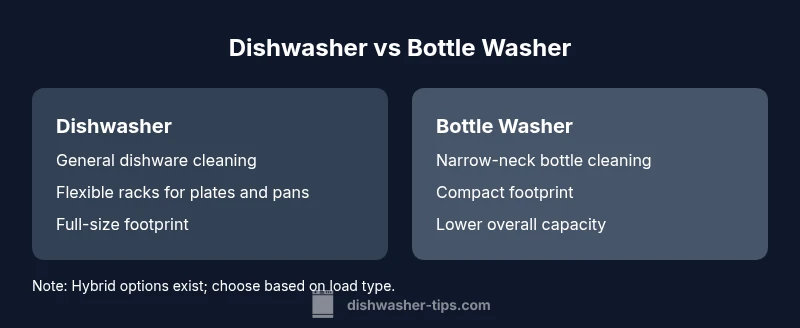
According to Dishwasher Tips, understanding the difference between dishwasher and bottle washer starts with recognizing their intended tasks. The primary difference between dishwasher and bottle washer lies in scale, loading patterns, and cleaning goals. A standard household dishwasher is designed to clean a full load of tableware, glassware, and cookware with a range of cycles from light to heavy; a bottle washer is a dedicated unit or accessory optimized for narrow-neck vessels, baby bottles, valves, and sipper cups. From a practical standpoint, most households find that a dishwasher handles daily meals efficiently, while a bottle washer excels in sterilizing baby bottles and related accessories. The decision should reflect your most common loads, available space, and tolerance for cycle time. If your kitchen frequently mixes large plates with pans, a traditional dishwasher provides throughput; if your cleaning primarily involves bottles, nipples, and small parts, a bottle washer offers targeted performance. Consider plumbing and electrical requirements, ventilation, and how much floor space you can devote. The rest of this guide compares capacity, cycles, maintenance, and cost, so you can choose with confidence.
Design and build: size, layout, and accessibility
Dishwashers generally come in standard full-size footprints with adjustable racks and multi-arm spray systems designed for bulk dishware. Bottle washers, whether standalone units or inserts on a countertop or under-sink setup, prioritize narrow-neck cleaning and compact dimensions. The design difference matters when you consider kitchen layout, cabinet depth, and access to a water line. If space is tight, a compact bottle washer can be installed with minimal cabinet disruption, whereas a full-size dishwasher will demand a dedicated enclosure and a larger water hookup. In terms of accessibility, bottle washers typically offer focused interior configurations that keep bottles easily reachable and upright during cycles, while standard dishwashers emphasize loading variety and tall items like pots. The practical takeaway: choose the form factor that aligns with your primary cleaning targets and kitchen geometry, then verify depth, height, and door clearance before purchase.
Cleaning capabilities and loader styles
A household dishwasher treats a mixed load—plates, bowls, silverware, and cookware—using orbiting spray arms and heated drying to optimize throughput. A bottle washer concentrates on containers with narrow necks, nipples, valves, and sippy cups, often using specialized fixtures that ensure thorough cleaning without disassembly. Loader styles reflect their targets: tall racks and removable bins in dishwashers versus bottle-stirrers or cup organizers in bottle washers. For families with infants or extensive bottle accessories, the bottle washer’s targeted cleaning reduces the risk of residual contaminants. For regular cooks, the dishwasher’s flexible racks accommodate bulky pans and assorted dishware, making it a more versatile option for everyday meals. The key insight is to align the internal fixtures with your typical load profile to maximize cleaning efficiency.
Cycles, temperature controls, and drying approaches
Dishwashers typically provide a broad range of cycles—from light wash for delicate glassware to heavy-duty for pots and pans—paired with adjustable temperature settings and extended heated drying. Bottle washers emphasize shorter, bottle-focused cycles with warm or high-temperature rinses to sanitize small parts. Temperature consistency is crucial in both, but bottle washers prioritize gentler handling on plastic components and sterilization of baby bottles. Drying strategies differ as well: dishwashers rely on heated air and condensate drying, while bottle washers may use rapid drying or manual air-drying for certain parts. When choosing, consider whether your priority is a quick turnaround on bottle cleaning or versatile handling of mixed dish loads.
Placement, water, and electrical requirements
Installing a dishwasher typically requires a dedicated water inlet, a drain hookup, and a power outlet with a dedicated circuit. Bottle washers, depending on configuration, can be plumbed for under-sink use or installed as countertop units with simplified drainage. Electrical considerations matter for both; a dishwasher often needs more amperage and a stable supply, while bottle washers may run on smaller circuits or require adapters for certain setups. In kitchens with limited space, countertop bottle washers offer a low-friction option, whereas a built-in dishwasher provides greater throughput and long-term convenience if space and plumbing permit. Planning ahead reduces the chance of retrofit costs later on.
Efficiency, longevity, and maintenance
From an efficiency standpoint, dishwashers tend to deliver a high-throughput solution for varied dish loads, though energy use scales with cycle selection. Bottle washers concentrate on smaller loads with a focus on hygiene, particularly for infant feeding equipment. Maintenance for both centers on cleaning spray arms, filters, and seals; however, bottle washers may require more frequent cleaning of bottle fixtures and adapters due to the small internal passages that can trap residues. Dishwasher Tips analysis shows that regular filter cleaning and proper detergent use play significant roles in sustained performance for either appliance. The longer-term durability depends on build quality, routine maintenance, and adherence to manufacturer care guidelines.
Cost considerations and total ownership
Initial purchase price and installation costs for dishwashers can be higher, reflecting their capacity and versatility. Bottle washers generally have lower upfront costs but may require ongoing accessory purchases and periodic equipment upgrades to address changing bottle cleaning needs. Total ownership also depends on energy and water use, maintenance frequency, and the cost of detergents and sanitizers. When evaluating cost, consider not just upfront price but expected lifespan, resale value, and potential compatibility with your existing plumbing and electrical setup. A careful comparison helps you avoid overpaying for features you won’t use.
Real-world scenarios: when to choose which
If your household regularly entertains guests, uses a wide variety of dish sizes, and values hands-off cleaning for plates and cookware, a dishwasher usually delivers the best overall value. If your family has infants, relies on numerous bottles and accessories, or operates in a kitchen with limited space, a bottle washer offers targeted hygiene and compact convenience. For households with both heavy dish loads and frequent bottle cleaning, a hybrid approach—using a dishwasher for most loads and a dedicated bottle washer for daily bottle sanitation—can be optimal. Consider your typical daily routine, space constraints, and budget when making a final decision.
Common misconceptions debunked
A common myth is that bottle washers can replace dishwashers entirely. In reality, bottle washers excel at narrow containers but lack full-capacity versatility for bulky dishware. Another misconception is that larger equals better; the right size depends on load type and space, not just capacity. Finally, some buyers assume bottle washers are inherently lower maintenance; while they may require less routine cycle variety, they still need regular cleaning of specialized fixtures to prevent residue buildup. Clarifying these points helps buyers pick appropriately.
Comparison
| Feature | Dishwasher | Bottle Washer |
|---|---|---|
| Primary purpose | General dishware cleaning for households | Specialized cleaning for narrow bottles and infant accessories |
| Typical capacity | Full-size racks for plates, bowls, and cookware | Compact footprint with smaller internal capacity |
| Design emphasis | Versatile racks, multiple spray arms | Narrow-neck spray heads, bottle adapters |
| Loading styles | Standard trays and adjustable racks | Bottle racks or modular inserts for bottles |
| Water usage and cycles | Moderate to high water use across cycles | Lower capacity with targeted cleaning cycles |
| Best for | Households with regular dish loads | Families with infants or frequent bottle needs |
| Cost range | Mid to high upfront cost | Lower upfront cost with limited capacity |
The Good
- Streamlines daily cleaning with hands-off operation
- Provides versatile performance for mixed loads (dishware + cookware)
- Bottle-focused models offer hygiene optimization for infant accessories
- Compact bottle washers fit small kitchens without major renovations
Disadvantages
- Higher upfront cost for full-size dishwashers
- Bottle washers have limited capacity for bulky dishware
- Some households may need both units to cover all loads
- Maintenance can be more involved if fixtures require frequent cleaning
Dishwasher is generally the better all-around choice for most households; a bottle washer is ideal when bottle-focused hygiene and compact space are top priorities.
If your daily loads include a wide variety of dishes, choose a dishwasher for throughput and flexibility. If your priority is frequent bottle cleaning with a smaller footprint, a bottle washer shines. For mixed needs, a hybrid setup may offer the best balance.
People Also Ask
Can a bottle washer replace a dishwasher for a family that cooks daily?
A bottle washer cannot fully replace a dishwasher for most households. Bottle washers are optimized for bottles and small parts, not large dishware or cookware. If you cook daily and have plates and pans, a dishwasher typically provides more comprehensive cleaning coverage.
No, a bottle washer isn’t a complete replacement for a dishwasher for most families.
Are bottle washers more energy-efficient than dishwashers?
Energy efficiency depends on usage patterns and specific models. Bottle washers often use less water per cycle for small loads, but dishwashers offer higher throughput per energy unit when used for full cycles. Look for Energy Star or equivalent ratings and match usage to load size.
It depends on how you use them; full dishwasher cycles can be efficient, but small loads on a bottle washer may save energy per item.
What kind of space do I need for a bottle washer?
Bottle washers range from countertop to compact under-sink or mini freestanding units. They require a water inlet and proper drainage, but they typically need less floor space than a full-size dishwasher. Measure your available cabinet depth and clearance around the unit.
A bottle washer can fit in smaller spaces, including under-sink setups or countertops.
Can I run a bottle washer and a dishwasher at the same time?
Yes, in kitchens with separate circuits and outlets, you can run both appliances simultaneously. Ensure electrical load and water supply can handle concurrent operation and that you comply with local codes.
Yes, with proper wiring and water supply planning, you can run both at once.
What maintenance steps are common to both appliances?
Regularly clean filters, spray arms, and seals. Use the recommended detergents and descalers as advised by the manufacturer. Inspect hoses and connections for leaks and schedule periodic professional servicing if recommended.
Keep filters clean and run routine checks to prevent blockages.
Is a bottle washer a good option for apartment living?
A bottle washer can suit apartment living if you need compact cleaning solutions for bottles and small parts. Look for countertop or slim under-sink models that fit your space and water supply constraints.
Yes, for compact spaces it can be a practical choice.
What to Remember
- Choose a dishwasher for versatility and bulk loads
- Opt for a bottle washer when bottle hygiene and compact space are crucial
- Consider space, plumbing, and power before buying
- Hybrid setups can cover both needs efficiently
- Regular maintenance extends appliance life