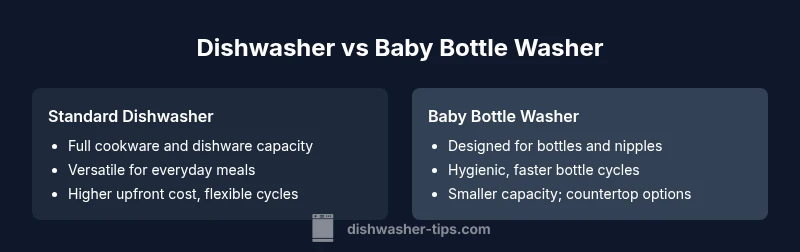
Dishwasher vs Baby Bottle Washer: A Practical Comparison
This analytical comparison weighs dishwasher vs baby bottle washer options for homes, detailing efficiency, capacity, cost, ease of use, and ideal use cases.


When choosing between a standard dishwasher and a dedicated baby bottle washer, consider your household’s routine: everyday dishes and cookware benefit most from a full-size dishwasher, while frequent infant feeding gear requires bottle-specific cleaning. The dishwasher generally offers greater capacity and versatility, whereas a bottle washer emphasizes hygiene and ease of sanitizing small items. For many families, the smart choice is a full-size dishwasher with a secondary bottle-cleaning setup if infant care dominates the schedule.
Overview and Context
The comparison between a standard household dishwasher and a dedicated baby bottle washer is a practical decision for homes that juggle regular meals with infant feeding needs. The dishwasher is designed to handle plates, bowls, silverware, pots, and pans in a single cycle, delivering convenience and efficiency for everyday use. By contrast, a baby bottle washer is specialized for bottles, nipples, rings, and sippy cups, often offering faster, gentler cycles and simple drying options. According to Dishwasher Tips, most households realize greater value from a full-size dishwasher for daily meals, while infant-care routines may justify a bottle washer as a supplementary device. This article expands on capacity, performance, costs, ergonomics, and real-world use so you can judge which option aligns with your family’s rhythms. We’ll also discuss how a hybrid approach can sometimes deliver the best of both worlds. For readers who want a concise takeaway, the quick answer above points to the scenario that fits most families—yet the details below help you tailor a solution to your kitchen and schedule.
As you weigh dishwasher vs baby bottle washer, consider not only the number of daily loads but also the types of items you clean most often. Are you washing large pots and baking sheets in addition to dinnerware, or do infant bottles, breast pump accessories, and pacifiers drive most cycles? Do you prefer fully integrated appliances or compact, countertop options? By basing your choice on real-use patterns rather than labels, you’ll reduce surprises and boost satisfaction over the device’s lifetime. The Dishwasher Tips team emphasizes that the right choice is highly context dependent, and your decision should reflect both routine needs and future expectations. In this guide, we rely on practical criteria such as capacity, hygiene performance, maintenance costs, and space requirements to help you decide more confidently.
wordCount_toBeDeterminedInFinalField":null}],
comparisonTable_RawData_Notes_removed_for_json_block_only_when_required_until_submission
prosCons_RawData_Keep_for_rendering_in_final_page_removed
verdictBox_RawData_Keep_for_rendering_in_final_page_removed
keyTakeaways_RawData_k
faqSection_RawData_placeholders
mainTopicQuery_max3WordNounPhrase_for_Wikidata_lookup_is_placeholder
mainTopicQuery_placeholder_block_ensure_appropriate_value
Comparison
| Feature | Standard Dishwasher | Dedicated Baby Bottle Washer |
|---|---|---|
| Capacity | High—handles full-size dish racks and cookware | Bottle-oriented with compact racks; smaller overall capacity |
| Cleaning Performance | Excellent all-around performance for plates, silverware, and cookware | Optimized for bottles, nipples, and small infant items |
| Energy Efficiency | Varies by model; full loads maximize efficiency | Often efficient for small, dedicated loads but limited for other items |
| Run Time | Typically longer cycles for soils and heavy loads | Short cycles for bottle cleaning; may require pre-rinse |
| Cost Range (upfront) | Mid to high for full-size units | Low to mid for bottle-focused devices |
| Best For | Everyday meals; versatile use across dish categories | Infant feeding gear and bottles; dedicated bottle hygiene |
The Good
- Versatile for everyday meals and cookware
- Easier to find service and replacement parts for standard models
- Higher capacity per cycle for larger households
- Generally better resale value and integration with kitchen layouts
Disadvantages
- Bottle washers excel at bottle hygiene but offer limited capacity for non-bottle items
- Dedicated bottle devices add upfront cost and occupy extra space
- Bottle-only devices may require special racks or adapters for accessories
- If infant-care needs decrease, a bottle washer may become underutilized
Dishwasher wins for overall practicality; bottle washer wins for dedicated bottle hygiene
For most households, a standard dishwasher provides broader utility, better capacity, and greater versatility. A bottle washer is the better choice when infant-care routines dominate, offering focused hygiene and faster bottle cycles. The Dishwasher Tips team recommends assessing your routine to determine whether a hybrid setup is worth the extra space and cost.
People Also Ask
How do dishwasher and bottle washer compare in energy use?
In general, standard dishwashers deliver energy efficiency when fully loaded and used with eco programs. Bottle washers typically consume less energy per cycle but may run more cycles if you’re bottle-heavy. The overall energy impact depends on load patterns and model efficiency.
Energy use varies by model and how you load it. A full dishwasher on eco settings is usually efficient, while bottle washers use less energy per bottle but may run more cycles if you’re bottle-heavy.
Can a bottle washer replace a dishwasher?
A bottle washer cannot fully replace a dishwasher for routine household cleaning because it is designed for bottles and small accessories, not plates, pots, and utensils. If your diet consists mainly of bottled items, you might prioritize one, but for most homes a dishwasher remains essential.
A bottle washer alone usually can’t replace a full dishwasher for everyday meals.
Are bottle washers safe for infant bottles?
Yes, most bottle washers sanitize bottles effectively when used with appropriate cycles and detergents. Always follow manufacturer instructions and ensure nipples and accessories are compatible with the chosen machine.
Bottle washers are built for bottles and sanitizing; just follow the guidelines for safe use.
What items can a bottle washer clean besides bottles?
Most bottle washers clean related accessories like nipples, rings, valves, spoons, and small sippy cups. They’re not typically designed for large items like dishes or pots.
They’re great for baby parts, not so much for big dishes.
How much space do these appliances require?
A standard full-size dishwasher typically requires a 24-inch width, while bottle washers are often countertop or under-sink sized. Measure your available space and check plumbing and electrical access before purchasing.
Know your space and plumbing before choosing.
Do detergents differ between the two devices?
Yes. Dishwashers use dishwasher detergents formulated for larger, tougher soils, while bottle washers use bottle-specific detergents designed to remove milk residues and sanitize without harming nipples or seals.
Different detergents are optimized for each device.
What to Remember
- Assess your infant-care needs before buying
- Choose a dishwasher for daily versatility and space efficiency
- A bottle washer is ideal when bottle hygiene is the priority
- Plan for space and wiring/accessory requirements before purchase