Difference Between Washing Machine and Dishwasher: A Guide
Explore the difference between washing machines and dishwashers, focusing on water use, cycle options, detergents, and practical scenarios to help you decide which appliance fits your home in 2026.


The core difference between washing machines and dishwashers is purpose, cleaning method, and loading. Washing machines clean textiles using agitation and fabric care cycles, while dishwashers sanitize tableware with spray jets and hot water. For most households, choose based on what you frequently clean: clothes vs dishes. Understanding these differences helps prevent buying the wrong appliance.
Understanding the difference between washing machine and dishwasher
The difference between washing machine and dishwasher is defined by purpose, cleaning method, and loading constraints. This article explains how each appliance is designed to tackle different messes and why that matters for your home. According to Dishwasher Tips, kitchens and laundry rooms often share space, so understanding each device's strengths helps homeowners optimize utility, space, and cost. By clarifying use cases for textiles vs tableware, you can set expectations for performance, maintenance, and durability. In the rest of this article, we compare water use, detergents, cycle options, loading patterns, and total cost of ownership, with practical guidance to help you decide which appliance belongs in your home.
Water usage and energy efficiency: the core differentiator
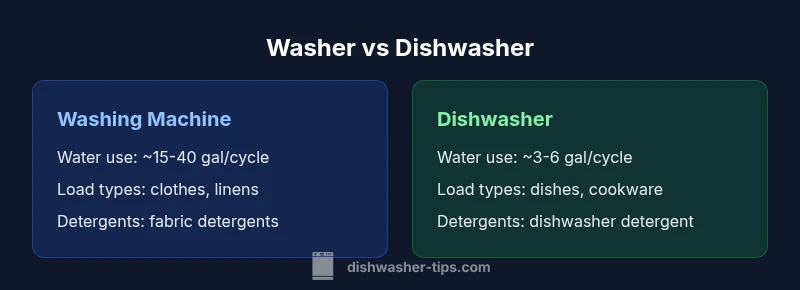
Water use and energy efficiency are among the most consequential differentiators between a washing machine and a dishwasher. Modern high-efficiency washers typically consume around 15-40 gallons per cycle, depending on load size and model, whereas standard dishwashers generally use about 3-6 gallons per cycle. Energy efficiency ratings vary by model and cycle selection, but dishwashers often consolidate cleaning power into fewer cycles with lower water usage. Dishwasher Tips analysis shows that the efficiency gap is most pronounced when comparing typical household loads: clothes versus plates, cups, and cookware. This section analyzes how this affects monthly water and energy bills, along with implications for hot-water supply and utility planning.
Cleaning mechanics: detergents, cycles, and fabric care
Washing machines rely on tumbling actions, drum agitation, and fabric-safe cycles to handle textiles ranging from delicate silks to heavy towels. Detergent choice includes liquid, powder, and pods designed for fabrics, with options like pre-wash, sanitize, and gentle delicate cycles. Dishwashers use spray arms, high-temperature rinses, and dishwasher detergents formulated for grease, starch, and protein residues on hard surfaces. The detergents differ in chemistry and residue potential, so misusing one type in the other machine is not advisable. Proper loading patterns, such as separating heavily soiled dishes and ensuring even water exposure, optimize performance for both machines.
Capacity, loads, and space: how space and items differ
Load configurations reflect fundamental design differences. A washing machine is built for clothing and linens, with drum capacity measured in cubic feet and generally accommodates bulky items like comforters. A dishwasher is designed for a kitchen load: plates, bowls, glasses, and cookware, with racks and tines arranged for vertical and horizontal clearance. Space constraints matter: a compact apartment may require a compact washer or dishwasher, and under-counter placements affect venting, hookups, and drainage. When renovating a kitchen or laundry area, consider future needs (e.g., seasonal hosting, family size) to choose the appropriate capacity and dimensions.
Costs, lifespan, and maintenance demands
Total cost of ownership includes upfront price, installation, and ongoing maintenance. Washing machines often have higher variability in price due to capacities and features (digital cycles, steam options, smart controls). Dishwashers tend to offer strong value for heavily loaded households due to water efficiency and hands-off operation. Maintenance differs: washers require drum care, seal checks, and occasional belt or pump service; dishwashers require spray arm cleaning and filter maintenance. Both benefit from routine descaling in hard-water regions and proper detergent use to prevent mineral buildup.
Practical scenarios: determining which appliance fits your lifestyle
If your primary need is laundry care with delicate fabrics or bulky items like comforters, a washing machine is essential. If you frequently host and generate daily dishware loads, a dishwasher dramatically reduces hands-on time and supports sanitation through high-temperature cycles. For renters with limited space, weigh the trade-offs between stacking options, hookups, and noise. In some cases, households opt for compact, apartment-friendly units or even a combination washer-dryer unit when space is severely constrained.
Environmental considerations and sustainability
From an environmental perspective, both appliances can be highly efficient when used properly. Energy Star-rated models and load optimization reduce waste and emissions. Dishwashers generally excel in water efficiency for standard loads, while washers offer fabric care metrics that minimize wear and extend the life of clothing. If you live in a region with water scarcity or you are energy-conscious, compare the energy per cycle and the maintenance needs tied to your local water hardness. Dishwasher Tips guidance emphasizes modeling your purchase around real-world usage and long-term costs.
Decision framework: a quick method to decide
A simple framework helps you decide: list your primary cleaning tasks (clothes vs dishes), estimate weekly loads for each task, assess space and hookups, compare water and energy figures from model specs, and finally factor in maintenance and lifespan. If you clean more clothing than dishes, pick a washing machine; if you clean more dishes, pick a dishwasher. Remember to check for size constraints, noise levels, and warranty terms when selecting models.
Common misconceptions debunked
Many people assume you can substitute one appliance for the other to save space. In reality, their core functions and cleaning mechanisms are not interchangeable. Some buyers worry that dishwashers can’t sanitize, but many modern models reach high temperatures that sanitize effectively; washers, on the other hand, are optimized for fabric care rather than surface cleaning. Always verify load compatibility, detergent type, and cycle options before purchase.
Authority sources and further reading
For more authoritative information on appliance efficiency and best practices, consider reputable sources such as government energy and environmental agencies, and peer-reviewed publications (see the sources section below). This section provides additional context and practical tips to help you make an informed choice.
How to maintain and optimize performance year-round
Regular maintenance is critical to sustain performance. Clean lint filters and pump housings in washers, and descaling and filter cleaning in dishwashers help maintain efficiency. Use the recommended detergents and avoid overloading to prevent strain on motors and spray arms. Finally, update controls and firmware when available to improve energy management and cycle accuracy.
Comparison
| Feature | Washing Machine | Dishwasher |
|---|---|---|
| Water usage per cycle | ~15-40 gal | ~3-6 gal |
| Energy efficiency emphasis | Model-dependent; broader variation | Typically high efficiency for standard loads |
| Detergent/Soap requirements | Fabric detergents; additives for stains | Dishwasher detergent; no fabric care |
| Load types supported | Clothes, linens, bulky items | Dishes, cookware, utensils |
| Typical cycle duration | 20-90 minutes | 60-120 minutes (standard) |
| Built-in water heating | May heat water or rely on hot water supply | Most models have built-in heaters or rely on hot water |
The Good
- Flexibility for fabric care and bulky items
- Hands-off cleaning for dishes
- Potentially lower maintenance in some models
- Wide range of cycle options for textiles and linens
- Space-efficient designs can fit compact homes
Disadvantages
- Higher water usage per cycle for many washers
- Dishwashers require proper loading and pre-rinsing for best results
- Dishwashers depend on plumbing and drainage; leaks can occur
- Washers have moving parts that may wear over time
Washer and dishwasher each excel in their own domain; choose based on primary cleaning tasks and space
If clothes are the main cleaning task, a washing machine is essential; if you frequently clean dishes, a dishwasher offers significant time savings and water efficiency. In many homes, both appliances complement each other for optimal convenience.
People Also Ask
What is the main difference between a washing machine and a dishwasher?
The primary difference is purpose: washing machines clean textiles, while dishwashers clean dishes and cookware. They use different detergents, cycle patterns, and loading configurations, so your decision should reflect what you clean most.
Washing machines wash clothes; dishwashers clean dishes. Pick based on your main cleaning task.
Can a dishwasher wash clothes?
No. Dishwashers are designed for dishware and cookware, not textiles. Using a dishwasher for clothes can cause fabric damage and void warranties.
Dishwashers aren’t for clothes; use a washer for laundry.
Do dishwashers use less water than washing machines?
Generally, dishwashers use less water per cycle than many washing machines, especially older models. Modern washers with high efficiency improve water use, so compare per-cycle figures.
Dishwashers usually use less water per cycle than washers, especially older models.
Which is more energy efficient overall?
Both can be highly efficient depending on model and cycle choices. Dishwashers often achieve strong efficiency on standard cycles, while washers vary more by capacity and settings.
Energy efficiency depends on the model; check energy ratings and cycle selection.
What should I consider for a small apartment?
In small spaces, choose compact models with proper hookups and drainage. If space is extremely constrained, a combination washer-dryer or a compact dishwasher may be worth considering.
Measure space and hookups; pick compact models if you’re in a small apartment.
Is maintenance different between the two?
Yes. Washers require drum care and seals; dishwashers need spray arms and filter cleaning. Regular descaling is important in hard water areas for both.
Maintenance differs: wash your drum and seals for washers; clean dishwasher filters and spray arms.
What to Remember
- Prioritize your primary cleaning tasks (clothes vs dishes)
- Compare water and energy use per cycle for realistic budgeting
- Check space, hookups, and noise before buying
- Consider long-term costs, maintenance, and warranty terms
- Use a reputable guide to align with your needs and space constraints