Are Dishwashers Hard on Electricity? A Practical Guide to Energy Use
Explore how dishwashers consume electricity, what affects energy use, and practical steps to lower consumption without compromising cleanliness. Data-driven guidance from Dishwasher Tips to help homeowners and renters optimize energy.


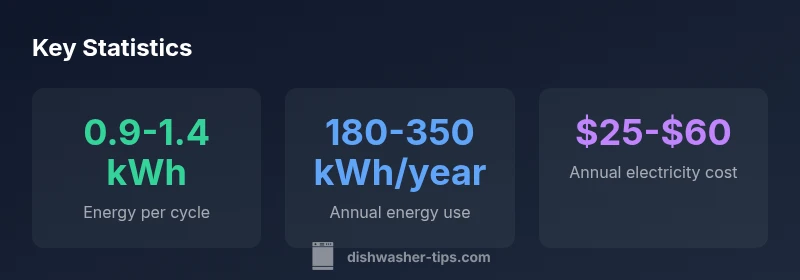
A modern dishwasher typically uses 0.9-1.4 kWh per cycle, translating to about 180-350 kWh per year for a typical household. This range depends on model efficiency, cycle selection, and how often you run cycles. Smarter cycles and ENERGY STAR-rated models can lower electricity draw without sacrificing cleanliness.
Are dishwashers hard on electricity? A quick assessment
Are dishwashers hard on electricity? The short answer is: not inherently, but the total energy impact depends on model efficiency, cycle choice, and how you use it. According to Dishwasher Tips, modern dishwashers are designed to optimize energy use, yet real-world consumption can swing based on load size and heating requirements. Understanding these factors helps homeowners estimate their yearly footprint more accurately.
Baseline consumption is the constant energy draw when the unit is idle or warming water. In energy-efficient models, standby power is typically low, and most significant energy use happens during the wash and dry phases. The days of assuming a dishwasher always guzzles power are behind us; however, the electricity you draw during each cycle remains a useful metric for comparison. The best way to compare models is to look at energy per cycle alongside estimated annual kilowatt-hours (kWh). Lab tests and independent assessments provide a benchmark, but your actual numbers hinge on how often you run cycles, the cycle type selected, and your home's electricity price.
In practice, the key questions are: How often do you run cycles? Do you run full loads or partial ones? Are you selecting eco modes or standard cycles? Answering these questions with a quick calculation gives you a usable estimate of energy use. This approach makes it easier to decide whether a given dishwasher will be kind to your electricity bill over its lifetime.
How cycles affect energy consumption
Cycle choice has a meaningful impact on electricity use. Heavier cycles (heavy, pots-and-pans, or intensive) typically rely more on heating and longer run times, increasing energy draw per cycle. Eco or energy-saving cycles usually reduce power consumption by optimizing water temperature and pump cycles, even if they take longer to complete. Quick or express cycles can save energy per cycle in some models, but the shorter duration does not automatically mean lower energy; in some cases, the supply of hot water remains similar, and heating may still occur. When evaluating cycles, compare energy per cycle and the corresponding run time to gauge overall efficiency. For households aiming to cut energy without sacrificing cleaning, prioritize eco modes and longer but efficient wash cycles that finish with a dry phase using ambient or efficient drying.
Efficiency ratings and standards you should know
Look for ENERGY STAR certified dishwashers as a baseline for efficiency. ENERGY STAR models meet specific criteria for energy and water use, which tends to translate into lower annual kWh consumption. Labels also help you compare idle power, heat recovery, and drying technologies across brands. Beyond labels, check the manufacturer's stated energy per cycle and estimated annual energy consumption, and consider real-world usage patterns—like average loads per week—to gauge likely electricity costs. Regular maintenance, such as cleaning filters and spray arms, keeps energy use predictable and helps sustain performance.
The interaction of load size, water usage, and energy
Electricity use is not the only driver; water heating accounts for a substantial portion of energy in many cycles. Full loads maximize energy efficiency per dish, as the machine applies heat to a larger volume of water once. Partial loads force the machine to cycle more often, increasing baseline energy draw per dish. Efficient models minimize hot-water heating by better insulating tubs and using advanced heating elements only when necessary. Practically, combining full loads with efficient cycles yields the best balance between cleaning performance and electricity use.
Real-world usage patterns and energy footprints
Real-world energy footprints vary with household size, dishwashing habits, and local electricity rates. A family of four running a typical cycle a few times per week may consume more energy overall than a single occupant doing a few full loads per week. Conversely, tech-forward households that frequently use eco modes and avoid pre-rinsing can reduce energy consumption by significant margins over a year. The key is to track actual cycles and compare them to the model’s claimed energy metrics rather than relying on ad hoc estimates.
Practical tips to reduce electricity usage without sacrificing cleaning
- Load fully: Maximize capacity to spread fixed energy costs across more dishes.
- Use eco/energy-saving cycles when appropriate and avoid high-heat dry settings every time.
- Don’t pre-rinse dishes unless necessary; modern detergents and sprayers handle residue effectively.
- Maintain the dishwasher: clean filters, spray arms, and seals to ensure efficient water flow and thorough cleaning with less energy.
- Consider external cold-water supply where allowed; some models use less energy when heated water comes in cooler, depending on the design.
- Schedule cycles during off-peak hours when electricity is cheaper and more abundant on the grid.
- Keep the door gasket and latch in good condition to avoid heat loss during cycles.
Reading labels and comparing models for energy efficiency
When comparing models, focus on energy per cycle and annual energy consumption rather than sticker price alone. Look for the energy factor (EF) or kWh per cycle and the estimated annual energy use on the spec sheet. The model's water-heating strategy, insulation quality, and drying method (condensing vs. fan-assisted) also influence total energy consumption. Read independent test reports and user reviews to corroborate manufacturer claims and identify models with consistently good performance.
Estimating your own energy footprint: quick scenarios
To estimate your household energy footprint, multiply your average cycles per week by the energy per cycle, then scale to yearly usage. For example, if you run four full cycles per week at 1.2 kWh per cycle, you’re looking at roughly 249 kWh/year (4 cycles x 1.2 kWh x 52 weeks). If you frequently run longer eco-cycles or use heated-dry features, adjust the estimate upward accordingly. Keep a simple log for a month to refine your numbers and compare against ENERGY STAR estimates.
Energy usage snapshot for common dishwasher scenarios
| Aspect | Typical range | Notes |
|---|---|---|
| Energy per cycle | 0.9-1.4 kWh | Modern ENERGY STAR models |
| Annual energy use | 180-350 kWh/year | Depends on cycles per week |
| Annual electricity cost | $25-$60/year | Based on local rates and usage |
People Also Ask
Do all dishwashers use the same amount of energy?
No. Energy use varies by model, cycle type, load size, and how often you run cycles. Higher efficiency models and eco modes can substantially reduce consumption.
Energy use varies by model and cycle; pick efficient models and eco modes to reduce consumption.
Is it worth paying more for an ENERGY STAR dishwasher?
In most cases, ENERGY STAR models deliver lower annual energy use, which can offset the higher upfront price over several years.
ENERGY STAR models usually save energy over time and can pay off with lower bills.
Can I use hot water settings to save energy?
Many dishwashers heat water internally, so supplying hot water may not reduce energy use and can sometimes shorten cycle life. Check your model's guidance.
Check your machine's guidance; hot water supply doesn't always cut energy use.
How does load size affect energy usage?
Full loads maximize energy efficiency per dish. Partial loads waste energy on startup and reheating water for fewer dishes.
Full loads are more energy-efficient per dish.
Do express or quick cycles save energy?
Often yes, but it depends on the model. Some quick cycles heat water aggressively, offsetting the shorter duration. Compare energy per cycle.
Quick cycles can save energy, but check energy per cycle for your model.
How often should I service to keep energy efficiency?
Regular cleaning of filters, spray arms, and seals helps maintain optimal water flow and cleaning efficiency, which supports lower energy use.
Keep filters clean to maintain efficiency.
“Energy efficiency in dishwashing is achieved through a combination of an efficient machine, smart cycle choices, and proper loading. Even small changes can yield meaningful savings over a dishwasher's lifetime.”
What to Remember
- Run full loads to maximize energy efficiency.
- Choose eco modes and avoid unnecessary heating.
- ENERGY STAR models typically use less electricity.
- Regular maintenance helps sustain efficiency.