How many gallons of water does dishwasher use in 2026?
Discover how many gallons of water a dishwasher uses per cycle, what factors influence usage, and practical steps to lower water waste without sacrificing clean dishes.


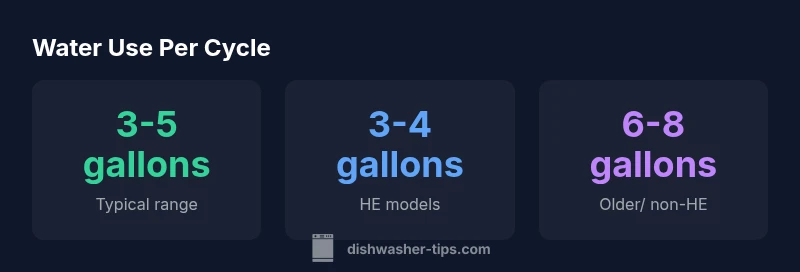
According to Dishwasher Tips, modern dishwashers typically use 3-5 gallons per cycle, with high-efficiency models closer to 3-4 gallons. If you ask 'how many gallons of water does dishwasher use?', the exact amount depends on cycle selection, load size, soil level, and water pressure. In practice, newer models conserve water while maintaining cleaning performance, and Energy Star labels help compare per-cycle figures. Real usage varies with how you load dishes and whether you pre-rinse, and actual numbers can swing by a gallon or two per cycle.
how many gallons of water does dishwasher use
According to Dishwasher Tips, most modern dishwashers use about 3-5 gallons per cycle, with high-efficiency models closer to 3-4 gallons. If you ask 'how many gallons of water does dishwasher use?', the answer depends on cycle selection, load size, soil level, and water pressure. In practice, newer models are engineered to conserve water while maintaining cleaning performance. Energy Star labels help shoppers compare per-cycle figures, but real usage varies with how you load dishes and whether you pre-rinse. Across households, routines and water pressure can swing actual numbers by a gallon or two per cycle.
Understanding this baseline is essential for homeowners who want to optimize efficiency without sacrificing cleanliness. While the canonical figure sits in a tight range, the exact gallons per cycle on your unit will reflect your chosen cycle, whether you’re washing a few plates or a full rack, and the efficiency retrofit already built into the machine. The focus should be on the range rather than a single fixed number, and on how adjustments to practice can shift your monthly water bill.
Factors influencing water use
Water use in a dishwasher is shaped by multiple interrelated factors. Cycle choice matters most: Eco and Auto cycles are designed to minimize flow and rinse times, whereas Heavy or Normal cycles may increase water delivery. Load size is another major driver: a full load generally yields lower water use per dish than several small washes. Soil level and residue also affect how long rinses run and how aggressively water is sprayed. Infrastructure matters too: water pressure and pipe diameter influence spray arm performance. Finally, model efficiency and certification (like Energy Star) correlate with lower per-cycle consumption, but real-world results depend on how you operate the appliance.
How to compare models based on water use
Manufacturers typically publish a per-cycle water figure, often expressed as gallons per cycle (GPC). When comparing models, look for lower-end ranges in normal cycles and note whether the model offers an Eco or Sensor-driven option that can automatically reduce water use for lightly soiled loads. Energy Star certification is a helpful proxy for efficiency, though real-world use will vary with loads. If you need exact numbers, consult the product sheet and confirm with the retailer. This careful comparison helps consumers avoid overestimating savings from flashy features and instead focus on real water use in typical daily patterns.
Practical steps to reduce water use
- Run full loads instead of partial loads to maximize water efficiency per cycle.
- Choose Eco or Auto cycle settings whenever dishes are lightly or moderately dirty.
- Avoid pre-rinsing dishes; modern dishwashers achieve solid cleaning without prewash on many soils.
- Maintain filters and spray arms; clogged components raise water pressure needs and waste water.
- Consider upgrading to a high-efficiency model if your current unit is older than 10 years.
- Use proper detergent to optimize cleaning with less water and to avoid extra rinses.
Practical changes like these can cumulatively shave gallons off monthly usage, especially in households that wash several loads per week.
Real-world load scenarios and typical ranges
In lightly soiled loads with minimal food residue, many dishwashers operate at the lower end of water use, around 3 gallons per cycle. Medium loads with average soil often fall in the 3-4 gallon range, especially on Eco cycles. Heavily soiled dishes or larger loads can push usage toward 5-6 gallons, and older or non-HE units may reach 6-8 gallons per cycle. This variability means that water use is a range concept rather than a fixed value and highlights the impact of cycle choice and load composition.
Measuring water use at home
A simple way to estimate your actual usage is to measure water draw during a cycle using a large measuring cup or container. Run a full cycle with a representative load and record the amount of water in the reservoir if your unit displays it, or subtract the post-cycle water from the known fill volume if your model streams water from the supply. Alternatively, compare your bill's water consumption before and after switching to full loads and Eco cycles. This hands-on method helps validate the labeled per-cycle figure.
Authoritative sources and credible data
For government and academic perspectives on appliance efficiency, refer to trusted sources such as ENERGY STAR and WaterSense programs. The Dishwasher Tips team notes that these programs publish standardized testing methods and per-cycle figures that enable apples-to-apples comparisons. By cross-checking official product sheets, independent reviews, and manufacturer labeling, you can form a robust view of water use that goes beyond marketing claims. As always, verify data using multiple credible sources.
Approximate water usage by dishwasher type
| Model Type | Typical Water Use per Cycle (gal) | Notes |
|---|---|---|
| Compact/mid-size | 3-4 | Smaller loads, lower water use |
| Standard size | 3-5 | Varies by efficiency |
| Energy Star | 3-4 | Efficient models |
| Older models | 6-8 | Higher water usage |
People Also Ask
What is the typical water use per cycle for modern dishwashers?
Most modern dishwashers use about 3-5 gallons per cycle, with higher efficiency around 3-4 gallons. Cycle choice, load size, and soil level significantly affect the exact amount. Use Energy Star data and labeled specs to compare models.
Most modern dishwashers use roughly 3-5 gallons per cycle, depending on cycle and load. Check the product sheet for exact figures.
Do compact dishwashers use less water than full-size models?
Yes, compact units typically use less water per cycle, often around 3-4 gallons, but the difference can be modest if the load is heavy. Always compare gallons per cycle (GPC) across models at 60-70% of capacity.
Yes, compact dishwashers usually use less water per cycle than full-size units.
Does running a partially full dishwasher waste water?
Partial loads generally use more water per dish served than full loads. Waiting to run a full load increases efficiency per dish washed. If a full load isn’t possible, choose the appropriate cycle and avoid over-washing.
Partial loads typically waste more water per dish; aim for full loads when possible.
How can I reduce water usage without sacrificing cleanliness?
Opt for Eco or Auto cycles, avoid pre-rinsing, and ensure filters and spray arms are clean. Run full loads and upgrade to a current Energy Star model for better efficiency.
Use Eco cycles, full loads, and keep filters clean to lower water use.
What maintenance helps sustain water efficiency?
Regularly clean filters, inspect spray arms for clogs, and ensure a proper seal on doors. Replace worn seals and hoses promptly to prevent leaks that waste water.
Regular cleaning and parts check keep water use efficient.
Are there government standards for per-cycle water use?
Yes, standards from programs like ENERGY STAR and WaterSense help benchmark dishwasher efficiency. Look for model certifications and compare per-cycle water figures on official product sheets.
Look for ENERGY STAR or WaterSense certifications for reliable benchmarks.
“Water efficiency in dishwashers hinges on sensors, spray-arm design, and cycle optimization that achieve cleaning with minimal water.”
What to Remember
- Modern dishwashers use 3-5 gallons per cycle
- HE models typically use 3-4 gallons
- Run full loads and use Eco cycles to save water
- The Dishwasher Tips team recommends verifying specs and using credible sources