How Many Ounces Does a Dishwasher Use? A Practical Guide
Discover how many ounces of water a typical dishwasher uses per cycle, what factors drive the range, and how to compare models for efficiency, cost, and environmental impact.


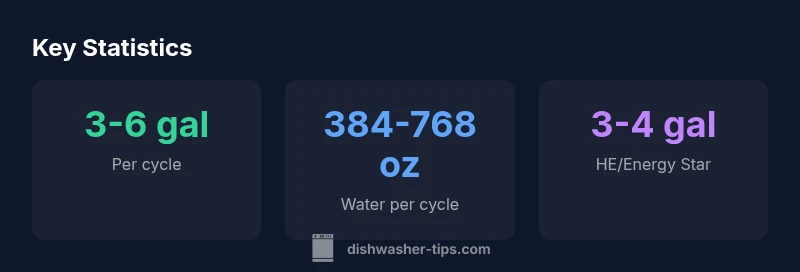
According to Dishwasher Tips, a typical residential dishwasher uses about 3-6 gallons of water per cycle, which is roughly 384-768 ounces. Efficiency varies by model and cycle type; Energy Star machines usually run on 3-4 gallons, while older non-HE units can exceed 6 gallons. For exact figures, check the Energy Guide label or the manufacturer’s per-cycle spec. Understanding this helps estimate monthly water costs and environmental impact.
Why Understanding Water Use per Cycle Matters
Knowing how many ounces a dishwasher uses per cycle helps homeowners estimate water costs, plan budgets, and reduce environmental impact. The per-cycle water load reflects not only the machine design but also cycle selection, soil level, and load size. According to the Dishwasher Tips team, most residential units use a few gallons per cycle, translating to a few hundred ounces. The difference between 3 gallons and 6 gallons can add up across multiple weekly cycles. By comparing per-cycle specs across models, you can choose a unit that fits your household usage while still delivering clean dishes.
How a Dishwasher Uses Water: The Basics
A dishwasher fills with water, jets are sprayed to lift and rinse soil, and a pump drains and sprays again during a rinse. Water usage is influenced by valve design, spray pattern, and the duration of the fill and rinse cycles. The electronics inside modern dishwashers optimize spray angles, temperatures, and dwell times to maximize cleaning while minimizing waste. As a result, even two otherwise similar machines can differ noticeably in water consumption depending on chosen programs.
Variability Across Models: HE vs Standard vs Compact
High-efficiency (HE) and Energy Star models are designed to minimize water per cycle. In typical HE cycles, you may see 3-4 gallons per cycle, whereas standard or older non-HE models can push toward 5-6 gallons or more. Compact or countertop models often use less water but may require smaller loads to achieve similar cleanliness. When shopping, compare per-cycle water figures alongside cycle duration and soil options to understand overall efficiency.
Reading Per-Cycle Water Figures: Labels and Specs
Look for per-cycle water consumption on the Energy Guide label or the manufacturer specification sheet. The label may list a range or a specific value per cycle, often expressed in gallons per cycle. If a model lists multiple cycles, note the water use for the cycle you actually plan to run most (e.g., normal or eco). This figure should be paired with energy use to gauge overall efficiency.
The Role of Soil Level, Detergent, and Rinse Settings
Soil load and residue influence water demand. Heavily soiled dishes may trigger longer wash cycles with more water, while eco settings reduce both water and energy use. Concentrated detergents can help reduce rinse water needs by breaking up soils more effectively in the wash phase. Soft water or hard water can also impact how much water is needed to achieve a spotless load.
How to Estimate Your Household's Monthly Water Impact
If you run four cycles per week at 4 gallons each, you are using about 16 gallons per week, or roughly 64 gallons per month, which equals about 8,192 ounces. If you run heavier cycles or more loads, the monthly total will rise accordingly. Use the per-cycle figure from your model, multiply by your typical weekly load, and scale by weeks in a month to estimate costs.
Practical Tips to Reduce Water Use
- Choose eco or light soil cycles when dishes are lightly soiled.
- Run full loads instead of partial loads to maximize efficiency per cycle.
- Do not pre-rinse unless absolutely needed; pre-rinsing can add water use.
- Use high-quality detergent that improves soil removal and reduces rinse needs.
- Consider upgrading to a modern HE model if your current unit is older; newer designs often use less water.
How to Compare Models for Water Efficiency
When comparing models, focus on per-cycle water use first, then consider energy use and cycle options. Check the Energy Star rating, but also look at real-world performance data from independent testing if available. For households with hard water, some models may require more water to achieve the same cleanliness; in such cases, reviewing spec sheets and user reviews helps.
Common Myths About Dishwasher Water Use
Myth: Pre-rinsing saves water. In many cases, pre-rinsing adds extra water and effort, while modern dishwashers can handle soil without pre-rinsing. Myth: All cycles use the same water. In reality, cycle type and soil level significantly affect water use. Myth: Compact units use less water than full-size models by default. Water use depends on the specific model and cycle selected, not just size.
Estimated per-cycle water use by dishwasher type
| Model Type | Typical Water Use | Approx. Per-Cycle Volume (oz) |
|---|---|---|
| Front-Load | 3-4 gallons | 384-512 |
| Top-Load HE | 3-4 gallons | 384-512 |
| Top-Load Standard | 5-6 gallons | 640-768 |
People Also Ask
Do all dishwashers use the same amount of water?
No. Water use varies by model, cycle type, and soil level. ENERGY STAR models tend to use less water, but always check per-cycle specs for the exact figure.
No. It varies by model and cycle. ENERGY STAR models usually use less water, but check the exact cycle specs to be sure.
How can I reduce water usage without sacrificing cleaning?
Choose eco or light soil cycles, run full loads, and avoid pre-rinsing unless necessary. Use a high-quality detergent that reduces rinse requirements, and consider upgrading to a newer, more efficient model.
Pick eco cycles, fill the dishwasher, skip pre-rinsing when possible, and use a good detergent. Think about upgrading to a newer model for better efficiency.
What does the Energy Guide label tell me about water use?
The label lists per-cycle water consumption and energy use, helping you compare models. Use this alongside cycle options to estimate annual water costs.
The Energy Guide shows per-cycle water use, so you can compare models and estimate your annual water costs.
Does cycle type affect water usage?
Yes. Heavier soil cycles typically use more water than Eco or quick cycles. Always check the spec for the cycle you intend to use most.
Absolutely. Heavy cycles use more water than eco or quick cycles. Check the cycle specs for your most-used setting.
Are compact dishwashers more water-efficient than full-size ones?
Not automatically. Some compact models are efficient, but water use depends on the specific model and cycle. Compare per-cycle figures rather than size alone.
Size alone doesn't determine efficiency. Look at the per-cycle water use for each model you’re considering.
Should I pre-rinse dishes before loading?
In most cases, pre-rinsing is unnecessary and wastes water. Modern dishwashers handle soils well when dishes are scraped and loaded properly.
Usually not necessary to pre-rinse. Scrape and load properly to let the machine do the work.
“Water usage is strongly influenced by cycle selection and design, but most modern dishwashers strive to minimize per-cycle consumption without compromising cleaning quality.”
What to Remember
- Typical cycles use 3-6 gallons (384-768 oz) of water.
- Energy Star HE models are usually at the lower end of the range.
- Per-cycle figures come from labeled specs; check your model for accuracy.
- Eco settings can significantly reduce water usage.
- Read the Energy Guide label to compare across models.