How Much Water Does a Dishwasher Use? A Practical Guide to Water Consumption
Explore typical water usage per cycle, how to estimate consumption for your model, and practical tips to cut water use without sacrificing cleanliness.


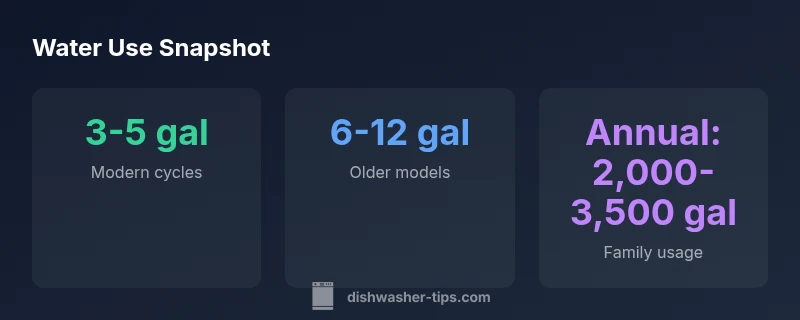
Most modern dishwashers use about 3 to 5 gallons of water per cycle, with energy-efficient models closer to 3–4 gallons. Older or non‑ENERGY STAR units can use between 6 and 12 gallons per cycle. Your exact usage depends on cycle choice, load size, soil level, and how full the rack is. Insert a conservative estimate of 3–5 gallons per cycle for planning and compare against your model’s label.
What affects a dishwasher's water usage
Water consumption is not a fixed constant for every cycle. It depends on several interacting factors, including the cycle you choose, the load size, soil level on dishes, and how well you load the rack. The Dishwasher Tips team notes that newer, ENERGY STAR-certified models are designed to conserve water without sacrificing cleaning power, but the exact amount per cycle can still vary. According to Dishwasher Tips, most modern dishwashers operate in a practical range around 3 to 5 gallons per cycle, with your precise number depending on cycle selection and how full the washer is. Heavily soiled pots or heavily stained pans may require longer runtimes or additional rinse phases, which can increase water use, while eco or quick cycles typically use less water but may require more total cycles to achieve the same cleanliness. Additionally, water usage can be influenced by water pressure, the efficiency of the spray arms, and the design of the wash chamber. Understanding these variables helps homeowners estimate consumption more accurately and explore ways to reduce it without compromising hygiene.
We should also mention that WaterSense and Energy Star standards influence typical ranges; these programs encourage near-constant improvements in efficiency. The Dishwasher Tips analysis for 2026 indicates gradual progress toward lower wash-water per cycle across mainstream models. In practice, the best approach is to pick a cycle that matches the soil level and load and avoid prerinsing excessively, which can add to water use. By aligning cycle choice with load, you gain meaningful water savings over time.
Typical ranges by model and cycle
The water use ranges vary by model type and cycle. In general, modern ENERGY STAR units cluster around 3-4 gallons per cycle on normal or eco cycles, while more robust settings or heavier soil loads can edge toward 5 gallons. Older or non-efficient dishwashers can consume 6-12 gallons per cycle depending on cycle and soil. Compact or portable models might skew lower but are still influenced by the same principles. When evaluating a dishwasher, examine the Energy Guide label and the WaterSense certification if available. The label will indicate the approximate water usage per cycle or per cycle value. Real-world usage depends on how full you run it, whether you pre-rinse, and how many cycles you run in a day. The Dishwasher Tips analysis shows a steady narrowing of the gap between high-efficiency models and standard models, driven by improved spray-arm design and smarter sensors. To estimate your own usage, map your typical loads and cycles, then compare to the ranges above to determine if you are within a desirable band.
How to estimate water usage for your specific model
To estimate your dishwasher’s water usage, start with the data offered by the manufacturer. Look for a water-per-cycle figure on the Energy Guide label or the user manual. If you can’t locate a precise figure, use a practical measurement approach: note your home’s water meter reading before starting a cycle and again after it finishes; the difference approximates water used for that cycle. Keep in mind cycle type matters—a quick or eco cycle typically uses less water than a heavy or pre-rinse cycle, but may run longer or require multiple cycles. For household planning, create a baseline from a few cycles and then apply a conservative adjustment for soil level and load size. Cooking vessels or utensils with stubborn residue can skew results upward slightly. In practice, most households see meaningful savings when cycles are matched to soil level and loads are kept full, as this minimizes the number of cycles needed per week.
Practical tips to reduce water usage without sacrificing cleanliness
- Run full loads whenever possible; never run a cycle with a half-empty rack just to “get it done.”
- Use eco or energy-saving cycles tuned for normal loads; reserve intensive cycles for heavily soiled items.
- Avoid pre-rinsing dishes before loading; trust the dishwasher’s spray system to do the work, especially with modern models.
- Use the proper amount of detergent and a rinse aid if your water is hard; this can improve cleaning efficiency per cycle.
- Clean filters and spray arms regularly; clogs reduce water distribution efficiency and increase cycle length.
- Check door seals and gaskets for leaks; a small drip can waste water over many cycles.
Measuring and monitoring water use at home
If you want a precise, repeatable measure of your dishwasher’s water use, track multiple cycles with a water meter. Record the meter reading before each cycle and subtract to get the exact gallons used per cycle. This approach works best if your home has a dedicated water meter or sub-meter. For a quick approximation, use manufacturer data as a baseline and validate with a couple of cycles. If you notice a sudden increase in water usage, inspect the dishwasher for leaks, clogged filters, or damaged spray arms. Regular maintenance helps keep water use predictable and minimizes waste.
The bigger picture: environmental and cost implications
Water usage in dishwashers translates directly into utility costs and environmental impact. Even small reductions per cycle compound over the year, translating into tens or hundreds of gallons saved for a typical family. The Dishwasher Tips analysis shows that switching to an energy-efficient model and adopting full-load practices can produce measurable savings on both water and energy bills. Beyond personal savings, reduced water use eases demand on municipal systems and conserves local water resources, aligning with broader sustainability goals advocated by WaterSense and energy programs.
Water use by dishwasher model and cycle type
| Model Type | Water per Cycle | Typical Cycle Options | Notes |
|---|---|---|---|
| Energy Star compact | 3-4 gallons | Eco/Normal | Efficient for small households |
| Energy Star standard | 3-4 gallons | Auto/Normal | Balanced efficiency |
| Older non-efficient | 6-12 gallons | Heavy Soil | Higher water usage |
| High-efficiency modern | 3-4 gallons | Eco, Quick | Best efficiency with full loads |
People Also Ask
How much water does a typical energy-efficient dishwasher use per cycle?
Most energy-efficient dishwashers use roughly 3–4 gallons per cycle, depending on cycle selection and soil level. Always check the Energy Guide label for your specific model.
Most energy-efficient dishwashers use about three to four gallons per cycle; check your model’s label for exact numbers.
Are newer dishwashers always better for water conservation?
In general, newer models improve water efficiency due to updated sensors and spray arm designs. Compare models using the Energy Star and WaterSense labels to confirm exact figures.
Usually, newer models save water, but always verify with the label.
Is it worth running a half-load to save water?
A half-load cycle can waste water because many units are designed to work most efficiently with full racks. If you have a smaller load, use an appropriate eco cycle and ensure the rack is reasonably filled.
A half-load often isn’t the best for water savings; use eco modes with modest loads.
Do special cycles save water?
Eco or short cycles save water per cycle but may require more cycles to finish. For lightly soiled dishes, they usually deliver adequate cleanliness with less water.
Eco cycles often save water, but may run longer.
What should I do if my dishwasher uses too much water?
First, check filters, spray arms, and door seals for clogs or leaks. If the issue persists, compare against the model’s label for deviations and consult a technician if needed.
If you see high water use, inspect filters and spray arms first.
“"Effective water savings come from smart cycle selection and proper loading, not just a lower rating alone."”
What to Remember
- Know your cycle: water use varies by cycle and soil level.
- Modern ENERGY STAR dishwashers typically use 3-4 gallons per cycle.
- Older units can consume substantially more water per cycle.
- Load full cycles to maximize water efficiency over time.
- Regular maintenance helps prevent hidden water waste.