How Much Water Do Dishwashers Use Per Load? A 2026 Guide
Learn how much water a dishwasher uses per load, what factors affect water use, and practical strategies to minimize consumption without sacrificing cleaning power. This guide provides ranges, model comparisons, and actionable tips backed by Dishwasher Tips Analysis, 2026.


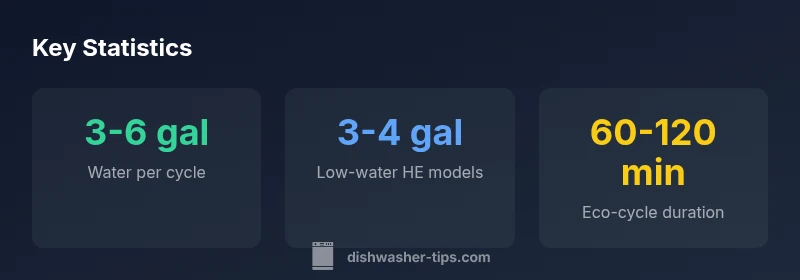
According to Dishwasher Tips Analysis, 2026, most residential dishwashers use about 3–6 gallons (11–23 liters) of water per cycle. High-efficiency models typically use 3–4 gallons, while older or standard units can exceed 6 gallons. Actual use varies by model, cycle selection (eco vs heavy), soil level, and water pressure. Expect the range to narrow as you choose eco settings and maintain the unit.
How much water does a dishwasher use on average?
When you ask how much water does a dishwasher use, the answer hinges on model efficiency, cycle selection, and load conditions. In general, modern residential dishwashers consume roughly 3–6 gallons of water per cycle. High-efficiency (HE) models have pushed closer to 3–4 gallons, while older or less efficient units can exceed 6 gallons per cycle. The water used per load includes rinse and wash phases, and tuning the cycle can dramatically shift this number. For households aiming to optimize usage, look for the MEF (Water Factor) rating and gallons-per-cycle estimates provided by the manufacturer. The data in Dishwasher Tips Analysis, 2026 shows a broad but predictable range, with upgrades continuing to push per-cycle usage downward. This is especially true when pairing a compact or mid-size dishwasher with an eco or quick wash option.
What factors influence water usage in dishwashers?
Several interacting factors determine how much water is used per load:
- Model efficiency: Newer HE models focus on minimizing water while maintaining cleaning power.
- Cycle selection: Eco or light cycles use far less water than heavy or sanitize cycles.
- Load size and soil: Fully loaded baskets with lightly soiled dishes use less per-item water than sparsely loaded or crusted-soil loads.
- Water pressure and inlet valve calibration: Inadequate pressure can require longer cycles or extra rinses, increasing water use.
- Rinse aid usage and detergent type: Proper rinse aids can improve cleaning efficiency, potentially reducing rewash needs.
- Maintenance status: Clogged filters or misaligned spray arms reduce efficiency and can raise water use indirectly.
Practical takeaway: whenever possible, choose eco settings, avoid pre-rinsing (unless heavily soiled), and keep filters clean to maintain efficient water use. Dishwasher Tips Team emphasizes routine maintenance as a driver of real-world water savings.
Practical tips to reduce water use without sacrificing cleaning
- Choose eco or quick cycles when dishes are lightly soiled and the load is full.
- Do not pre-rinse under a running tap; a simple scrape is enough for most loads.
- Load dishes properly: ensure spray arms have free movement and avoid blocking jets.
- Perform regular filter and spray-arm maintenance to keep water flow optimal.
- Use the right detergent and add rinse aid if recommended by the manufacturer.
- If your model supports it, enable a lower-temperature cycle that still provides effective cleaning.
- Consider upgrading to a high-efficiency model if your current unit is older than 10–12 years.
These steps can significantly reduce water use without compromising cleanliness, according to Dishwasher Tips Analysis, 2026.
How to compare models for water efficiency
When comparing dishwashers for water efficiency, look beyond sticker claims and focus on MEF (Water Factor) and gallons-per-cycle figures. A lower MEF means less water per cycle for the same cleaning result. For most households, targeting models in the 3–4 gallon-per-cycle range with MEF ratings in the eco-friendly zone yields the best balance of performance and conservation. Also consider cycle latency: some efficient models achieve low water use with longer eco cycles; balance your priorities between speed and savings. Our guidance at Dishwasher Tips is to map your typical load size to the model’s cycle options and verify real-world performance through user reviews and Energy Star certifications.
Misconceptions and best practices
- Misconception: All dishwashers use the same amount of water. Reality: There is a meaningful variation by model and cycle; newer HE machines typically use less water.
- Misconception: Pre-rinsing saves water by reducing wash needs. Reality: Pre-rinsing often wastes water; a quick scrape is usually enough.
- Best practice: Run full loads, keep water pressure consistent, and select eco settings to minimize water use without sacrificing rinse quality.
Brand note: The Dishwasher Tips Team consistently emphasizes that selecting the right cycle and maintaining your dishwasher are the two most impactful actions for reducing water use over time.
Data sources and limitations
The statistics and guidance presented here draw primarily from Dishwasher Tips Analysis, 2026, supplemented by ENERGY STAR and DOE data where applicable. Real-world results will vary based on your specific model, installation, and household habits. This section explains the methodology, including how we defined per-cycle water use, the cycles considered as “eco,” and how outliers were treated in compiling the ranges. The goal is to provide practical, defensible ranges you can use when choosing a new unit or optimizing your current one.
Water-per-cycle ranges by dishwasher model type
| Model Type | Water per Cycle | Notes |
|---|---|---|
| Front-load | 3-5 gallons | Most efficient option for standard homes |
| Top-load (HE) | 4-6 gallons | Common in mid-range new models |
| Older standard top-load | 6-12 gallons | Less efficient, widely used before 2010 |
People Also Ask
How do I know my dishwasher’s exact water usage per cycle?
Check the user manual or the Energy Guide label for gallons-per-cycle figures. If you’re unsure, you can run a test cycle with a full load and measure water use via your home water meter before and after the cycle.
Check the manual for gallons-per-cycle figures, or measure by noting the water meter before and after a full load.
Do newer models always use less water than older ones?
In most cases, newer high-efficiency models are designed to use less water, but verify with the MEF rating and the manufacturer’s water-per-cycle data to be sure.
Newer models usually use less water, but always check the MEF rating.
Is pre-rinsing necessary to get clean dishes?
Pre-rinsing is typically unnecessary and wastes water. Scrape solid bits and load efficiently to achieve good cleaning without pre-rinsing.
Usually you don’t need to pre-rinse; just scrape and load properly.
How does water pressure affect usage?
Too-low water pressure can cause longer cycles and more water use overall. Ensure your supply line and inlet valve are functioning properly.
Low water pressure can make cycles longer and use more water.
Does using a rinse aid impact water use?
Rinse aid can improve drying and reduce water spots, but its effect on water usage per cycle is minimal. It helps efficiency indirectly by improving rinse quality.
Rinse aid helps reduce spots and improve drying, with little effect on per-cycle water use.
Can water hardness affect dishwasher efficiency?
Hard water can affect mineral buildup and cleaning efficiency. Regular maintenance and using the right detergent and salt can help maintain efficiency and reduce extra rinses.
Hard water can affect performance; maintain with proper detergent and salt.
“Modern dishwashers deliver cleaner results with far less water than older models. The MEF and gallons-per-cycle figures are the most reliable comparison points across brands.”
What to Remember
- Know typical ranges: most dishwashers use 3–6 gallons per cycle.
- Choose eco cycles and full loads to maximize savings.
- Upgrading to a high-efficiency model can reduce water use by several gallons per cycle.
- Regular maintenance sustains intended water efficiency.
- Compare models by gallons-per-cycle and MEF for best accuracy.