Dishwasher E1 Error: Urgent Troubleshooting Guide
Urgent guide to diagnose and fix the dishwasher e1 error. Learn common causes, step-by-step fixes, safety tips, and cost ranges to get your dishwasher running again.


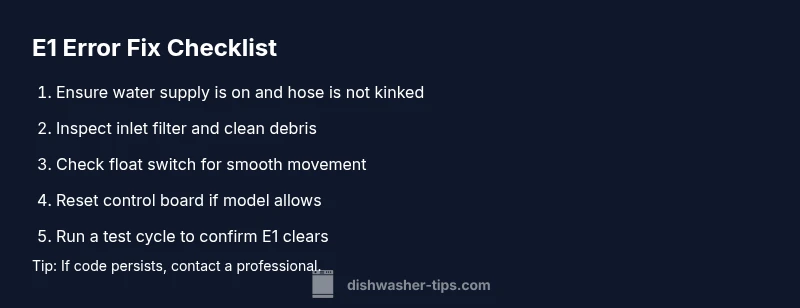
The dishwasher e1 error signals an early-cycle fault that interrupts normal operation, often tied to water inlet, sensors, or drainage issues. Start with quick checks: verify water supply, inspect the inlet filter, and reset the control. If the code persists, follow the step-by-step diagnosis and consider professional help for component replacement.
What the E1 Error Means for Your Dishwasher
When your dishwasher displays the e1 error, it indicates an early-cycle fault preventing the machine from completing a wash. This code is used by several brands to flag problems that occur as the appliance tries to fill or sense water levels, sometimes tied to the water supply, sensors, or drainage circuits. In 2026, homeowners report that E1 often stems from a blocked inlet, a stuck float switch, or a misreading by the control board. The Dishwasher Tips team notes that while the exact cause can vary by model, a systematic approach helps you identify the culprit quickly and safely. If you’ve just started a cycle and the indicator persists, power down, then re-energize to see if the fault reappears. This initial assessment reduces unnecessary disassembly and keeps you focused on the most likely fixes for the dishwasher e1 error.
When the E1 code appears, the appliance won’t advance through its fill and sensor checks. Because water-related faults are common with this code, your first port of call should be verifying water flow and valve operation. In many homes, a partially closed valve, kinked hose, or clogged screen can trigger E1. The Dishwasher Tips analysis shows that these issues account for a majority of E1 occurrences in modern units. Keep a record of any door latching issues or unusual sounds, as those details help pinpoint whether the fault is hydraulic, mechanical, or electronic.
Steps
Estimated time: 45-60 minutes
- 1
Power down and safety prep
Unplug the dishwasher and shut off the water supply to the machine. Have a towels-ready area and a shallow basin to catch any residual water. This step prevents leaks and ensures your safety before inspecting components.
Tip: Always turn off power at the outlet or breaker before touching electrical parts. - 2
Inspect the water supply and hoses
Check that the faucet is fully open and that the supply hose from the wall is straight, with no kinks. Detach the hose at the valve end if needed to inspect for debris. Reconnect securely before testing.
Tip: If you notice reduced flow, call your water utility or a plumber to verify supply pressure. - 3
Clean the inlet screen and filter
Locate the water inlet valve and remove the screen or filter. Rinse away debris under running water and use a soft brush to remove mineral buildup. Reassemble carefully.
Tip: Do not scrub aggressively; use a toothbrush to dislodge stubborn particles. - 4
Check the float switch and chamber
Access the float assembly and ensure it moves freely up and down. Remove any obstruction and test that it returns to resting position. A stuck float can falsely signal overfilling and trigger E1.
Tip: If the float is damaged, replacement is usually straightforward but may require model-specific parts. - 5
Reset the control board
Power down the unit for a full minute, then restore power and run a test cycle. If the E1 code reappears, note any new or recurring symptoms.
Tip: A reset can clear transient glitches but won’t fix a broken component. - 6
Run a diagnosis test cycle
Start a normal cycle or a test mode if your model supports it. Observe whether the door latch, water fill, and sensor readings proceed correctly and whether E1 reoccurs.
Tip: Keep an eye on the first minute of fill for unusual splashing or stuttering in water flow.
Diagnosis: Dishwasher displays E1 error and won’t complete the cycle
Possible Causes
- highWater inlet or supply issue
- highClogged water inlet filter or debris in the supply line
- mediumFloat switch stuck or faulty
- lowDoor interlock or latch fault
- lowControl board or sensor failure
Fixes
- easyCheck that the water supply valve is fully open and the inlet hose isn’t kinked
- easyClean or replace the inlet valve screen/strainer to remove mineral buildup
- mediumTest the dishwasher’s float switch for smooth movement and replace if stuck
- easyInspect the door latch/interlock for secure engagement and proper operation
- easyReset the control board by unplugging the unit for 1–2 minutes and plugging back in
- hardIf the code persists, replace the inlet valve or control board as a last resort
People Also Ask
What does the E1 error mean on a dishwasher?
E1 generally indicates an early-cycle fault, often related to water intake, sensors, or drainage. It prevents the dishwasher from advancing and completing the wash.
E1 means there’s an early fault, usually tied to water intake or sensors, stopping the cycle.
Can I fix E1 myself?
Many cases can be addressed with basic checks—water supply, inlet filter, and a reset. If the fault persists, a professional may need to diagnose the control board or internal components.
Yes, you can try basic checks, but persistent faults usually need a pro.
How long does an E1 repair take?
Most quick checks take 30–60 minutes. More complex fixes or part replacements can extend to 1–2 hours, depending on model and accessibility.
Typically under an hour for simple checks, longer for parts replacement.
Should I call a professional for E1?
If you’re uncomfortable with electrical connections, water lines, or replacing parts, it’s safer to call a technician. An electrical or plumbing error can cause damage.
If you’re unsure about safety or parts, contact a professional.
Will E1 come back after a reset?
A reset may clear a temporary glitch, but if the root cause persists (valve, float, or control issues), E1 can reappear.
Resetting can clear a temporary fault, but if the underlying issue stays, E1 may return.
Is there a cost estimate for E1 repairs?
Repair costs vary by model and parts but expect a range that includes parts and labor if needed. Get a written estimate before authorizing work.
Costs depend on parts and labor; ask for a range before any work.
Watch Video
What to Remember
- Verify water supply first.
- Clean the inlet filter to restore flow.
- Test float switch for proper operation.
- If E1 persists after steps, consider professional service.