F8 E4 Whirlpool Dishwasher Troubleshooting Guide
Urgent guide for F8 and E4 codes on Whirlpool dishwashers. Learn quick fixes, diagnostic steps, common causes, safety tips, and when to call a professional.


F8 and E4 on Whirlpool dishwashers signal faults detected by the control board, often tied to drainage, temperature sensing, or sensor glitches. Because meanings vary by model, begin with a reset, inspect filters and drain hose, and then follow a structured diagnostic flow. If the codes persist, escalate to deeper checks or professional help.
What F8 E4 Codes Mean on Whirlpool Dishwashers
F8 and E4 codes are reported by Whirlpool’s control system to indicate a fault detected during a cycle. The exact meaning can vary by model and firmware, so treat these codes as a prompt to inspect core systems rather than assuming a single root cause. According to Dishwasher Tips, the quickest path to clarity is to reset the unit, re-run a cycle, and methodically test major failure points like drainage and sensors. This approach aligns with practical troubleshooting for homeowners and renters, ensuring you don’t overlook simple fixes before diving into parts replacement.
Quick Checks You Can Do Right Now
Before you dive into deeper diagnostics, perform a quick, safe reset and physical inspection. Unplug the unit for a full minute, then reconnect and restart a short cycle. Check the door latch, rinse aid levels, and water supply valve. Open and inspect the filter and filter housing for debris; rinse thoroughly. Inspect the drain hose for kinks or clogs and ensure it isn’t pinched. If visible blockages are found, clear them and rinse the sump area.
Common Causes Behind F8 and E4 (Without Model-Specific Claims)
Several broad categories can trigger F8 or E4 codes, and they’re not limited to Whirlpool models. Drainage problems are a frequent culprit, including clogged filters, a blocked sump, or a malfunctioning drain pump. Sensor or thermostat faults that monitor water temperature can also trigger these codes, especially if the dishwasher doesn’t reach or maintain the proper heat. Finally, a loose wiring harness or a faulty control board can mimic sensor or drainage issues. Each category has a different repair path, so approach the diagnosis with a process-oriented mindset.
Step-by-Step Fix Plan You Can Follow
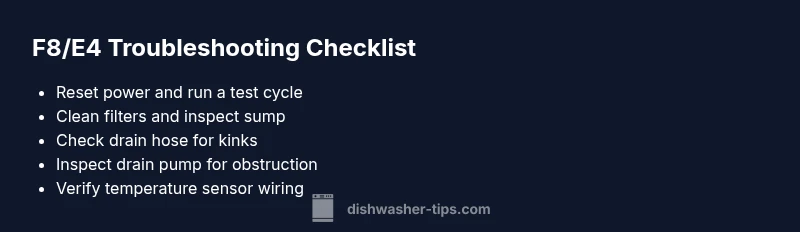
Start with the least invasive fixes and progress to more involved repairs. Clean the filter and check the sump for debris. Inspect the drain hose for kinks and verify the drain pump is running during a cycle. Reset the control board by unplugging for several minutes and re-energizing. If the codes persist, test sensors with a multimeter if you have experience, or move to professional service. Document each step to compare before/after behavior.
Safety and When to Stop
Electrical appliances carry risk, so always unplug the dishwasher before inspecting internal components. If you notice burning smells, melted insulation, or scorch marks, stop immediately and seek professional help. Do not attempt to bypass safety interlocks or run flooded components. For most homeowners, persistent F8 or E4 codes after basic checks warrant a professional evaluation, especially if the unit is under a service contract or extended warranty.
Maintenance to Prevent F8/E4 Recurrence
Create a monthly maintenance routine that includes cleaning the filter and sump, inspecting the drain hose for wear, and confirming the inlet valve functions properly. Use recommended detergents and rinse aids to maintain sensor cleanliness and reduce mineral buildup. Regularly survey the area around the dishwasher for signs of leaks, and address any corrosion or loose connections promptly. A small, proactive schedule reduces the chance of recurring F8/E4 codes.
Cost and Time Estimates for Common Fixes
Basic cleaning and reset typically costs nothing beyond your time. If a drain pump or hose replacement is needed, expect parts plus labor in a broad range (often $200–$500). Replacing a thermostat or temperature sensor might fall in the $150–$350 range for parts plus labor, depending on model and local rates. A control board replacement can be the most expensive option, generally $300–$700. These are rough ranges; actual costs depend on model, availability of parts, and labor rates.
Troubleshooting by Model Variation
Model-specific meanings for F8/E4 exist, so consult your Whirlpool user manual or official support portal for precise definitions by serial number. If your model is newer, firmware updates can modify error code interpretations. When in doubt, use model lookup to confirm the exact fault mapping and recommended resets. Always document the exact code display and cycle stage to share with support.
Steps
Estimated time: 60-90 minutes
- 1
Power cycle the unit
Unplug the dishwasher, wait 60 seconds, plug back in, and run a short test cycle to clear transient faults.
Tip: This is often the fastest way to reset the control board. - 2
Inspect and clean filters
Remove the lower spray arm and pull out the filter assembly. Rinse under warm water until free of debris. Reassemble and run a test cycle.
Tip: Even small food particles can trigger drainage warnings. - 3
Check drainage path
Examine the drain hose for kinks or clogs and ensure it leads to the sink drain or disposal without obstruction.
Tip: Secure clamps and avoid sharp bends that restrict flow. - 4
Test the drain pump
With the unit unplugged, access the pump and verify impeller movement. If you hear grinding or no movement, consider pump replacement.
Tip: Only attempt this if you’re comfortable with basic appliance repair. - 5
Check sensors and wiring
Inspect the temperature sensor and connectors for corrosion or loose pins. Replace or reseat connectors as needed.
Tip: Handle sensors with care to avoid further damage. - 6
Run a controlled test cycle
After reassembly, run a quick cycle with no dishes to observe drainage and heat behavior. Note any reappearance of codes.
Tip: Document cycle stage when codes appear for precise troubleshooting.
Diagnosis: Whirlpool dishwasher shows F8 and E4 codes during a cycle
Possible Causes
- highDrainage blockage or filter clog
- mediumDrain pump failure or hose kinks
- lowThermostat or temperature sensor fault
Fixes
- easyClean the drain filter and inspect the sump for debris
- easyCheck drain hose for kinks and ensure proper routing
- hardTest or replace drain pump if needed
- mediumInspect temperature sensor/thermostat and connector wiring
- easyReset power to the unit and re-run a test cycle
People Also Ask
What do F8 and E4 codes indicate on Whirlpool dishwashers?
F8 and E4 indicate faults detected during a cycle. The exact meaning depends on model, so consult the manual or support portal for precise interpretations. Start with resets and basic checks before delving into parts.
F8 and E4 are fault codes that depend on your model; start with a reset and check filters, then proceed with the diagnostic steps if needed.
Can I fix F8 E4 myself?
Yes, many F8 and E4 issues resolve with basic maintenance: reset, filter cleaning, and drain path inspection. If codes persist after these steps, consider professional service for component testing or replacement.
You can often fix it yourself by resetting and cleaning; if it keeps coming back, get a professional to test sensors or the control board.
How much does it cost to repair F8/E4 issues?
Costs vary by component: cleaning is free or inexpensive, drain pump or hose replacement may be $200–$500, thermostat or sensor replacement around $150–$350, and control board replacement can range $300–$700, excluding labor.
Repair costs vary from a few dollars for cleaning to several hundred dollars for pumps or boards, depending on parts and labor.
Will resetting clear the codes permanently?
Resetting can clear transient faults and reset the cycle, but persistent codes after a reset indicate an ongoing fault that requires inspection of drainage, sensors, or the control board.
A reset may clear transient faults, but if codes come back, you need to troubleshoot the root cause.
When should I call a professional?
Call a pro if codes persist after basic maintenance, if you suspect a faulty control board or sensor, or if you’re uncomfortable working with electrical components.
If codes persist after basic steps or you’re unsure, it’s wise to call a professional.
Do model differences affect F8/E4 meanings?
Yes. Whirlpool models vary in code mappings. Always reference your model number when looking up the exact meaning and fixes for F8 and E4.
Model differences can change what F8 and E4 mean, so check your number before troubleshooting.
Watch Video
What to Remember
- Diagnose F8/E4 with a staged approach
- Start with reset, clean filters, and drain path
- Progress to pump, sensors, or board if needed
- Safety first: unplug and avoid electrical hazards
- Document codes and cycle stages for support calls