Whirlpool Dishwasher F8 E4: Urgent Troubleshooting Guide
Urgent guide to diagnose and fix Whirlpool dishwasher F8 E4 error. Understand meanings, quick fixes, diagnostics, costs, and when to call a professional.


The Whirlpool code F8 E4 signals a dual fault: a heating/temperature issue (F8) and a water level or flow/sensor problem (E4). This means the control board detected abnormal readings during a cycle. Quick fixes include resetting the unit, inspecting the heat element and wiring for damage, and checking the water flow sensor. If the codes persist, professional service is advised.
What F8 E4 Means for Whirlpool Dishwashers
F8 and E4 are fault codes that indicate together a heating/temperature fault and a water-sensing or flow issue in Whirlpool dishwashers. While model variations exist, most diagnostics point to problems in the heating circuit, temperature sensor, water level sensor, or flow path. The Dishwasher Tips team emphasizes that when you see F8 E4, you should treat it as a high-priority fault that can prevent the unit from completing cycles and may indicate underlying electrical or sensor problems. According to Dishwasher Tips, start with safe resets, then verify visible components before proceeding to more invasive checks. This approach reduces risk and helps you decide whether a professional repair is warranted.
How Whirlpool Defines F8 E4 (Model Variances)
Manufacturers occasionally map codes differently across model lines. In many Whirlpool dishwashers, F8 is associated with heating or temperature anomalies, while E4 relates to a water sensing or fill issue. Because the exact meaning can vary by model and firmware version, it’s essential to consult your model-specific manual or Whirlpool’s official support for precise definitions. Use your serial/model number to cross-check the fault with model-relevant documentation. If you cannot confirm a model-specific interpretation, treat the fault as two-pronged: inspect both heating components and water sensing circuitry.
Quick Checks You Can Do Before Calling a Technician
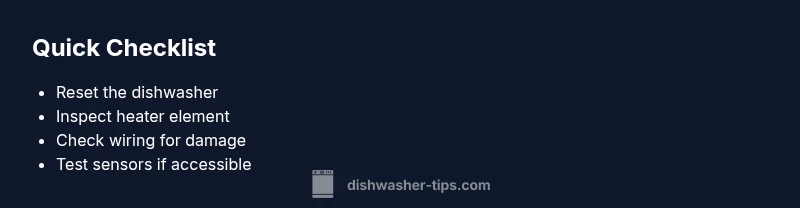
- Power cycle the unit: unplug for 60 seconds or switch the breaker off and on. This resets the control board and may clear transient faults.
- Inspect the drain and water intake: ensure water is filling to the expected level and that hoses are not kinked or blocked.
- Check the heating element area for visible damage or burn marks and examine wire harnesses for loose connections.
- Clean accessible sensors and filters: clogged sensors or filters can misread water levels and temperatures, triggering E4 or F8.
- Review recent loads: extremely large or nonstandard loads can affect sensors; redistribute dishes and rerun a cycle.
In-Depth Diagnostic Flow (Overview)
If your quick checks do not resolve F8 E4, a deeper diagnosis is required. This section explains how to approach the fault methodically, without assuming a specific model configuration. Start with the least invasive tests and progress toward component-level checks. Document your findings to guide a professional if needed. The goal is to confirm whether the fault is in the heating circuit, the water sensor, or the control logic. A careful inspection of wiring harnesses, connectors, and the PCB can reveal loose connections or signs of arcing that warrant replacement. Remember, safety first: disconnect power before opening panels and avoid contact with exposed conductors.
Most Common Causes for F8 E4 (With Likelihood)
- Heating element failure or damaged wiring (high): A compromised heater or its wiring can trigger temperature faults that appear as F8.
- Water level sensor/pressure switch fault (high/medium): If readings are off, the E4 code can appear in tandem with an F8 fault.
- Control board fault or sensor harness damage (low): Firmware or schematic issues can cause misreads but are less common as the primary cause.
Step-by-Step Fix for the Primary Cause (Heating Circuit)
If you suspect the heating element or its wiring, proceed with caution. Do not perform high-voltage tests unless you are qualified. Begin with non-invasive checks and move to component testing where safe.
- Power down and unplug the dishwasher; gain access to the bottom panel to locate the heating element and thermal fuse.
- Visually inspect for scorching, melted insulation, or broken wires; reseat any loose connectors.
- Test the heating element and thermostat with a multimeter for continuity; replace if open-circuit or shorted.
- Clear any mineral buildup around the heater housing; accumulate deposits can insulate and cause erroneous sensor readings.
- Reassemble, plug in, and run a short cycle to see if F8 E4 recurs. If it does, proceed to sensor checks or consult a technician.
Other Causes and How to Verify
- Sensor wiring or harness issues: Inspect connectors for corrosion or loose pins. Reseat and clean as necessary.
- Faulty water level sensor: If water does not reach expected levels, E4 can trigger; verify with model-specific tests.
- Control board problems: Look for burn marks, swollen capacitors, or loose PCB connectors. This often requires professional replacement.
Safety, Costs, and When to Call a Professional
- Safety first: Always unplug the unit and wear eye protection when inspecting electrical components.
- Diagnostic fee ranges: Expect a diagnostic visit to cost within a moderate range, with variations by locality and service provider.
- Repair cost ranges: A simple sensor or heater replacement can fall within a mid-to-high range depending on parts and labor; full control-board replacement can be more expensive.
- When to call a pro: If you are uncomfortable with electrical testing, if the fault recurs after resets, or if you notice burnt smells or visible damage.
Prevention and Maintenance to Avoid Future F8 E4 Codes
- Regularly clean filters, sensors, and spray arms to prevent inaccurate readings.
- Use the right detergent and avoid overloading the dishwasher.
- Schedule routine professional inspections if your model is prone to sensor or heating faults.
- Keep the unit venting properly to prevent overheating.
Quick Tips for a Safer, Faster Resolution
- Always disconnect power before opening interior panels.
- Document error codes and the cycle each occurred in to help technicians diagnose faster.
- Use model-specific manuals to confirm wiring layouts and part numbers before purchasing replacements.
How to Decide the Next Step When F8 E4 Persists
If the codes persist after basic resets and sensor/heater checks, you should escalate to professional service. A licensed technician can perform advanced testing, reflow connectors, test the control board, and verify firmware compatibility with your model. The goal is a precise fault isolation and safe, durable repair.
diagnosticFlowKeyPointsNeededForMaintainenceNoteRemovedForClarityOnlyIfNeeded
estimatedTimeForBodyBlockChangesNotRequired
Steps
Estimated time: 60-90 minutes
- 1
Power down and unplug the unit
Shut off power at the breaker and unplug the dishwasher. This minimizes the risk of electric shock while you access internal components.
Tip: Always confirm there is no power at the outlet before you touch any wiring. - 2
Access heating element and thermistor wiring
Remove the lower access panel or toe-kick to reach the heater assembly and temperature sensor wiring. Inspect for obvious damage and loose connections.
Tip: Take photos of wiring before unplugging connectors to simplify reassembly. - 3
Test heater and sensor continuity
Use a multimeter to check continuity on the heating element and the thermistor/temperature sensor. Replace any component showing open or shorted circuits.
Tip: If you’re unsure how to test, consult the model’s wiring diagram. - 4
Inspect water level sensor and hoses
Check the water inlet valve, fill hoses, and level sensor for kinks, clogs, or leaks. Clean or replace as needed.
Tip: Make sure the tub is filled to the correct level during a test run. - 5
Run a diagnostic cycle
Reconnect power, load dishes, and run a short diagnostic cycle to observe whether F8 E4 recurs. Note any abnormal readings.
Tip: Record the cycle notes to share with a tech if needed. - 6
Decide on next steps
If codes persist, contact a professional for advanced testing or component replacement. Have your model number ready for parts and service.
Tip: Professional help often saves time and reduces the risk of further damage.
Diagnosis: Whirlpool dishwasher displays F8 E4 and stops mid-cycle
Possible Causes
- highHeating element failure or wiring issue
- mediumWater level sensor fault or flow sensor issue
- lowControl board fault or sensor harness damage
Fixes
- easyReset the dishwasher to clear transient faults
- easyInspect heating element and wiring for damage and test continuity
- hardReplace heating element or sensor components as needed; consult a technician for control-board issues
People Also Ask
What does Whirlpool F8 E4 mean on my dishwasher?
F8 E4 usually signals a heater/temperature fault combined with a water-sensing issue. Model-specific meanings vary, so consult your manual or Whirlpool support for precise definitions. If the code recurs, perform the diagnostic steps.
F8 E4 means a heating and water-sensing fault. Start with resets and sensor checks, and if it repeats, get a professional diagnosis.
Can I fix F8 E4 myself?
Basic resets, cleaning sensors, and checking visible wiring can be attempted by confident homeowners. More complex tasks, especially electrical components or the control board, should be handled by a technician.
You can try resets and simple checks, but for wiring or component replacements, call a professional.
What are typical repair costs?
Diagnostics usually incur a moderate fee. Parts and labor vary by model and component; heating or sensor repairs can range from the mid to high hundreds, with board replacements potentially higher.
Diagnostic fees are common, and total repair costs vary based on the part and labor required.
Will this void my warranty?
If the unit is under warranty, contact Whirlpool or an authorized technician. Unauthorized DIY repairs can void coverage, so follow warranty guidelines.
Check your warranty terms; professional service is safer if under warranty.
When should I call a professional?
If resets don’t clear the code, you notice burning smells, or you’re uncomfortable with electrical work, it’s time to schedule a service call.
If the code persists after basic checks, call a professional.
Watch Video
What to Remember
- Power down safely before any inspection
- F8 E4 likely involves heating and water-sensing components
- Start with simple resets before deeper diagnostics
- Call a pro if the fault persists after basic checks