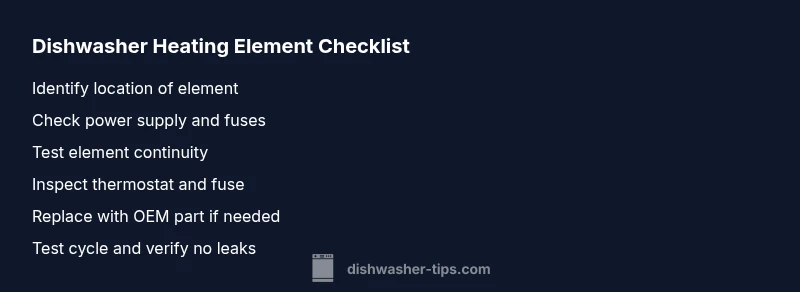
When to Replace Dishwasher Heating Element: Troubleshooting Guide
Learn how to tell when your dishwasher's heating element needs replacement, with a clear diagnostic flow, step-by-step fixes, safety tips, and maintenance to prevent future failures. A practical, human-centered guide from Dishwasher Tips.


If your dishwasher isn’t heating water, the heating element is the most common culprit. Start with simple checks: confirm the circuit breaker is on, inspect the timer/thermostat, and verify wiring at the element terminals. Test continuity with a multimeter; if the element shows an open circuit or short, replace it or have a qualified technician perform the fix.
Common failure modes of the heating element
If you’re asking when to replace dishwasher heating element, the heating element is a simple resistor, but it lives in a harsh environment. Over time, mineral buildup from hard water can insulate the element and reduce heating efficiency. Corrosion at the element terminals or in the tub housing is common, especially in older models. An internal open circuit or short can occur if the element wears down, and a faulty thermostat or high-limit fuse can prevent heat from turning on even if the element is intact. Wiring damage from vibration, improper installation, or exposure to moisture can also interrupt power to the element. Identifying the exact failure mode is important, because a misdiagnosis leads to unnecessary replacement or missed heating issues. According to Dishwasher Tips, start with the simplest checks before you assume the worst: look for visible signs, test continuity, and verify the control signals.
Symptom cues that indicate the heating element needs replacement
Not heating is the most obvious sign, but other symptoms point to the heater as the culprit. If cycles run longer than normal, or you notice water that never reaches hot temperatures, the element may be failing. Error codes related to temperature or a 'not heating' or 'heating element failure' fault are red flags. You might also hear buzzing or a whine during heat-up, or you may notice scorch marks or a burnt odor inside the tub. If you test with a multimeter and see no continuity through the element, replacement is likely necessary. On the other hand, if the element tests fine but the problem persists, the issue could lie with the control board, thermostat, or wiring.
How the heating element works and where it's located
In most dishwashers, the heating element is a compact metal coil located at the bottom of the tub or behind a kickplate panel. When the control board calls for heat, current passes through the element, warming the water for sanitizing cycles. The temperature is regulated by a thermostat and a high-limit fuse to prevent overheating. If the element isn't reaching temperature, it may be because the element isn't receiving power, the thermostat has failed, or there is an open circuit. Understanding its function helps you decide whether you can test safely or need to plan for a replacement.
Safe DIY checks you can perform before replacement
- Power down: unplug the dishwasher and switch off the circuit breaker to minimize shock risk.
- Inspect the power lead and terminal block for loose or corroded connections.
- Check the door latch and control panel for faults that could prevent heat from being commanded.
- Look for obvious signs: burn marks, melted insulation, or kinked wires.
- If your model has a thermal fuse, confirm it hasn’t opened (a multimeter can help).
- If any of these checks indicate a problem beyond visible wiring, stop and consult a pro.
Diagnostic sequence: test and verify
- Step 1: Reset and test basic electronics. Restore power and run a short cycle to observe if heating begins.
- Step 2: Check the thermostat and thermal fuse with a multimeter to verify continuity.
- Step 3: Measure heating element resistance. A healthy element typically shows a continuous path with the specified range for your model; an open circuit means replacement.
- Step 4: Inspect the wiring harness between the control board and element for cracks or loose connectors.
- Step 5: If all tests indicate the element is fine but heat is still absent, the issue likely lies with the control board or sensor and professional service is advised.
Replacement vs professional service: decision guide
- If you are comfortable with appliance electronics, replacing the element yourself can save money; however, wrong installation can cause leaks or electrical hazards.
- Many modern dishwashers require specific torque and gaskets to prevent leaks; use OEM parts and follow manufacturer guidelines.
- If you’re unsure about wiring or safety, or if your model uses a nonstandard assembly, call a certified technician.
- Warranty considerations: some warranties require factory-approved service for heating element failures.
Replacement process overview: what to expect
Replacement involves accessing the lower tub area, disconnecting power and wires to the old element, removing mounting screws or clips, and installing the new element with fresh seals. Expect about 1-2 hours of hands-on work for a typical model, plus any additional time for testing and checks. It’s important to use the correct part number and gasket kit to prevent leaks and to follow the manufacturer’s torque specs. If you encounter stubborn fasteners, apply penetrating oil and let it sit, then reattempt while supporting the tub to avoid warping.
Prevention and maintenance tips to extend heating element life
Descale regularly if you have hard water, since mineral buildup reduces heating efficiency and can shorten element life. Use the recommended detergent and rinse aids to minimize mineral deposition on internal components. Periodically inspect the power cord, terminal block, and door seal for wear, and address small issues before they escalate. A simple preventative maintenance routine includes running a hot wash with a cleaning additive every few months and checking for unusual smells or noises that could indicate early-stage failure.
Safety reminders and common mistakes to avoid
Never work on live wiring or with the power connected. Avoid using metal tools near exposed terminals to prevent shorts. Do not ignore strange smells, steam, or buzzing noises during a heating cycle—these are warnings, not normal operation. Always verify compatibility of replacement parts with your model and consider professional service if you are unsure about any step.
Steps
Estimated time: 60-90 minutes
- 1
Power down and access the element
Unplug the dishwasher and switch off the circuit breaker. Remove the front kickplate or lower access panel to reveal the heating element housing. Refer to the model diagram for exact location and mounting hardware.
Tip: Label wires as you disconnect them to ensure correct reassembly. - 2
Inspect for obvious damage
Look for melted insulation, scorch marks, cracked heat seals, or corroded terminals. Address any obvious damage before continuing; do not proceed if wiring looks compromised.
Tip: If you see burnt components, stop and replace damaged parts rather than attempting a temporary fix. - 3
Test continuity of the element
Use a digital multimeter to check continuity across the heating element. An open circuit indicates a failed element; a short to ground is also a failure. Note any abnormal resistance values per your model's spec.
Tip: Consult your service manual for the recommended resistance range. - 4
Check thermostat and thermal fuse
With the power off, test the thermostat and high-limit fuse for continuity. If either is open, replace as needed; these parts can fail independently of the element.
Tip: A faulty fuse can prevent heat even when the element is good. - 5
Inspect wiring and connections
Confirm all connectors are tight and undamaged. Replace any frayed wires or corroded terminals. Re-check the ground connection for safety.
Tip: Loose connections are a common source of intermittent heating issues. - 6
Replace the heating element (if needed)
If tests indicate a faulty element, install the new heating element using the manufacturer’s torque specs and gasket kit. Reassemble the unit carefully.
Tip: Use OEM parts when possible and follow the service manual exactly. - 7
Test the appliance
Reconnect power and run a short hot cycle to verify heating. Check for leaks around the gasket and ensure water reaches the expected temperature.
Tip: Listen for unusual noises and watch for steam or leaks during test runs.
Diagnosis: Dishwasher runs but water doesn't heat sufficiently or at all
Possible Causes
- highPower or control board issue
- mediumFaulty high-limit thermostat
- mediumBlown thermal fuse
- highOpen/shorted heating element
Fixes
- easyReset the circuit breaker and recheck power to the unit
- mediumTest element continuity with a multimeter and replace if open/shorted
- easyInspect and reseat wiring at the element terminals; fix damaged harnesses
- hardReplace the heating element assembly following OEM instructions
People Also Ask
What are the first signs that indicate the heating element is failing?
The most common signs are not heating water, longer wash cycles, and code errors related to temperature. You may also notice unusual noises or a burnt smell inside the tub. If you notice any of these, perform a continuity test on the element and check related components.
Common signs include no heat, longer wash times, and temperature codes. Do a quick element check and inspect related parts.
Can I replace the heating element myself?
Yes, if you feel comfortable with basic electrical work and have the right tools and parts. For safety and warranty reasons, follow the manufacturer’s instructions and consider professional service for complex models.
You can DIY if you’re comfortable with electrical work, but follow the manual and consider a pro for tricky models.
How long does a heating element replacement take?
For a typical model, plan about one to two hours of hands-on work, plus time for testing. Time can vary depending on accessibility and model complexity.
Expect about one to two hours, depending on your model and access.
Will replacing the heating element fix all heating problems?
Not always. If the issue lies with the control board, thermostat, or wiring, replacing the element won’t solve the problem. Proper testing is essential to pinpoint the actual cause.
Not always—the control board or thermostat could be the real culprit.
Is there a safety risk if I ignore heating issues?
Yes. Ignoring heating problems can lead to electrical hazards or water leaks. If you’re unsure, stop and call a professional.
There are safety risks—get a pro if you’re unsure.
Watch Video
What to Remember
- Inspect electrical supply before replacing parts
- Test element continuity prior to replacement
- Use OEM parts and follow manufacturer guidance
- Call a professional for complex diagnostics
- Descale and maintain to extend heater life